A solar plant is sold on a 25 year financial model. Every projection in that model, the payback period, the internal rate of return, the debt service coverage ratio, assumes the plant keeps performing close to its design output for decades. What most owners don't realize until year three or four is that the single biggest variable standing between that model and reality isn't the panels, the inverters, or even the EPC contractor. It's operations and maintenance.
Commissioning gets the attention. Ribbon cuttings, performance testing, handover certificates. But a plant's actual lifetime ROI is decided in the twenty five years that follow, not the few weeks it takes to build it. Solar operations and maintenance services in Kutch exist precisely because that gap between commissioning and long-term performance is where most of the value in a solar investment is either protected or quietly lost.
O&M Isn't Upkeep. It's the Mechanism That Protects Your Return
Owners often think of O&M as housekeeping: cleaning panels, checking cables, filing the occasional fault report. That framing undersells what's actually at stake. Every percentage point of output lost to a preventable issue is a percentage point taken directly off the return the plant was financed to deliver.
Consider what a well-run O&M program actually protects:
The generation assumptions baked into the PPA or captive consumption model
The degradation curve promised by the module manufacturer's warranty
The debt repayment schedule tied to projected cash flows
The residual asset value at the end of the plant's operating life
None of these are abstract. They're the numbers a lender, an investor, or a plant owner's own finance team is tracking against actual generation data every quarter. Solar plant operations services in Kutch that are structured around protecting these figures, rather than just responding to breakdowns, are what keep a plant's financial performance aligned with what was promised on paper.
The Real Cost of Treating O&M as an Afterthought
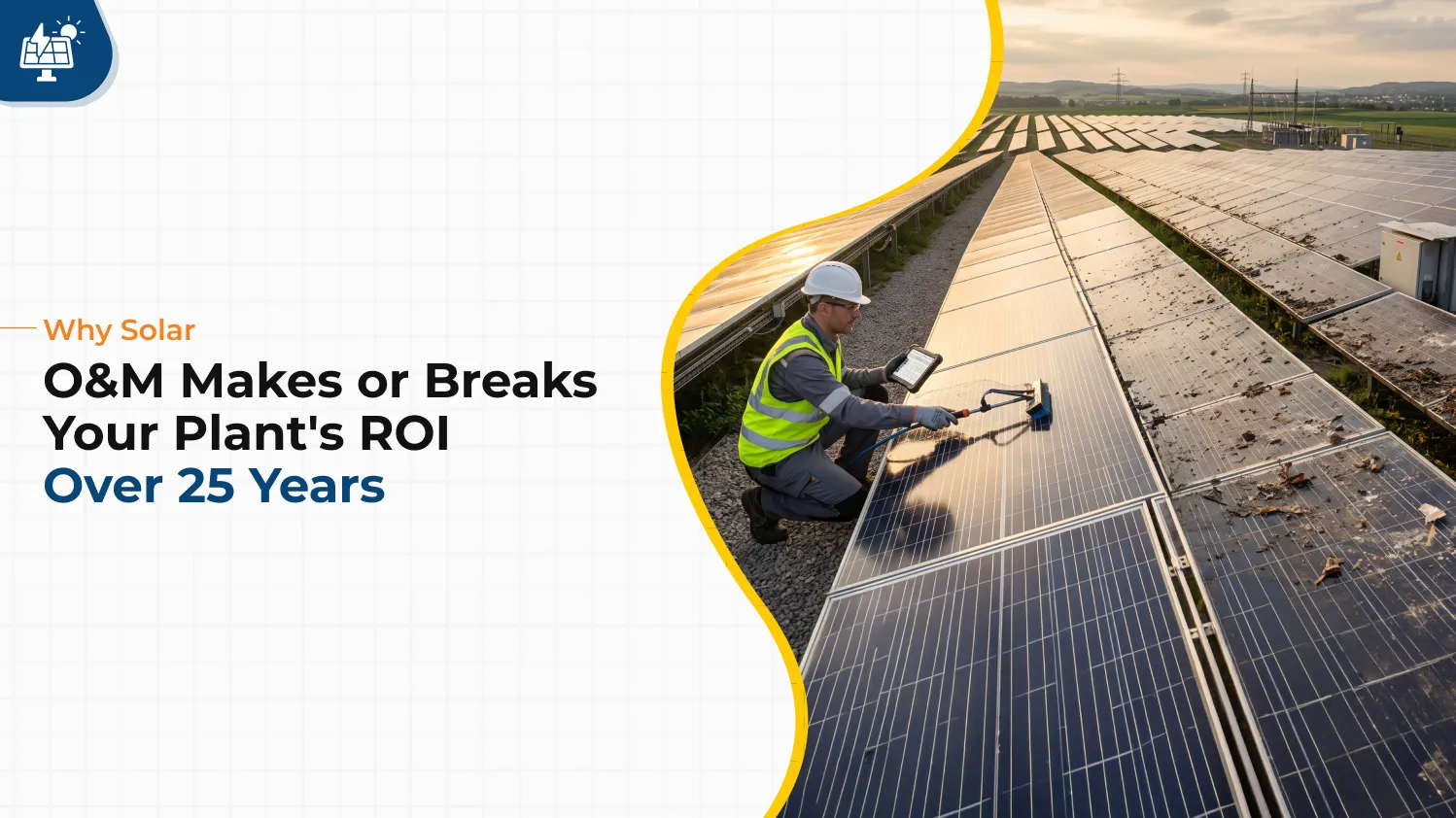
A plant that loses two percent of annual output to unaddressed soiling and another one and a half percent to a string fault that sat undiagnosed for six weeks doesn't look like a failure on any single day. It looks like a plant that's simply underperforming, quarter after quarter, in ways that are easy to dismiss individually and expensive to ignore collectively.
Issue | Typical Annual Impact if Unmanaged | Cumulative Effect Over 25 Years |
Soiling and dust buildup | 2-5% output loss | Compounds every cycle, permanently lowers baseline yield |
Delayed fault response | 1-3% output loss | Widens as component wear accelerates unaddressed |
Inverter inefficiency over time | 0.5-1% annual degradation beyond spec | Shortens effective inverter lifespan, raises replacement costs |
Corrosion and connector wear | Gradual resistance increase | Higher fire risk, energy loss, unplanned outages |
Missed curtailment claims | Variable, often untracked | Direct revenue write-off with no recovery path |
Run these numbers against a 25 year model and the gap between a plant with disciplined O&M and one without isn't marginal. It's often the difference between a project that meets its IRR target and one that quietly falls short of it for the entire operating period.
What Lifetime-Focused O&M Actually Looks Like
The plants that hold their value over decades aren't the ones with the fewest problems. Every plant develops issues over 25 years. The plants that perform are the ones where solar operations and maintenance services in Kutch are structured to catch and resolve those issues before they compound.
Performance Monitoring Tied to Financial Metrics
Real-time monitoring only creates value if the data is being read against the numbers that matter, generation forecasts, PR (performance ratio) targets, and revenue projections, not just plant-level dashboards showing whether the system is technically online.
Predictive Maintenance Over Fixed Schedules
Cleaning panels on a calendar is a starting point, not a strategy. Predictive maintenance uses actual performance trends, thermal imaging, and string-level data to catch a developing fault weeks before it would show up as a scheduled inspection finding.
Warranty and Documentation Management
Module and inverter warranties typically run 10 to 25 years, but claims require documented proof of proper maintenance and fault history. Poor record keeping during the operating period can quietly void warranty coverage right when a plant needs it most, often a decade or more into its life.
Spare Parts and Response Time Planning
An inverter fault that takes three weeks to resolve because a replacement part had to be sourced from scratch costs far more than the part itself. Established solar plant operations services in Kutch maintain spare inventory and vendor relationships built for fast turnaround, not reactive procurement.
Curtailment and Compliance Tracking
Grid curtailment instructions, if not tracked and documented properly, become revenue that's simply written off. A structured O&M program treats curtailment tracking as a recurring financial task, not an occasional afterthought.
Where O&M Connects Back to How the Plant Was Built
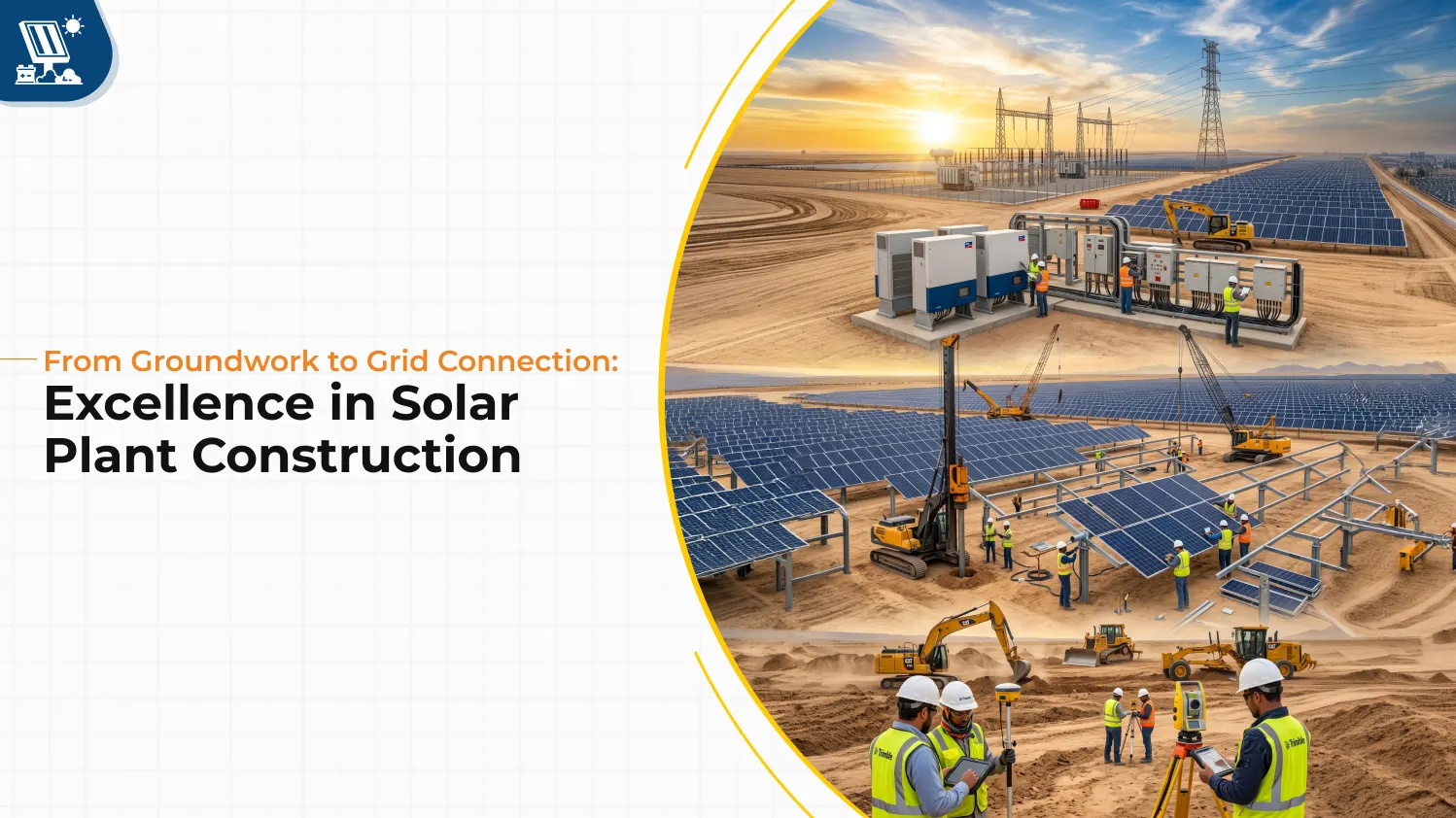
Long-term performance doesn't start at commissioning. It's shaped by decisions made during design and construction, which is why solar project execution services in Kutch and the O&M phase that follows work best when they're not treated as separate, disconnected stages. A plant built with maintenance access, cable routing, and monitoring infrastructure in mind is simply cheaper and faster to service over 25 years than one where operations have to work around design shortcuts.
This is also where the choice of contractor at the construction stage matters more than owners often expect. Solar EPC execution services in Kutch that hand over complete as-built documentation, design specifications, and component-level data give the O&M team a real foundation to work from, rather than forcing them to reverse-engineer the plant's design years into its operating life.
Why This Matters More in Kutch
Kutch's solar irradiance is among the strongest in India, which means the revenue at stake from every percentage point of lost output is higher here than in most other regions. That same environment, however, comes with high heat, persistent dust, and coastal humidity in parts of the region, all of which accelerate the exact issues that erode long-term ROI if left unmanaged.
Environmental Factor | Effect on Long-Term Plant Value |
High ambient temperature | Faster electronic component wear, shorter equipment lifespan |
Frequent dust exposure | Accelerated soiling, more frequent cleaning cycles required |
Coastal humidity | Higher corrosion risk for structures and connectors |
High solar radiation | Greater financial impact from every point of output lost |
This is why owners running plants in the region increasingly look for solar operations and maintenance services in Kutch that understand these regional conditions as part of the financial planning process, not as a maintenance detail addressed after the fact.
In-House Maintenance vs a Dedicated O&M Partner
Some owners assume managing maintenance internally protects returns better because it avoids a third-party service fee. Over a 25 year horizon, that assumption often doesn't hold up.
Factor | In-House Team | Dedicated O&M Partner |
Monitoring depth | Usually plant-level only | String and component-level visibility |
Fault diagnosis speed | Limited by staff bandwidth | Dedicated response protocols |
Warranty documentation | Frequently inconsistent | Structured and claim-ready |
Spare parts access | Limited vendor relationships | Established supplier networks |
Long-term cost impact | Hidden in downtime and missed claims | Directly tied to protecting projected ROI |
For most industrial and commercial plant owners without a dedicated technical operations team, the cost of an internal maintenance gap tends to show up years later, in a lower resale value, a voided warranty claim, or a generation shortfall that's difficult to trace back to its root cause.
What to Ask Before Choosing an O&M Partner
Not every provider offering solar plant operations services in Kutch is structured around lifetime ROI. A few questions separate a genuine long-term partner from a routine service vendor:
Do they report performance against your financial model, or only against technical uptime?
What's their documented response time between fault detection and resolution?
Do they maintain warranty-ready documentation you can hand to a lender or buyer?
Can they show performance retention data from other plants they've managed over several years?
Do they track curtailment and compliance as part of their standard reporting?
Vague answers here usually mean maintenance is being treated as a service call rather than a discipline tied directly to what the plant was financed to earn.
Conclusion
A solar plant's ROI isn't decided at commissioning. It's decided in the thousands of small decisions made over the following 25 years, whether a fault gets caught in days or months, whether a warranty claim is documented properly, whether curtailment losses get tracked or written off. Operations and maintenance is the discipline that determines which of those outcomes a plant ends up with.
White Desert Power Projects has worked with organizations including Shriram Kaolin, GIPCL, Aditi Packaging, and Monex Solar Power LLP, helping industrial and utility-scale plants stay aligned with their projected output and long-term financial performance through structured, ROI-focused O&M rather than reactive upkeep.
If your plant's performance data isn't matching your financial model, it's worth finding out why before the gap widens further. Talk to White Desert Power Projects about a lifetime-focused O&M program built around protecting your plant's 25 year return.