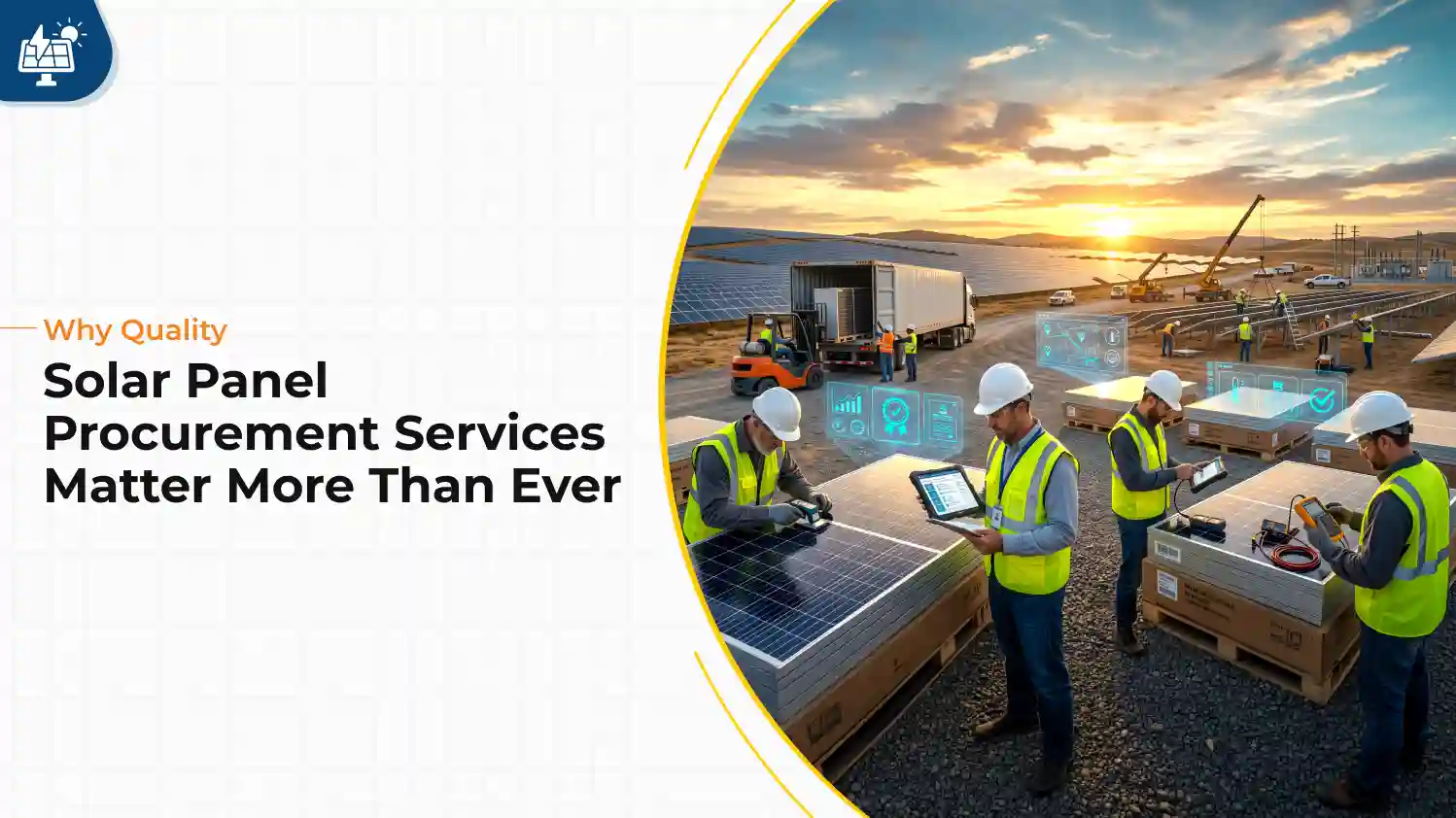
A solar plant is only as good as the parts that go into it. You can have the best engineering design on paper and the most experienced installation crew on site, but if the panels underperform, the inverters fail early, or the mounting structures corrode within a few years, none of that planning matters. This is where procurement quietly becomes the most consequential phase of any solar project, and why quality solar panel procurement services matter more than ever for developers who want a plant that still performs the way it should in year twenty, not just year one.
Procurement doesn't get the same attention as design or installation in most conversations about solar. It should. Every rupee saved by choosing a cheaper, unverified component tends to show up later as a maintenance bill, a warranty dispute, or a plant that quietly underdelivers for the rest of its operating life.
What Procurement Actually Involves
People often assume procurement means placing an order and waiting for delivery. In practice, it's a layered process that determines the technical and financial fate of a project long before construction begins.
A proper procurement function typically covers:
Vendor shortlisting and technical due diligence
Matching component specifications against site and design requirements
Price negotiation and lead-time planning
Factory or third-party quality audits
Logistics coordination, including customs clearance for imported equipment
Incoming inspection and warranty documentation
Skip any one of these steps and you're gambling on twenty-five years of plant performance based on a supplier's word alone.
Why Component Quality Decides Long-Term Output
Solar panels are rated to degrade at a known, predictable rate, usually under 0.5% per year for tier-one modules. Cheaper, poorly manufactured panels degrade faster and less predictably, which means the energy yield you modeled at the financing stage stops matching reality within a few years.
The same logic applies across every major component:
Component | Risk from Poor Sourcing | Long-Term Consequence |
Solar panels | Higher-than-rated degradation | Reduced energy yield over plant life |
Inverters | Inconsistent conversion efficiency | Higher losses, more frequent replacement |
Mounting structures | Weak corrosion resistance | Structural failure in coastal or humid zones |
Cabling | Substandard insulation | Fire risk, energy loss over distance |
Transformers | Mismatched capacity | Bottlenecks during peak generation |
This is the practical argument behind quality solar panel procurement services: the cost of getting sourcing wrong rarely shows up on day one. It shows up gradually, in the form of an asset that never quite performs to its potential.
The Procurement Process, Step by Step
A disciplined procurement workflow tends to follow a consistent sequence, regardless of project size.
Vendor Shortlisting and Due Diligence
This starts with identifying manufacturers whose certifications, track record, and manufacturing capacity match the project's scale. Financial stability of the vendor matters here too. A supplier that can't fulfil a warranty claim five years from now isn't much of a supplier at all.
Technical Specification Matching
Every component needs to align with the engineering design, not just meet generic industry standards. A panel with the right wattage but the wrong temperature coefficient can still underperform in a hot climate like Kutch's.
Price and Lead-Time Negotiation
Cost matters, but so does delivery timing. A cheaper component that arrives eight weeks late can cost more in delayed commissioning and idle labor than the savings were worth.
Factory or Third-Party Quality Audits
For larger orders, physical inspection of manufacturing facilities, or hiring a third party to do it, catches problems that data sheets don't reveal.
Logistics and Customs Coordination
Imported inverters and specialized glass often move through multiple ports and customs checkpoints. Delays here are one of the most common reasons Indian solar projects fall behind schedule.
Incoming Inspection and Documentation
Every shipment gets checked against the purchase order and technical specification before it's accepted on site, with warranty paperwork filed and stored for the life of the plant.
Why Kutch Needs Dedicated Procurement Expertise
Kutch has become one of Gujarat's busiest regions for utility-scale solar development, and that growth has created real demand for solar procurement services in Kutch that understand the region's specific conditions. High ambient temperatures, occasional dust storms, and proximity to the coast all affect which components hold up and which ones don't.
Factor | Relevance to Procurement in Kutch |
Average daily solar radiation | 5.5-6.0 kWh/m², among the highest in India |
Ambient temperature range | High summer temperatures affect panel temperature coefficient selection |
Coastal proximity | Raises corrosion risk for mounting structures and connectors |
Utility-scale project density | Higher volume orders, more leverage in vendor negotiation |
Import logistics | Nearby port access via Kandla and Mundra shortens lead times when managed well |
Developers working in this region increasingly rely on solar EPC procurement services in Kutch that combine local site knowledge with established vendor relationships, rather than treating sourcing as a generic, one-size-fits-all task.
Common Procurement Pitfalls
Even experienced developers run into avoidable problems when procurement isn't managed carefully.
Counterfeit or mislabeled components: Panels or inverters sold with inflated performance ratings that don't hold up under testing
Specification mismatches: Equipment that technically works but wasn't designed for the site's climate or load profile
Import delays: Customs holdups on inverters and specialized glass, sometimes stretching for weeks
Warranty gaps: Vendors who go out of business or become unreachable when a claim needs to be filed
Fragmented sourcing: Buying different components from disconnected vendors, making accountability difficult if something fails
A structured approach to solar component procurement in Kutch addresses most of these risks before they ever reach the construction site, rather than dealing with them after a plant is already underperforming.
In-House Sourcing vs a Dedicated Procurement Partner
Many businesses building their first solar asset default to sourcing components themselves, assuming it will save money. That's sometimes true, but not always for the reasons people expect.
Factor | In-House Sourcing | Procurement Partner |
Vendor access | Limited to known suppliers | Broader network, established terms |
Quality verification | Often based on data sheets alone | Includes audits and inspection |
Negotiating leverage | Lower, single-project volume | Higher, aggregated order volume |
Risk of specification errors | Higher without technical review | Lower, cross-checked against design |
Time investment | Significant, pulls focus from core business | Handled by dedicated team |
For most first-time developers, working with a solar equipment sourcing company in Kutch reduces both the technical risk and the time cost of managing dozens of vendor relationships directly.
What to Look for in a Procurement Partner
Not every provider offering solar panel procurement services in Kutch operates at the same standard. A few questions are worth asking before signing on:
Do they conduct factory audits, or rely purely on vendor documentation?
What's their track record with import logistics and customs clearance?
Do they maintain relationships with multiple tier-one manufacturers, or push a single preferred brand regardless of fit?
How is warranty documentation tracked and stored over the plant's lifetime?
Can they show component performance data from previously completed projects?
Vague answers to any of these are usually a sign that procurement is being treated as an afterthought rather than a core discipline.
Procurement Beyond Kutch
While Kutch's conditions demand region-specific expertise, the underlying discipline applies nationally. Developers across India increasingly look for solar procurement solutions in India that bring the same rigor, vendor vetting, quality audits, and documented traceability, regardless of where a project is located. As utility-scale and commercial solar capacity keeps expanding across the country, the gap between projects built on verified components and those built on the cheapest available option is only going to widen.
Conclusion
The title of this piece isn't an exaggeration. Quality solar panel procurement services matter more than ever precisely because solar assets are long-term investments, often running twenty-five years or more, and every component decision made at the sourcing stage compounds over that entire period. A plant built on verified, well-matched components performs closer to its projected output for decades. One built on unverified or mismatched parts starts falling short within a few years, quietly, in ways that are expensive to trace and fix later.
For developers in Kutch and across India, White Desert has worked alongside solar businesses that understand this distinction, helping projects source components that hold up to both the region's conditions and the demands of long-term performance.