
Setting up a solar plant sounds simple on paper: buy panels, hire installers, connect to the grid. In practice, most project owners quickly discover it's closer to managing five separate contracts at once, each with its own delays and finger-pointing. This is exactly the gap that turnkey solar solutions were built to close.
A turnkey solar solution in Kutch is a single-vendor model in which one company handles site assessment, design, procurement, installation, and commissioning for a solar project, so the client doesn't have to coordinate multiple contractors.
This piece breaks down what actually happens inside a turnkey project, why the model works especially well in a region like Kutch, and what to check before signing with a partner.
What "Turnkey" Actually Means in Solar
The word gets used loosely in marketing, so it's worth being precise. A genuinely turnkey project includes:
Feasibility and site assessment
Engineering and system design
Regulatory approvals and grid liaison
Equipment procurement
Civil, mechanical, and electrical installation
Testing, commissioning, and handover
Post-commissioning operations and maintenance (O&M)
If any of these steps sits outside the main contract, it isn't fully turnkey; it's a partial package dressed up as one. A genuine solar EPC company owns the entire chain, from the first site visit to the day the plant starts exporting power, under one accountable contract.
The Problem With the Traditional Approach
Before turnkey models became common, most commercial and industrial buyers assembled their own project team: a design consultant, a separate equipment supplier, a local installation crew, and a compliance agent for paperwork. On paper, it looked cheaper. In practice, it created three recurring headaches.
1. Communication gaps
When the designer and installer aren't the same team, mismatches between the drawing and the site are common: wrong panel tilt, undersized cabling, or a mounting structure that doesn't match the roof load.
2. Accountability gaps
If a plant underperforms, four vendors can each blame the other three. Nobody owns the outcome.
3. Timeline gaps
Procurement waits on design sign-off, installation waits on procurement, and commissioning waits on installation, and every handoff between separate companies adds buffer time that a single accountable team simply doesn't need.
A 2026 industry review of solar EPC in India found that project delays of three to six months are common on fragmented commercial and industrial installations, mostly due to vendor coordination issues rather than technical failures.
Site Assessment: Where Every Good Project Actually Starts
Skipping or rushing site assessment is the single biggest reason solar projects underperform their projected output. A proper assessment covers:
Assessment area | What it determines |
Solar irradiance data | Expected annual generation (kWh/kWp) |
Soil and land survey | Foundation type for ground-mount structures |
Shadow and obstruction analysis | Panel layout and row spacing |
Grid proximity and capacity | Interconnection feasibility and cost |
Load profile (for captive use) | System sizing against actual consumption |
Gujarat sits between latitudes 20°N and 24°N, which gives most of the state strong year-round solar irradiance, one reason it has become the country's leading solar hub. Kutch in particular combines high irradiance with large tracts of low-utility arid land, which is why utility-scale developers have gravitated there for over a decade.
Design and Engineering: One Team, One Set of Drawings
When design sits inside the same company that will install the plant, engineers design against real-world buildability instead of theoretical specs. A single solar power company managing both stages can catch conflicts like a transformer location that blocks vehicle access before they become expensive on-site rework.
Good engineering also documents the reasoning behind every design decision: tilt angle, string sizing, inverter placement, and cable routing should all trace back to the site data collected earlier, not a generic template applied regardless of location.
Permitting and Grid Approvals: The Quiet Timeline Killer
Approvals rarely make it into sales pitches, but they routinely account for the longest stretch of a project's calendar. In Gujarat, this typically involves:
GEDA registration for eligible projects
DISCOM technical feasibility and net metering or open access approval
CEA technical standards compliance for grid-connected systems
Land-use clearance for ground-mount installations, where applicable
For commercial and industrial systems above 1 MW, open access requires a minimum 1 MW contracted demand under Gujarat's intra-state rules, and the paperwork trail across GEDA, the relevant DISCOM, and GERC can stretch on for weeks if a project owner is managing it alone. Solar project developers who handle approvals routinely, rather than occasionally, tend to move through this stage faster simply because they already know which documents each authority expects on the first submission.
Procurement: Buying Power Without the Guesswork
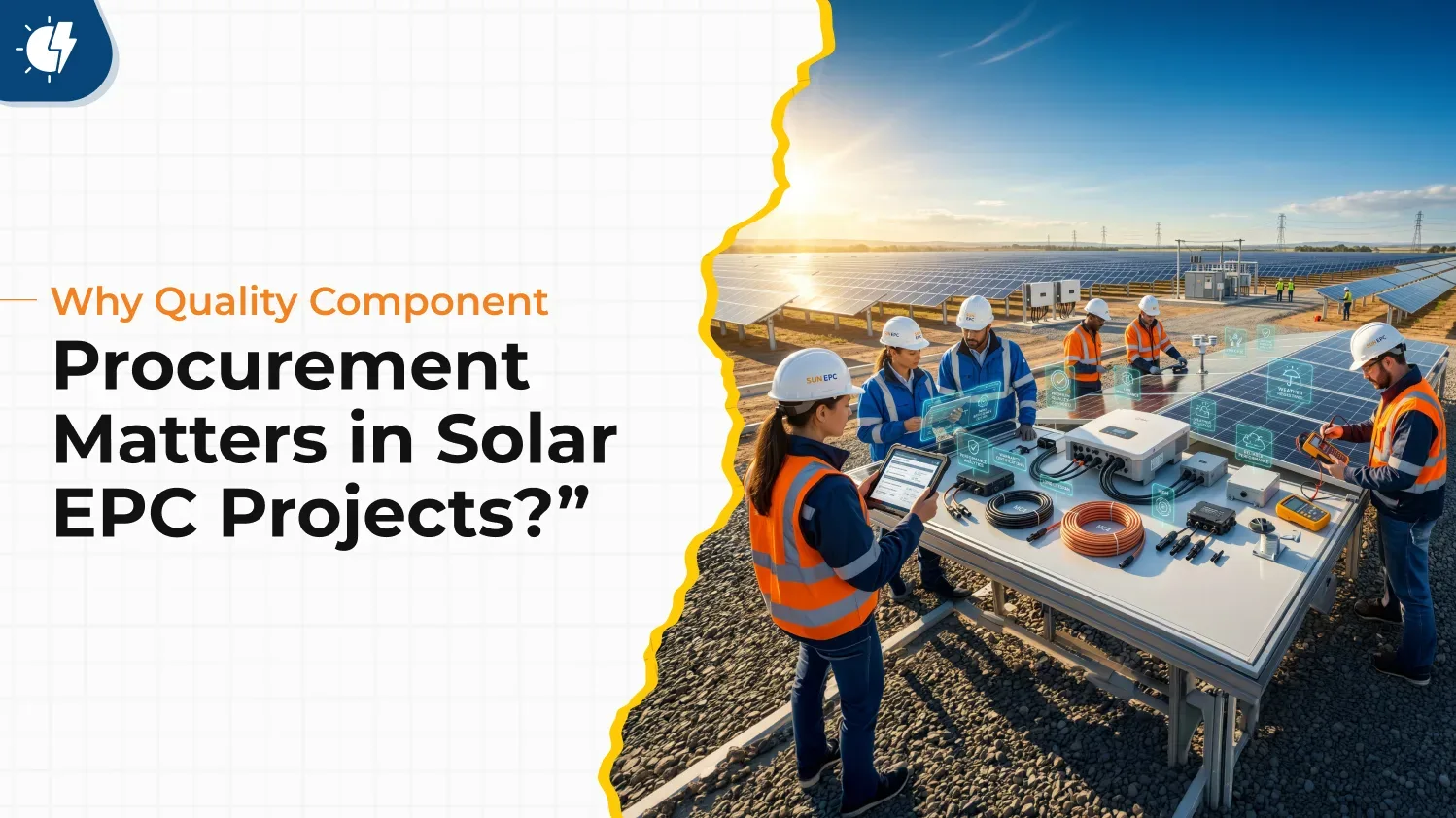
Component sourcing affects both project cost and 25-year performance, yet it's often where inexperienced buyers cut corners. Turnkey teams typically procure against three checks:
1. ALMM compliance
Modules must appear on India's Approved List of Models and Manufacturers for most grid-connected and subsidy-linked projects.
2. Warranty terms
Module performance warranties (commonly 25 to 30 years) and inverter warranties (commonly 5 to 10 years) should be verified against the actual manufacturer, not just the reseller.
3. Bulk-purchasing leverage
An established EPC partner buying at scale across multiple projects typically secures better component pricing than a one-off buyer negotiating alone.
A renewable energy company with direct manufacturer relationships also has more room to swap in equivalent components if a specific model runs into supply delays, without stalling the whole project.
Installation and Commissioning: Where Coordination Pays Off
Installation is the most visible part of any solar project, but it's also where a fragmented team loses the most time. A coordinated crew working from a single project plan can typically install and commission a mid-sized commercial rooftop system in a matter of weeks rather than months, because civil work, mounting, electrical wiring, and testing are sequenced by one scheduler instead of negotiated between separate contractors.
Commissioning itself involves string testing, insulation resistance checks, earthing verification, and a formal handover report, steps that protect the client if a warranty claim comes up years later. Working with an experienced solar plant installation company at this stage matters more than it seems, since commissioning errors are often what surface as performance shortfalls months later.
Turnkey vs. Traditional: A Direct Comparison
Factor | Turnkey Model | Fragmented Model |
Point of contact | One team, one contract | Multiple vendors, multiple contracts |
Accountability for delays | Centralized | Split across vendors |
Design-to-installation match | Consistent, same team | Prone to mismatches |
Typical timeline | Weeks to a few months | Often 3 to 6 months longer |
Post-commissioning support | Usually bundled | Often, a separate negotiation |
Warranty claims | Single point of resolution | Vendors may dispute liability |
Why Kutch Is a Region to Watch
Kutch doesn't get talked about as much as some of India's bigger solar hubs, but it's quietly turned into one of the busiest renewable energy zones in the country. Mostly, it comes down to sunlight and empty land. Kutch gets strong irradiance nearly all year, and there's a lot of arid terrain that was never much good for farming anyway.
A few numbers that tell the story:
Gujarat's solar capacity had reached roughly 25,529 MW by December 2025
Kutch alone holds close to half the state's wind capacity
Khavda, the renewable park sitting right in Kutch, is targeting 37.35 GW
Over 11.33 GW of Khavda was already up and running by early 2026
That scale isn't just a headline. It drags along equipment routes, trained crews, and grid capacity that newer solar regions simply don't have yet, which is exactly why demand for turnkey solar solutions in Kutch keeps climbing.
Metric | Kutch / Gujarat Figure |
Gujarat total solar capacity (Dec 2025) | ~25,529 MW |
Gujarat wind capacity (Dec 2025) | ~14,821 MW |
Kutch's share of Gujarat's wind capacity | ~7,477 MW |
Khavda Park planned capacity | 37.35 GW |
Khavda Park commissioned (as of early 2026) | 11.33+ GW |
Gujarat's share of India's renewable capacity | ~16.5% |
What to Check Before Choosing a Partner
Not every company offering a turnkey package delivers on all seven stages. Before signing, ask for:
A portfolio of completed projects with similar scale and use case
References who can speak to actual delivery timelines, not quoted ones
A clear O&M plan with response-time commitments, not just a generic clause
Transparency on which components are ALMM-listed and which carry manufacturer-direct warranties
A single-page project timeline showing every stage from survey to commissioning
A company unwilling to share any of the above is usually not equipped to manage the full chain, regardless of what the brochure claims. This checklist applies whether you're evaluating a large solar energy company or a smaller regional outfit; the fundamentals of accountability don't change with company size.
Conclusion
The appeal of a turnkey model isn't just convenience; it's the removal of coordination risk from a process that has plenty of technical risk already. One accountable team, one timeline, and one point of contact tend to outperform a patchwork of vendors on cost, speed, and long-term plant reliability. White Desert works across site assessment, EPC delivery, and ongoing O&M for solar projects in the Kutch region, bringing every stage of project development under a single accountable process from first survey to commissioned plant.