
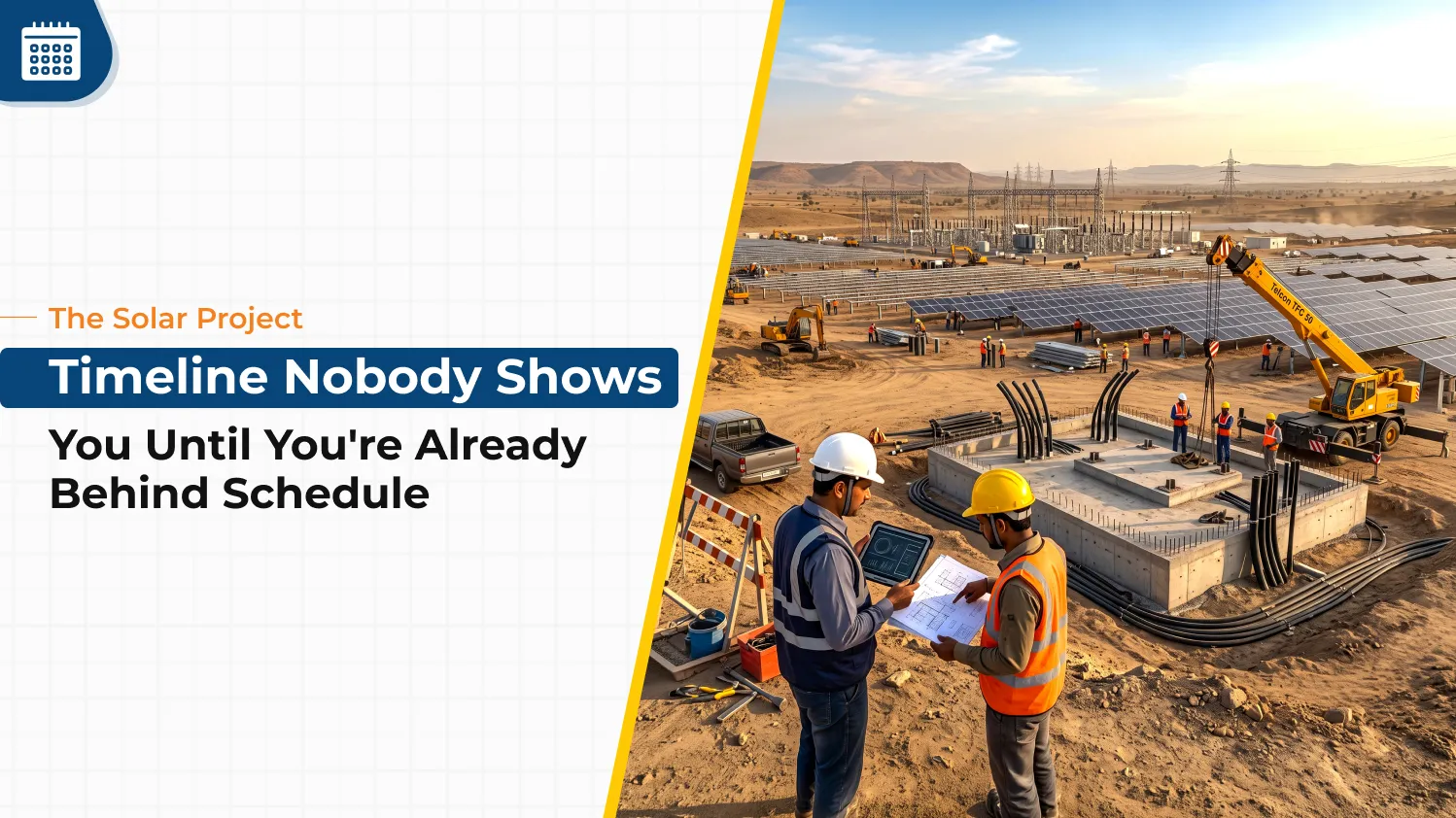
Most solar proposals include a timeline. Very few include the version of that timeline that actually matters: the one showing which milestones depend on things outside the contractor's control, where a realistic buffer needs to sit, and what happens to the schedule when one of those dependencies slips. Developers typically discover this version the hard way, three months into a project, when a delay in grid approval or a permit backlog pushes the completion date well past what was originally quoted, and nobody explained upfront that this was even a realistic possibility.
This is that missing timeline, laid out the way solar project development services in Kutch developers actually need to see it before signing a contract, not after they're already behind schedule.
Why the Quoted Timeline and the Real Timeline Are Often Different Numbers
A contractor's initial timeline quote is usually built from the tasks they directly control: design duration, procurement lead time, and construction days. What frequently gets left out, or mentioned only in passing, are the dependencies that sit outside direct contractor control: permitting and regulatory approval timelines, grid interconnection studies and utility scheduling, and financing or subsidy approval processes that can stall a project before construction even begins.
None of these omissions are necessarily dishonest. A contractor genuinely doesn't control how quickly a DISCOM processes an interconnection request or how long environmental clearances take to secure. But leaving these dependencies out of the initial timeline conversation sets developers up to be surprised later, when a delay that was actually predictable gets treated as an unexpected setback.
The Full Timeline, Phase by Phase, With Realistic Dependencies
Here's what a genuinely complete project timeline looks like, including the phases most proposals gloss over.
Phase 1: Site Assessment and Feasibility (2-6 weeks)
This includes topographical survey, geotechnical assessment, shading and irradiance analysis, and grid proximity evaluation. Straightforward sites move through this quickly. Sites with complex terrain, uncertain soil conditions, or grid capacity questions that require deeper investigation take longer, and rushing this phase to save time here almost always costs more time later when an assumption made during a quick assessment turns out to be wrong.
Phase 2: Design and Engineering (3-8 weeks)
Detailed engineering, including electrical design, structural calculations, and layout optimization, happens in parallel with the early stages of permitting in a well-run project, rather than waiting for permits to clear before design work starts. Design timelines stretch when load data isn't readily available, requiring additional data collection before sizing decisions can be finalized.
Phase 3: Permitting and Regulatory Approval (4-16 weeks, highly variable)
This is the phase most likely to be underestimated in initial proposals, because it's largely outside contractor control. It includes environmental clearances where applicable, local building and electrical permits, and land use approvals for ground-mounted systems. Timelines here vary enormously based on jurisdiction, project scale, and how complete the application package is when first submitted. A project team that submits thorough, well-prepared applications the first time avoids the resubmission cycles that stretch this phase considerably longer than necessary.
Phase 4: Grid Interconnection Study and Approval (6-20 weeks, highly variable)
For any project exporting power to the grid, interconnection approval depends on utility study timelines and available substation capacity, both of which are largely outside the developer's or contractor's direct control. This phase needs to be initiated as early as possible, often in parallel with permitting, since utility processing queues can be a genuine bottleneck in regions with high density of solar development already competing for grid capacity, a real consideration for utility-scale projects in Kutch specifically.
Phase 5: Financing and Subsidy Finalization (2-8 weeks, can run in parallel)
Loan approval, subsidy application processing, or project financing finalization can run alongside permitting and interconnection work rather than waiting until construction is ready to begin. Delays here typically stem from documentation issues, which are avoidable with careful preparation, rather than from processing time itself.
Phase 6: Procurement and Material Lead Time (4-16 weeks, highly variable)
Component lead times vary significantly depending on what's being sourced. Standard panels and racking from established suppliers with regional inventory move faster. Specialized inverters, transformers, or components requiring international shipping can introduce lead times that need to be planned for well ahead of when construction is scheduled to need them.
Phase 7: Construction (Varies by scale, typically 8-24 weeks for MW-scale projects)
Site preparation, foundation and structural work, panel installation, and electrical work, much of it happening in parallel across different sections of a larger site. This phase is also affected by seasonal factors specific to Kutch, since monsoon season can affect civil work and site access, and extreme summer heat limits safe working hours for certain tasks.
Phase 8: Testing, Commissioning, and Grid Synchronization (2-4 weeks)
Final testing sequences, including continuity testing, string verification, protection system testing, and grid synchronization, which depends partly on utility scheduling for final connection testing and approval.
A Realistic Combined Timeline View
Phase | Typical Duration | Primary Dependency Risk |
Site assessment and feasibility | 2-6 weeks | Site complexity, data availability |
Design and engineering | 3-8 weeks | Runs partly parallel to permitting |
Permitting and regulatory approval | 4-16 weeks | Jurisdiction, application completeness |
Grid interconnection approval | 6-20 weeks | Utility processing queue, substation capacity |
Financing and subsidy finalization | 2-8 weeks | Documentation accuracy, can run parallel |
Procurement and material lead time | 4-16 weeks | Component type, international sourcing |
Construction | 8-24 weeks | Weather, site conditions, sequencing discipline |
Testing and commissioning | 2-4 weeks | Utility scheduling for final synchronization |
Several of these phases overlap rather than running strictly end to end, which is exactly why a naive approach of simply adding up each phase's duration overstates total project time in one sense, while underestimating risk in another. The phases with the widest duration ranges, permitting and grid interconnection, are also the ones most likely to determine whether a project finishes on the early or late end of its overall timeline.
Where Developers Get Blindsided Most Often
For developers who've been through a delayed project before, the pattern of what actually causes the delay tends to be strikingly consistent.
Grid interconnection queue position. In regions with significant existing solar development, a new interconnection request can sit in a utility processing queue longer than the entire construction phase of the project itself. This risk needs to be flagged and planned for at the very start of a project, not discovered midway through.
Incomplete permit applications requiring resubmission. A permit application missing a required document or containing an inconsistency doesn't just delay by the time it takes to fix, it often means going back to the end of a processing queue, adding weeks beyond the original delay itself.
Component lead times underestimated during initial planning. Assuming standard lead times for specialized equipment, without confirming actual current availability with suppliers, is a common source of delay that surfaces only once procurement is already underway and it's too late to easily source an alternative.
Financing approval treated as a formality. Assuming a loan or subsidy approval will move quickly because the application looks straightforward, without accounting for the documentation review and verification steps lenders and government portals actually require.
Underestimating seasonal construction constraints. Scheduling construction phases without accounting for monsoon timing or extreme heat periods specific to the region, resulting in productivity assumptions that don't hold up once the season actually arrives.
How Proper Project Management Actually Compresses the Timeline
The value of experienced solar project management services in Kutch isn't in making individual phases faster through some special technique. It's in sequencing dependencies intelligently so they run in parallel wherever possible, and in front-loading the highest-risk, longest-lead-time items, permitting and grid interconnection especially, so they aren't sitting on the critical path unnecessarily.
What Effective Timeline Management Looks Like
Initiating grid interconnection studies and permitting applications simultaneously, as early as feasibility is confirmed, rather than sequentially after design is finalized
Submitting thorough, complete applications the first time to avoid resubmission cycles that add weeks to already-long approval queues
Confirming actual current lead times with suppliers before finalizing a construction schedule, rather than relying on standard assumptions
Building weather-aware construction scheduling specific to Kutch's seasonal patterns, rather than a generic schedule template
Running financing and subsidy processes in parallel with permitting and interconnection work, rather than waiting until construction is ready to begin
A solar infrastructure development company in Kutch that manages these dependencies proactively, rather than discovering them as delays partway through, is what actually separates a project that finishes close to its original timeline from one that drifts months behind schedule.
Why This Matters More for Utility-Scale Projects
The timeline risks described here scale up considerably for larger projects. A residential rooftop system has minimal permitting complexity and no grid interconnection study requirement in most cases. A MW-scale solar power plant development Kutch project carries meaningful exposure across every phase described above, which is exactly why proactive dependency management matters most at this scale, where a delay in any single phase can cascade into a multi-month overall schedule slip.
Effective solar EPC project development Kutch for utility-scale work means treating this timeline complexity as the central planning challenge from day one, not an afterthought handled once construction is already underway.
What to Ask a Project Development Partner Before Committing to a Timeline
For developers evaluating a partner's realistic timeline estimate, these questions tend to reveal whether a quote reflects genuine planning or an optimistic best-case scenario:
What's the current expected grid interconnection queue timeline for this specific region, based on recent projects?
How are permitting applications prepared to minimize the risk of resubmission delays?
Have current component lead times been confirmed with suppliers, or is the timeline based on standard assumptions?
How does the schedule account for seasonal construction constraints specific to Kutch?
What's the plan if a dependency outside contractor control, like grid interconnection approval, takes longer than expected?
A partner who can answer these with specifics, rather than a general assurance that the timeline is achievable, is generally the more reliable indicator of realistic solar project planning and development in Kutch execution.
Conclusion
The timeline that actually determines when a solar project gets commissioned is rarely the same as the one presented in an initial proposal. The gap comes from dependencies outside direct contractor control, permitting, grid interconnection, financing approval, and component lead times, that are predictable in nature even when their exact duration isn't. Developers who understand this full timeline upfront, and choose a partner who manages these dependencies proactively rather than discovering them as delays, are far less likely to end up behind schedule without warning.
White Desert Power Projects has managed project development and timelines for organizations including Shriram Kaolin, GIPCL, Aditi Packaging, and Monex Solar Power LLP, planning around these dependencies from the start rather than treating them as unexpected setbacks partway through a project.
If you're planning a solar project and want a timeline built on realistic dependency management rather than an optimistic best case, talk to White Desert Power Projects about what your specific project would actually require from site assessment through commissioning.