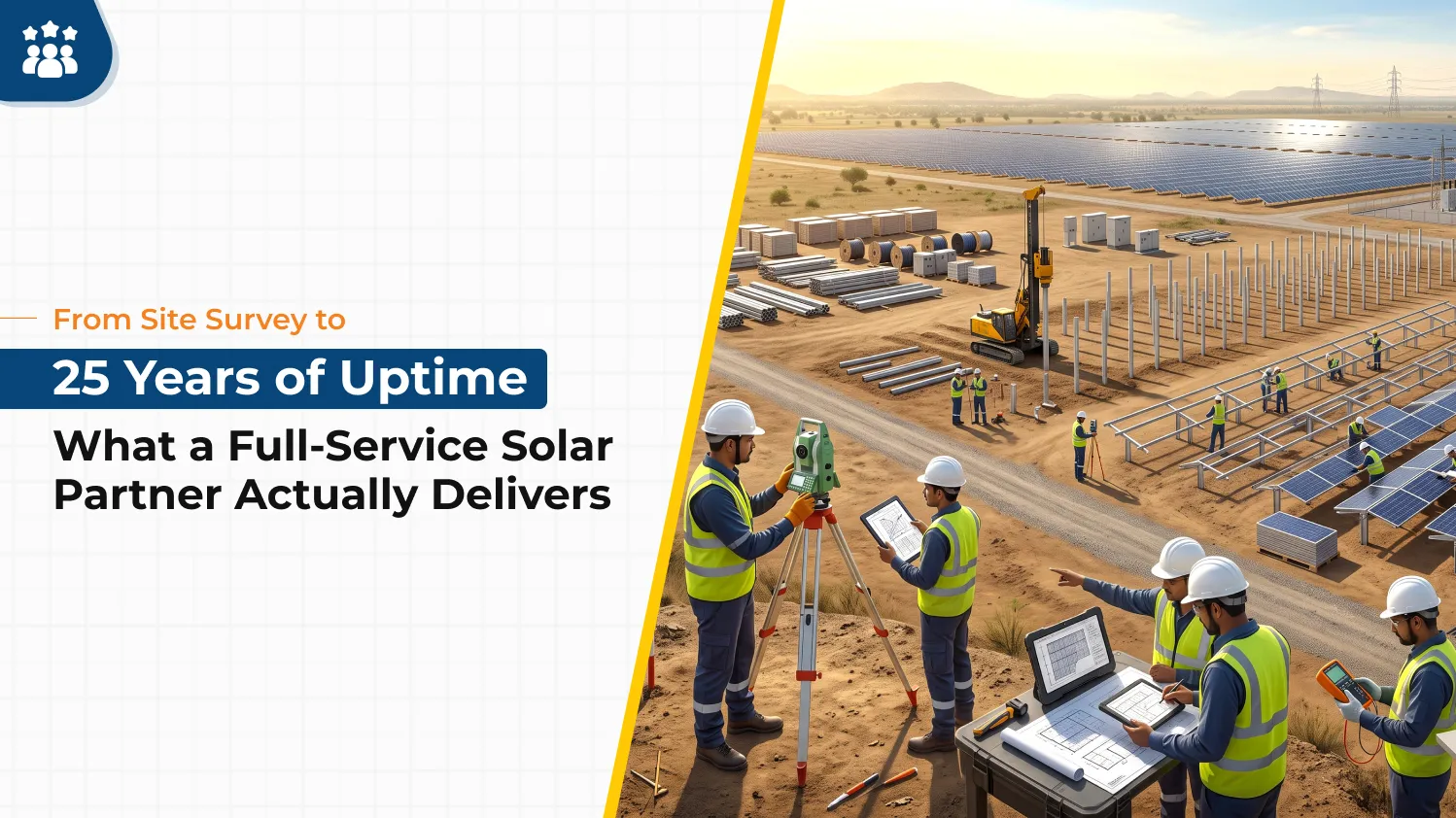
Most solar conversations start with a quote and end with a commissioning date. What happens in between, and more importantly, what happens for the twenty-five years after that commissioning date, is where the real value of choosing the right partner actually plays out. A plant that generates exactly what it was designed to for a quarter century isn't the result of a single good decision. It's the result of dozens of decisions made consistently across every stage of a relationship that most owners never see laid out end to end.
This is that full arc, from the first site visit through decades of operation, and what a genuine solar EPC company in Kutch clients rely on actually delivers at each stage along the way.
Stage 1: Site Survey and Feasibility Assessment
Every solar project starts with a question that sounds simple but rarely is: is this site actually right for what the client needs? Answering that properly means going well beyond confirming there's enough sunlight.
A thorough site survey examines land topography and soil conditions for structural planning, shading from nearby structures or terrain across different seasons, proximity and capacity of the nearest grid substation, and the client's actual load profile if the plant is meant to serve captive consumption. As a solar power company Kutch developers trust for this stage, the assessment also factors in regional specifics that generic feasibility templates miss, like local soiling rates, coastal humidity exposure in certain areas, and the density of other utility-scale projects already competing for grid capacity nearby.
Skipping rigor here doesn't show up as a problem immediately. It shows up two or three years later, as a plant that's underperforming its financial model for reasons that trace directly back to assumptions made during a rushed feasibility study.
Stage 2: Engineering and System Design
Once a site is confirmed feasible, design translates that feasibility into an actual technical plan. This stage determines system sizing against real load data rather than estimates, electrical architecture that minimizes resistive losses across the plant's full layout, structural design suited to local wind and soil conditions, and a layout that accounts for both seasonal shading patterns and long-term maintenance access.
This is also where many of the generation losses that plague underperforming plants originate, or get avoided. A design process built around site-specific data rather than generic assumptions is what separates a plant that hits its projected output from one that quietly falls a few percentage points short every single year for the next two and a half decades.
Stage 3: Financing and Subsidy Navigation
Even a well-designed plant needs a financing structure that actually works for the buyer, whether that's a residential system supported by PM Surya Ghar subsidies, a commercial rooftop financed through a structured business loan, or a utility-scale project backed by project financing tied to a power purchase agreement.
Navigating this stage well means matching the financing structure to the buyer's specific situation, not applying a one-size-fits-all approach. It also means handling the documentation and application process carefully enough to avoid the common delays that stall subsidy payouts or loan approvals, name mismatches, sanctioned load discrepancies, and incomplete paperwork that turn a straightforward application into a weeks-long resubmission cycle.
Stage 4: Procurement
The components selected during procurement determine how the plant performs and how much it costs to maintain for the next twenty-five years, regardless of how well it was designed. This stage means evaluating panel and inverter manufacturers on production consistency and financial stability, not just price, sourcing cabling and connectors rated appropriately for local heat and humidity conditions, and selecting mounting hardware suited to Kutch's specific corrosion risk in coastal areas.
A cheaper component that fails early or degrades faster than warranted isn't a savings, it's a cost deferred to a point in the plant's life when fixing it is considerably more expensive than sourcing it correctly the first time.
Stage 5: Installation and Construction
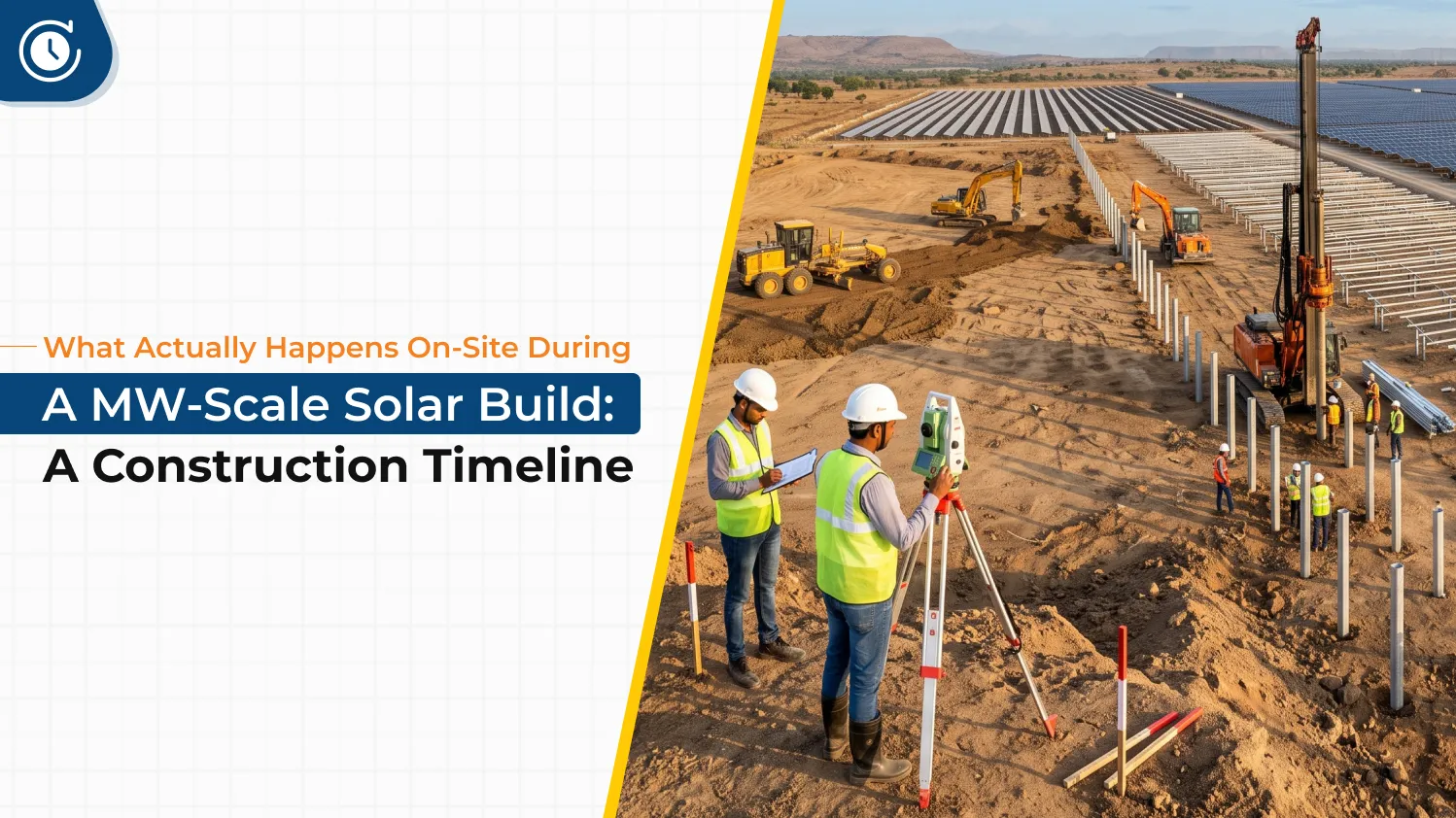
This is the stage most visible to a client, the physical build: site preparation, foundation and structural installation, panel mounting, electrical wiring, and grid interconnection work, all coordinated across a construction timeline that typically has far more parallel activity happening simultaneously than a simple linear schedule would suggest.
As a solar plant installation company in Kutch, clients see progress most directly, execution quality here matters in ways that aren't always visible during a site walkthrough. Proper torque on mounting hardware, correctly sized cable runs, and disciplined sequencing between structural and electrical crews all affect long-term reliability in ways that only become apparent years later, either through consistent performance or through a pattern of recurring faults traceable back to a rushed construction phase.
Stage 6: Testing and Commissioning
Before a plant is cleared to operate at full capacity, it goes through a structured sequence: continuity and insulation testing, string-level verification, inverter commissioning, protection system testing, grid synchronization testing, and initial performance ratio verification against design expectations. This stage is where design and construction quality actually get validated against reality, not assumed.
A plant that passes cleanly through this sequence reflects careful execution across every stage that came before it. Recurring issues during testing almost always trace back to a shortcut taken somewhere earlier in the process.
Stage 7: Operations and Maintenance
Commissioning isn't the finish line, it's the starting point for the twenty-five year period where a plant's actual financial performance gets decided. This is where scheduled and predictive maintenance, cleaning cycles calibrated to real soiling data rather than a fixed calendar, thermal imaging to catch developing electrical issues, and torque verification on connections all combine to keep a plant tracking against its design performance rather than gradually drifting below it.
Genuine solar operations and maintenance at this stage also means documentation discipline, keeping every repair, fault, and inspection recorded in a format that will actually hold up if a warranty claim needs to be filed years into the plant's operating life.
Stage 8: Performance Monitoring
Running in parallel with maintenance, ongoing monitoring is what catches a developing issue the day it starts rather than the quarter someone finally notices a revenue shortfall. String-level visibility, performance ratio tracking against the plant's original design baseline, and curtailment logging that supports revenue recovery claims where applicable all fall under this stage.
A plant without this level of monitoring granularity can lose meaningful output to a single underperforming string or a gradually degrading inverter for months before the loss becomes visible in total plant-level numbers, if it ever does at all.
Why This Has to Be One Continuous Relationship, Not Eight Separate Vendors
Laid out this way, it's clear these eight stages aren't independent tasks that happen to occur in sequence. Each one depends on decisions made in the stage before it. A financing structure only works if it matches the system design. A maintenance program only protects warranty coverage if it has access to the original installation documentation. A monitoring system only catches meaningful issues if it's measuring against the performance baseline the design stage actually established.
This is exactly why fragmenting these stages across different, disconnected vendors introduces risk at every handoff. Each transition, design to procurement, construction to commissioning, commissioning to operations, is a point where information gets lost, assumptions go unstated, and small compromises made under one team's schedule pressure become permanent limitations the next team has to work around without knowing why.
What Fragmentation Costs Versus What Continuity Protects
Stage Transition | Risk When Fragmented | Value When Continuous |
Design to procurement | Component specs drift from original design intent | Sourcing decisions directly reflect the design rationale |
Construction to commissioning | Incomplete as-built documentation | Complete, continuous record from day one |
Commissioning to operations | O&M team inherits a plant they didn't build or design | Same team, full context on every design and construction decision |
Ongoing operations to warranty claims | Documentation split across multiple parties, slower claims | Single, complete record supports faster claim resolution |
A turnkey solar solutions Kutch approach exists specifically to close these gaps, treating the entire eight-stage arc as one continuous engagement rather than a series of separate transactions.
What This Means for Different Types of Clients
The full lifecycle described above applies whether the client is a residential homeowner, a commercial property owner, or an industrial buyer developing a captive power plant, though the specifics shift by scale.
As a solar energy company Kutch working across this range, the core principle stays consistent even as the details change: a residential rooftop system still benefits from proper site assessment, correct component selection, and ongoing maintenance, just at a smaller scale than a utility-scale ground-mount project developed as a renewable energy company Kutch for grid-scale generation. What changes is the complexity of financing structures, the granularity of monitoring required, and the scale of the maintenance program, not the underlying discipline applied at each stage.
A Track Record Built Across This Full Arc
As solar project developers in Kutch organizations have relied on across this complete lifecycle, White Desert Power Projects has worked with clients including Shriram Kaolin, GIPCL, Aditi Packaging, and Monex Solar Power LLP, supporting each through the stages described here, from initial site assessment through years of ongoing operations and monitoring. These relationships extend well past commissioning, which is exactly the point at which a fragmented vendor relationship typically ends and a genuine long-term partnership actually begins to matter most.
What to Look for in a Full-Service Solar Partner
For a prospective client evaluating whether a provider genuinely delivers across this entire arc, rather than handling one or two stages well and treating the rest as an afterthought, a few questions help clarify the picture:
Does the same organization handle design, procurement, construction, and long-term operations, or are these separate contracts with different teams?
How is documentation maintained continuously from site assessment through years of operational reporting?
Can the provider show examples of plants they've supported through the full lifecycle, not just recently commissioned projects?
Does their design process account for financing structure, procurement quality, and long-term maintenance needs simultaneously, or are these treated as sequential, disconnected decisions?
What does their track record look like for plants five, ten, or more years into operation, not just at commissioning?
Conclusion
A solar plant's value isn't determined at any single point in its life. It's determined by how well eight interconnected stages, from the first site survey through decades of monitored operation, are executed and connected to one another. Fragmenting these stages across disconnected vendors introduces exactly the kind of gaps where a plant's actual performance drifts away from what it was designed and financed to deliver. A genuine full-service partner treats this as one continuous relationship, because that's the only way a plant actually holds up against its 25-year promise.
White Desert Power Projects has delivered this full arc for organizations including Shriram Kaolin, GIPCL, Aditi Packaging, and Monex Solar Power LLP, from initial site survey through years of sustained operational performance.
If you're evaluating a solar partner for an upcoming project, ask them to walk you through their approach across every one of these stages, not just the one they're pitching first. Talk to White Desert Power Projects about what a genuinely full-service, turnkey approach looks like for your specific site and goals.