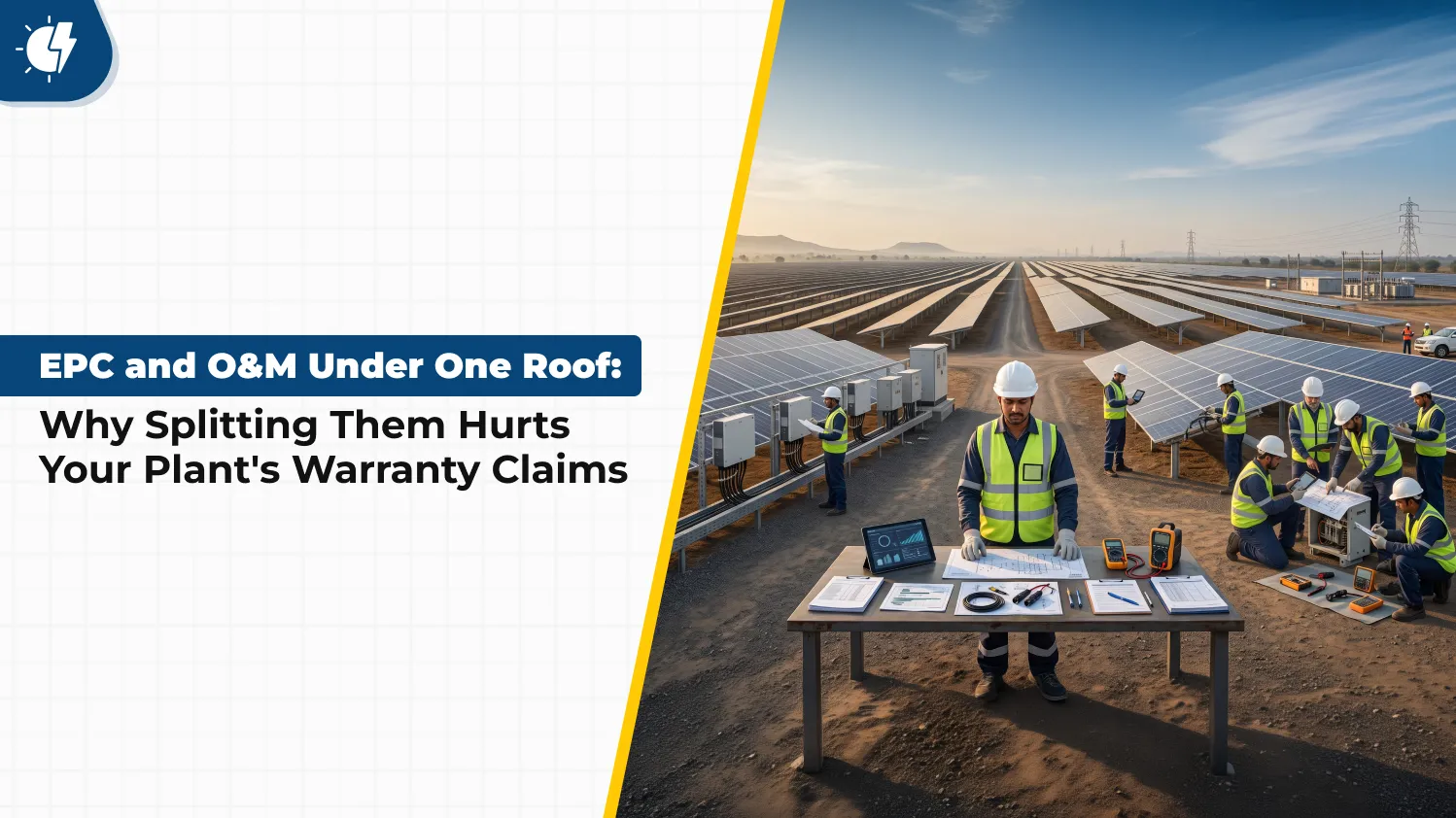
A warranty claim on a solar plant is only as good as the paper trail behind it. When a module underperforms in year twelve or an inverter fails outside its expected failure window, the manufacturer doesn't take the owner's word for it. They want documented proof: as-built specifications, installation records, maintenance history, and evidence that the component was operated and maintained according to the terms that kept the warranty valid in the first place. When the company that built the plant and the company maintaining it are two different organizations with no shared records, that paper trail has gaps, and gaps are exactly where warranty claims get denied.
This is the case for solar EPC execution services in Kutch structured to include long-term operations under the same roof, rather than a construction contractor who exits at commissioning and hands the plant to a separate maintenance vendor starting from zero.
Why Warranty Claims Depend on More Than Just the Original Defect
Module manufacturers typically guarantee performance for 25 years, and inverter manufacturers offer coverage for 5 to 10 years depending on the product. But these warranties come with conditions attached, conditions that are easy to overlook until a claim is actually filed and the manufacturer starts asking for supporting documentation the owner doesn't have.
A typical warranty claim requires proof of:
The exact component specifications and installation date, matched against original design documentation
Evidence that the component was installed according to manufacturer guidelines
A maintenance history showing the plant was operated within normal parameters
Documentation of the specific fault, including performance data showing the deviation from expected output
In some cases, proof that any prior repairs or replacements were performed by qualified technicians using compliant parts
When the EPC contractor and the O&M provider are separate entities, each of these documentation requirements sits with a different party, and neither one necessarily has the full picture the manufacturer is asking for.
Where the Documentation Gap Actually Forms
The gap doesn't appear because anyone is being negligent. It appears structurally, at the handoff between construction and operations, which is exactly the point where most fragmented projects lose continuity.
Documentation Type | Held By (Fragmented Model) | Problem When Claim Is Filed |
As-built drawings and component specs | EPC contractor, often archived and hard to retrieve | O&M provider doesn't have direct access, delays claim preparation |
Installation records and commissioning tests | EPC contractor | Rarely transferred in full detail during handover |
Ongoing performance and fault data | O&M provider | EPC contractor unaware of operational history, can't confirm original install matches current condition |
Maintenance and repair logs | O&M provider | Manufacturer questions whether repairs followed original design intent, since no unified record exists |
A claim that requires pulling data from two organizations that haven't been in regular contact since commissioning takes longer to assemble, and a delayed claim often means a delayed or partial payout, if it isn't denied outright over incomplete supporting evidence.
How This Plays Out in Practice
Consider a module string that starts underperforming in year nine, degrading faster than its warranted curve. The O&M provider flags the issue through monitoring data and wants to file a claim. But the manufacturer wants confirmation of the exact installation conditions, whether the racking angle matched design specifications, whether the string was wired according to the original electrical design, and whether any modifications were made in the years since commissioning.
The O&M provider, having had no role in the original construction, can only speak to what they've observed operationally. The EPC contractor, having exited after commissioning, has to be tracked down and asked to pull records that may or may not still be readily accessible, especially if it's been years and the original project team has moved on to other work. Every step in that process adds time, and time spent chasing documentation is time the plant continues underperforming without the fix or replacement the warranty was supposed to cover.
Now consider the same scenario under integrated solar plant operations services in Kutch, where the same organization designed, built, and has been operating the plant since commissioning. The installation records, the design specifications, and the operational history all sit in one continuous file. The claim gets assembled from a single source, with the same technical team that understands both how the plant was built and how it's been performing since.
Why Integrated Execution and O&M Protects More Than Just Warranties
Warranty claims are the clearest example, but the same documentation continuity affects several other areas where fragmented handoffs create risk.
Root Cause Diagnosis
When a fault occurs, knowing whether it stems from a design decision, an installation shortcut, or an operational issue requires understanding all three. A team that only inherited the plant at commissioning is diagnosing blind on the design and installation side, which slows down root cause identification and sometimes leads to a fix that treats the symptom without addressing the underlying cause.
Design Intent Preservation
Plants are built with specific design intent, cable routing chosen for a reason, maintenance access points placed deliberately, component spacing calculated for a specific thermal or shading consideration. An O&M provider unfamiliar with that intent can make maintenance decisions that unintentionally work against it, simply because the reasoning was never communicated across the handoff.
Insurance and Lender Reporting
Insurers and lenders evaluating a plant's ongoing risk profile want consistent documentation showing the plant has been maintained properly since commissioning. A continuous record from a single accountable provider is considerably easier to produce and defend than records assembled from two organizations with different reporting formats and record-keeping standards.
What Integrated EPC and O&M Actually Looks Like
Structuring solar project execution services Kutch to include long-term operations isn't just about convenience. It changes how design and construction decisions get made in the first place, since the same team responsible for building the plant knows they'll also be the ones maintaining it for the next 25 years.
Design Decisions Made With Maintenance in Mind
When the EPC and O&M functions sit under one organization, design choices, like maintenance access points, monitoring infrastructure placement, and component selection, get made with long-term serviceability as a factor, not just construction speed or cost.
Continuous Documentation From Day One
As-built records, commissioning test results, and component specifications flow directly into the operations phase without a formal handover process that risks losing detail. The same file that started during design continues growing throughout the plant's operating life.
Faster Fault Response With Full Context
When an issue arises, the team diagnosing it has direct access to why specific design and construction decisions were made, which shortens the path from fault detection to resolution considerably compared to a team working from someone else's handover notes.
Warranty Claims Backed by a Single, Complete Record
Every warranty claim draws from one continuous documentation trail, spanning design intent, installation records, and operational history, rather than requiring coordination between two separate organizations to assemble.
Comparing the Two Models Directly
Factor | Split EPC and O&M | Integrated EPC and O&M |
Documentation continuity | Broken at handover, reconstructed if needed | Continuous from design through operations |
Warranty claim preparation time | Slower, requires coordinating two organizations | Faster, single source of complete records |
Root cause diagnosis | Limited by incomplete knowledge of original design | Full context from design through current operation |
Design decisions | Focused on construction cost and speed | Informed by long-term serviceability needs |
Accountability when something goes wrong | Ambiguous, each party can point to the other | Clear, single organization responsible throughout |
The pattern across every row is the same. Fragmentation doesn't just create inconvenience, it removes the continuity that warranty claims, fault diagnosis, and long-term plant performance all depend on.
What to Ask Before Choosing an EPC and O&M Structure
For developers and owners deciding how to structure their vendor relationships, a few questions clarify whether a provider is set up to protect this kind of continuity:
Does the same organization handle both construction and long-term operations, or are these separate contracts with separate teams?
How is documentation transferred and maintained across the construction-to-operations transition?
Can the provider show a track record of successfully supporting a warranty claim using records from a plant they both built and maintained?
Who is responsible for coordinating with the manufacturer if a warranty issue arises years into operation?
Does the design and construction process account for long-term maintenance needs, or is that only considered once an O&M contract is separately awarded?
A provider offering genuinely integrated solar operations and maintenance services in Kutch, built into the same relationship as execution, should be able to answer these clearly, with specific examples rather than general assurances.
Conclusion
A warranty is only as useful as the documentation that supports a claim when something actually goes wrong. Splitting execution and operations across two separate organizations introduces a structural gap in that documentation trail, right at the handoff point where design intent, installation records, and operational history need to connect seamlessly and often don't. An integrated approach, where the same organization builds and then operates the plant, keeps that record continuous from day one, which matters most exactly when a claim needs to be filed and the details actually count.
White Desert Power Projects has delivered integrated execution and operations for organizations including Shriram Kaolin, GIPCL, Aditi Packaging, and Monex Solar Power LLP, maintaining a single continuous documentation trail from design through years of operational support.
If you're structuring vendor relationships for an upcoming solar project, or reviewing whether your current setup leaves warranty claims exposed to documentation gaps, talk to White Desert Power Projects about an integrated execution and O&M approach built to protect your plant's long-term coverage.