
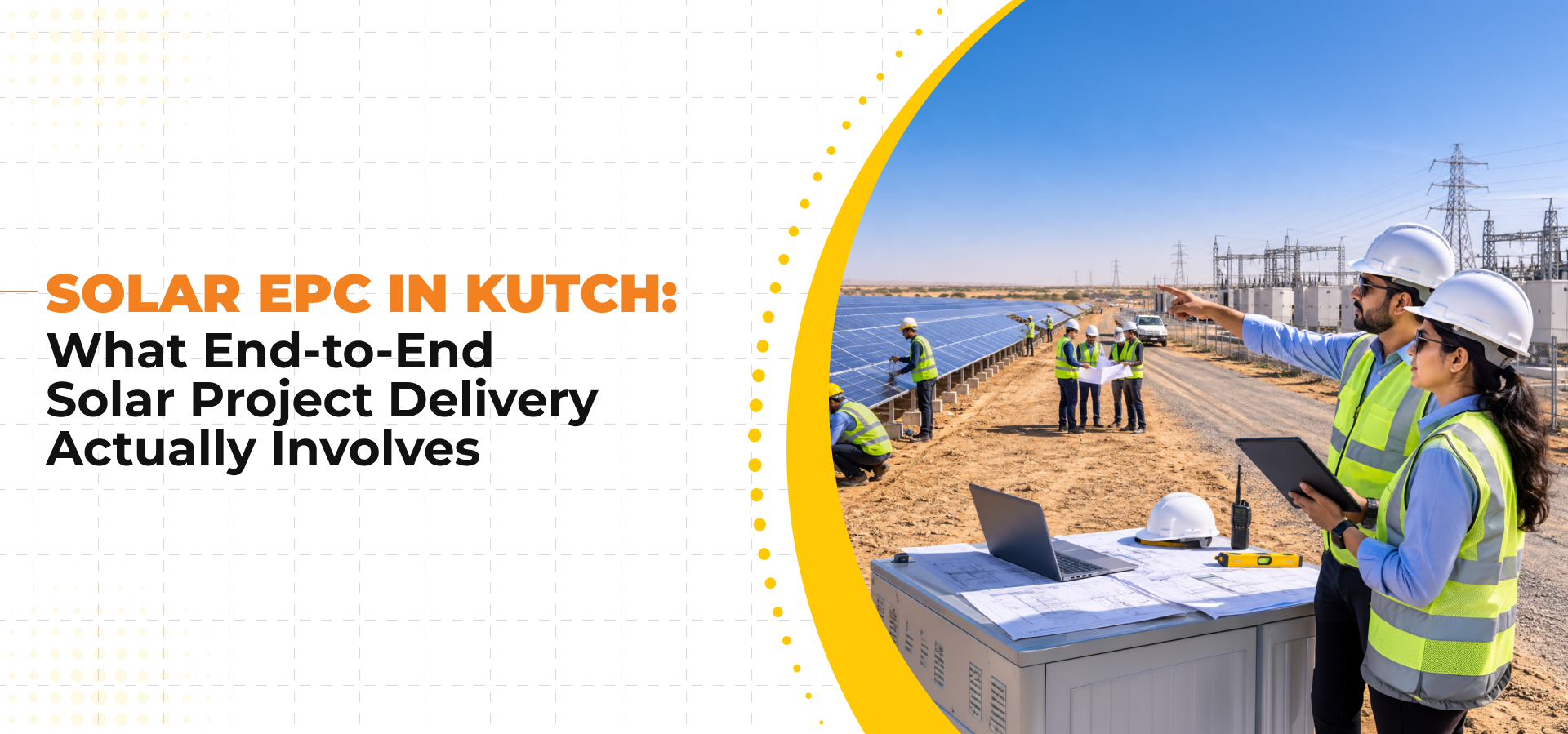
Choosing a solar company in Kutch is rarely as simple as comparing price per kilowatt. A plant in this district faces desert heat, fine dust, salt-laden air and strong winds. A quote that ignores those conditions can look cheap on paper and underperform for years. The better first question is not "who is cheapest?" but "who is responsible for what, from the first site visit to the last year of operation?"
A solar EPC contract answers that question. This guide explains what EPC delivery involves stage by stage, what it typically costs and how long it takes in Gujarat, and which approvals and rules apply. It also shows how to judge a contractor's capability before you sign. It is written for factory owners, warehouse operators, farmers, institutions and developers in Bhuj, Anjar, Gandhidham, Mundra, Mandvi, Nakhatrana and the wider Kutch district.
What Is a Solar EPC Company, and What Does It Actually Do?
A solar EPC company manages the full lifecycle of a solar power plant under one contract. EPC stands for Engineering, Procurement and Construction. Instead of coordinating a designer, equipment suppliers, civil contractors and electricians separately, you have one accountable party from design to handover.
Engineering is the planning phase. It typically covers:
A site assessment, including load profiling, shading analysis and solar irradiation data.
System sizing and an expected energy yield estimate.
Electrical and structural drawings, such as single-line diagrams (SLDs), DC/AC layouts and civil designs.
Support with permits and utility interconnection.
Procurement is sourcing the hardware:
Core components: solar modules and inverters.
Balance of System (BOS): mounting structures, DC and AC cables, string combiner boxes, switchgear and transformers.
Checking that components meet warranty terms and applicable standards, including ALMM listing where it applies.
Construction is the physical build:
Civil work: grading, trenching, foundations or rooftop anchoring.
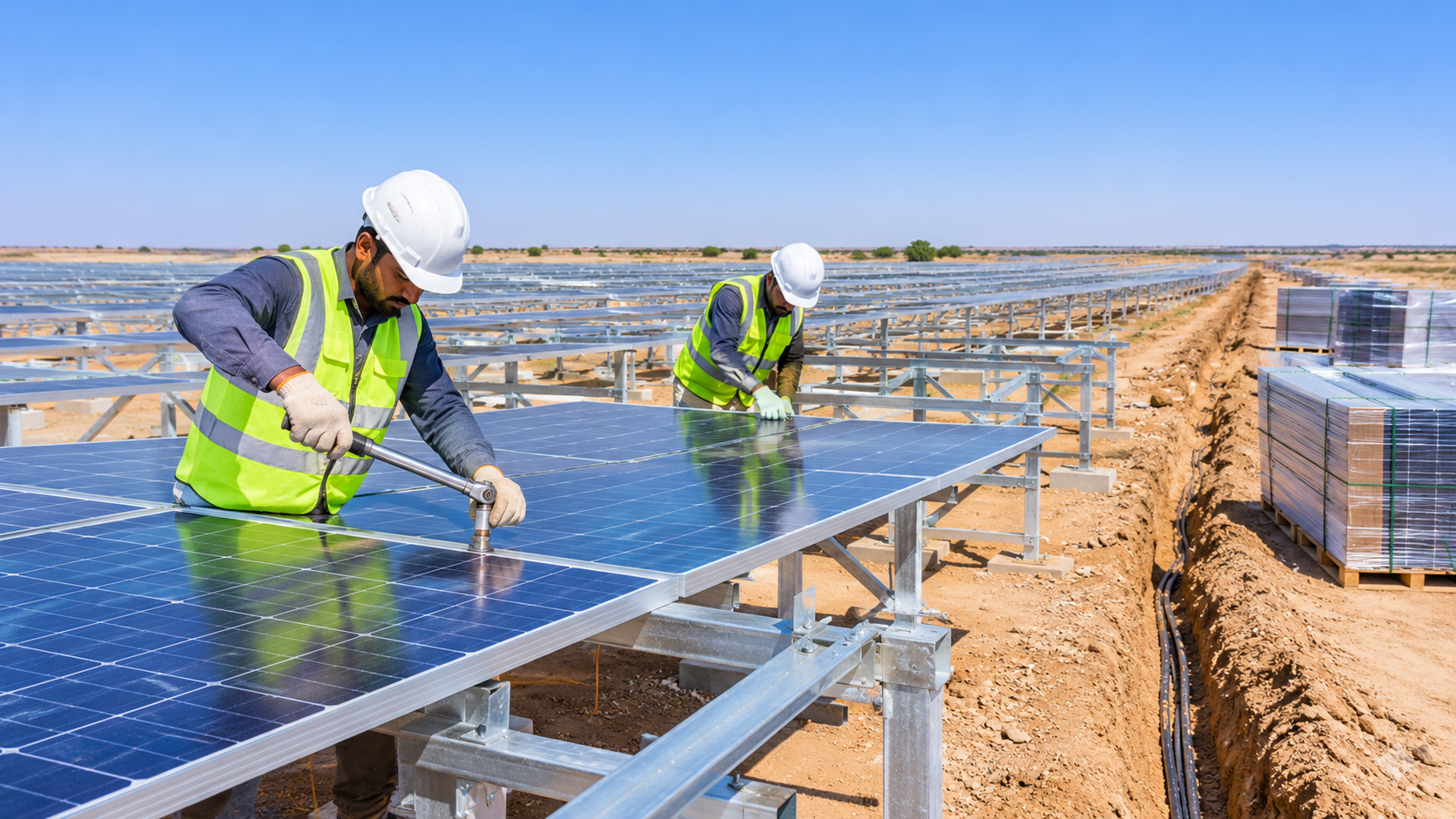
Structure erection, module installation and cabling.
Earthing, lightning protection and safety disconnects.
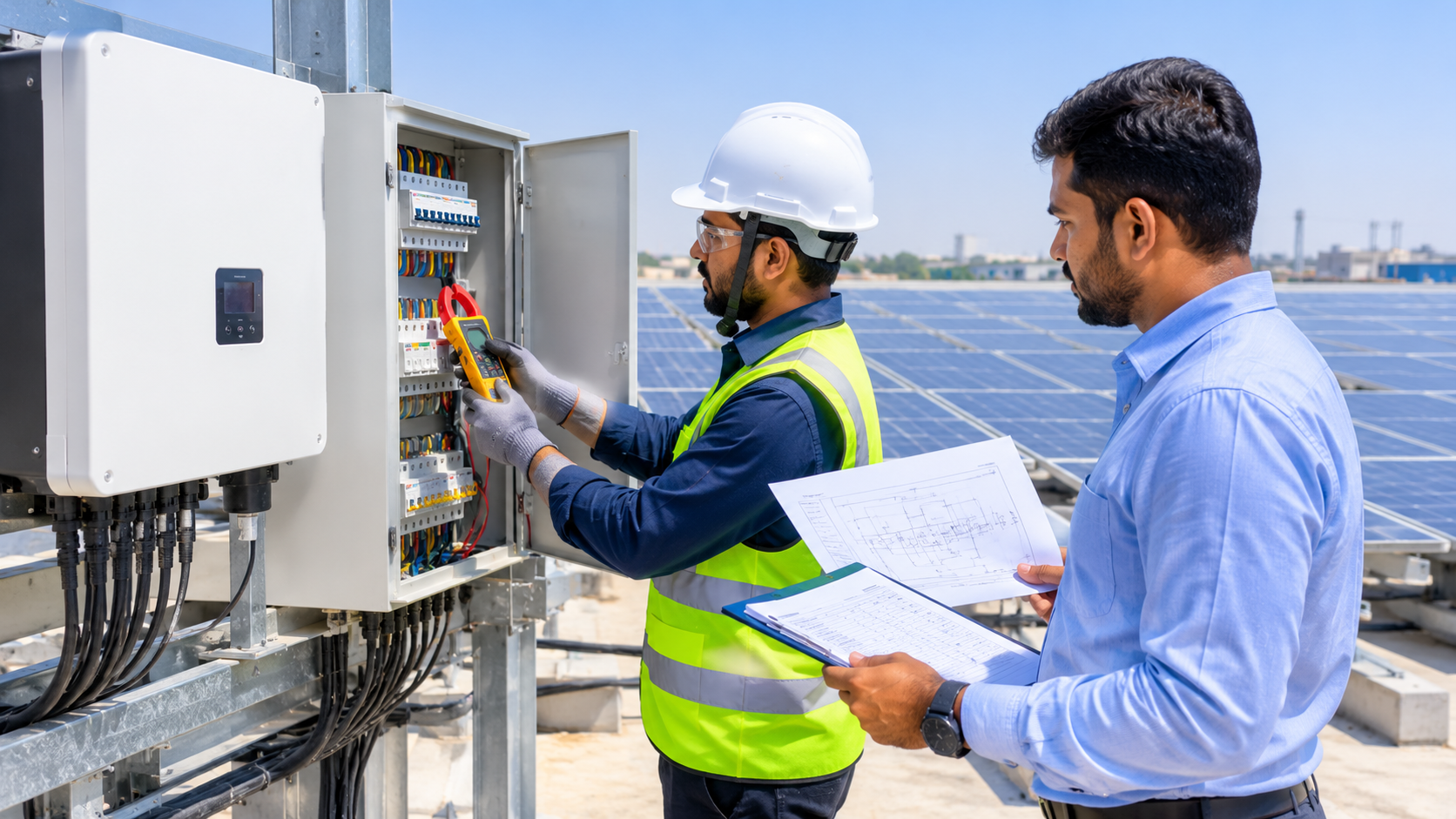
Testing and commissioning: insulation resistance checks, open-circuit voltage tests, IV curve tracing and grid synchronisation.
Net metering setup and handover of as-built drawings, often followed by a long-term O&M contract.
How Is a Solar EPC Contractor Different from an Installer or a Developer?
These three terms are often used interchangeably, but they describe different roles.
Feature | Solar installer | Solar EPC contractor | Solar developer (IPP/RESCO) |
Main focus | Physical mounting and wiring | Engineering, sourcing and building | Investment, ownership and selling power |
Design and engineering | Minimal | Comprehensive | Oversees feasibility and macro-design |
Typical project | Small rooftops | Factories, warehouses, institutions, utility plants | Utility-scale parks, long-term PPA projects |
Who owns the plant | Customer | Client | Developer or RESCO |
Accountability | Often fragmented across suppliers | Single point of responsibility | Contractual, through the PPA |
A developer usually hires an EPC firm to build the plant. An installer typically works where the customer or a third party handles design and equipment. For a business that wants to own its plant, the EPC contractor is the party that carries design, supply and construction risk in one contract.
Why Do Kutch's Conditions Change How a Solar Plant Is Designed?
A design copied from a coastal city or an inland plain will not necessarily suit the district. Published regional estimates put Kutch at roughly 5.5 kWh/m² of solar irradiation per day. A well-designed system there may generate about 1,500 to 1,650 kWh per kWp per year. Treat these as indicative, because actual yield depends on design, losses and maintenance. A proper yield simulation on your own site is the reliable figure.
Local condition | Effect on a plant | What good design does about it |
Extreme heat | Module efficiency falls roughly 0.5% to 0.7% for each °C above 25°C. Heat also stresses seals, junction boxes and solder joints. | Allows for temperature losses in the yield estimate, uses sound ventilation and layout, and schedules thermal inspections. |
Fine desert dust | Uncleaned soiling can cut output by 5% to 25% or more. | Plans a cleaning method and schedule from day one. |
Salt in the air (near the coast and Rann) | Salt films and corrosive residues degrade performance and metal parts. | Specifies corrosion-resistant structures and fasteners, and a separate cleaning routine. |
Strong winds | Vibration, loosening and uplift on tilted arrays. | Designs structures to IS 875 (Part 3) wind-load requirements, with torque checks on clamps and bolts. |
Varied soils | Loose sand, alluvial soil and rock need different foundations. | Chooses piles, screw piles or concrete stubs after site investigation. |
Daily temperature swings also mean structures need provision for thermal expansion. This is why a credible EPC process starts with a site survey and soil and structural review rather than a catalogue quote.

What Does Solar EPC Look Like Across Gujarat?
Demand for solar EPC in Gujarat spans three very different markets. Rooftop and captive plants serve factories, warehouses and commercial buildings. Agricultural and distributed projects fall under schemes such as PM-KUSUM and state programmes. Utility-scale parks, including the large Khavda Renewable Energy Park in the Rann of Kutch, are built for power utilities and developers.
Each segment has a different contract structure, approval route and timeline. A contractor strong in utility-scale tenders may not be the right fit for a 150 kW rooftop, and the reverse is also true. Match the contractor's actual experience to your project's size and type.
State policy matters too. Rules on captive use, banking and set-off have changed over the years. The Gujarat Solar Power Policy 2021 reportedly ran to the end of 2025 and has been followed by newer renewable energy provisions. Confirm the current rules with GEDA or your DISCOM before finalising your project economics.
How Does End-to-End Solar Project Delivery Work, Stage by Stage?
White Desert Power Projects describes its delivery model in seven stages. This sequence is a useful template for any EPC project.
Consultation. The contractor learns your load profile, site, budget and timeline. For a business, this means reviewing recent electricity bills and daytime demand.
Site survey. Shading analysis, structural review of the roof or ground, and a yield estimate.
Engineering design. System design, single-line diagrams, layouts and civil drawings. This is the documentation lenders and inspectors will ask for.
Procurement. Modules, inverters and BOS sourced from verified suppliers, checked against the applicable standards.
Installation. Civil, structural and electrical works carried out to specification.
Commissioning. Testing, DISCOM coordination, net metering and energisation.
Maintenance and monitoring. Cleaning, monitoring and fault response over the plant's life.
What approvals sit inside the EPC scope in Gujarat?
For a grid-connected plant, the approvals usually follow this order:
GEDA registration, where applicable to the project category.
SLD and technical feasibility. The DISCOM (PGVCL for most of Kutch) reviews grid capacity and issues a technical feasibility report.
Connectivity agreement with the DISCOM, after paying the applicable charges.
CEIG drawing approval. Drawings, equipment data sheets and safety calculations go to the Chief Electrical Inspector.
Physical installation by a licensed contractor.
CEIG inspection of earthing, protection and safety systems, ending in a charging approval for applicable plants.
Meter installation and commissioning. The DISCOM installs the meters, signs a joint inspection report and issues the commissioning certificate.
Requirements vary with plant capacity and voltage level, so ask your contractor to give you the exact approval list for your project.
How long does each type of project take?
Project type | Typical duration (indicative) |
Commercial rooftop, order to commissioning | About 4 to 8 weeks |
Site survey and design | 3 to 7 days |
DISCOM approvals (10–100 kW) | Roughly 15 to 20 days |
DISCOM approvals (above 100 kW) | Roughly 25 to 30 days |
Physical installation (rooftop) | 3 to 7 days |
Testing, net meter and commissioning | 7 to 15 days |
Ground-mounted plant, 1–10 MW | About 3 to 6 months |
The biggest variables are land or roof readiness, DISCOM response times and equipment lead times. Ask your contractor which of these they control and which they don't.
How Much Does Solar EPC Cost in Gujarat?
These are indicative market ranges from published sources in 2026. They are not quotations, so use them to sanity-check proposals.
Commercial and industrial rooftop
Plant size | Approx. cost per kW |
25–50 kW | ₹42,000 – ₹55,000 |
100–200 kW | ₹38,000 – ₹48,000 |
500 kW | ₹36,000 – ₹42,000 |
1 MW and above | ₹35,000 – ₹42,000 |
Ground-mounted
Project type | Approx. cost per MW |
C&I or captive, 1–5 MW | ₹3.5 – ₹4.5 crore |
Utility-scale, 10 MW+ | ₹3.2 – ₹3.8 crore |
DCR-compliant projects (for example, PM-KUSUM) | ₹4.3 – ₹5.0 crore |
Per-kW costs fall as capacity rises because fixed costs like engineering and approvals are spread across more capacity. Modules typically make up about half the cost of a ground-mounted plant, with BOS, inverters, structures and civil work making up the rest. Land is separate if you don't own it.
What should a quote include?
Two proposals with the same headline price can differ widely in scope. Ask for an itemised bill of quantities that states the following:
The make and model of the modules, inverters and structures.
Whether HT/LT net-metering infrastructure, DISCOM fees and structural safety checks are included.
Whether remote monitoring is included.
The cleaning method and O&M terms.
How do tariffs and tax benefits affect payback?
Published estimates suggest the effective cost of grid power for HT industrial consumers in Gujarat is in the range of ₹7.50 to ₹8.50 per unit once fixed charges, fuel adjustments and duties are included. Check your own latest bill, because this number drives your savings. For commercial and industrial plants, published payback estimates are typically 3 to 5 years, depending on size, tariff and tax treatment.
Two points shape the economics:
Size for daytime use. Under earlier Gujarat policy provisions, solar set-off for HT consumers was limited to daytime hours (7:00 AM to 6:00 PM). Surplus energy exported to the grid is typically paid at rates far below the retail rate, so self-consumption matters most.
Accelerated depreciation. Businesses that own their plant can generally claim 40% depreciation on the written-down value. On a ₹1 crore plant, that is a ₹40 lakh deduction, or roughly ₹10 lakh of tax saved at a 25% tax rate. If the plant is used for fewer than 180 days in the first year, the first-year rate is generally halved. Tax rules and section references have been updated recently, so confirm the position with your chartered accountant.
Should you buy the plant or sign a RESCO contract?
Parameter | Owned plant (CAPEX, EPC) | RESCO / OPEX (PPA) |
Upfront investment | Full project cost | None |
Who owns the plant | You | The developer |
O&M responsibility | You or your O&M contractor | The developer |
Commercial arrangement | One-time EPC contract | Long-term PPA, often 15–25 years |
Savings | Highest over the long term | Typically 20% to 40% below the DISCOM tariff from day one |
Depreciation benefit | Yours | Developer's |
An owned plant usually delivers the lowest lifetime cost, but you carry the capital and performance risk. A RESCO removes capital and maintenance burden at the price of a long lock-in and a lower total return.
Which Subsidies and Rules Apply?
PM Surya Ghar is a residential scheme. Central assistance is ₹30,000 for a 1 kW system and ₹60,000 for 2 kW, and it is capped at ₹78,000 for 3 kW and above. It requires an empanelled vendor and approved equipment. Commercial and industrial users are not eligible for it.
PM-KUSUM covers decentralised ground-mounted plants of 0.5 to 2 MW, standalone solar pumps up to 7.5 HP, and solarisation of grid-connected agricultural pumps. In Gujarat it works with GEDA and the DISCOMs.
DREBP (Distributed Renewable Energy Bilateral Purchase) is described in published summaries as a mechanism for 0.5 to 5 MW solar projects selling to DISCOMs under long-term agreements. Check the current terms with GUVNL or GEDA before relying on any tariff figure.
Module rules. ALMM List-I applies to modules in government-supported and many grid-connected projects. Domestic Content Requirement (DCR) modules are mandatory for subsidised schemes. A phase-in for ALMM List-II (domestic cells) for net-metering and open-access projects has been reported around the turn of 2026–27. Because the date is close, confirm the current MNRE notification with your contractor before fixing your commissioning schedule.
Why Does O&M Decide the Real Return on a Kutch Plant?
Commissioning is the beginning of a plant's working life, not the end of the project. In dust and heat, a plant that is not maintained will steadily lose output. Anyone looking for the best solar service in Kutch should judge it on what happens after the ribbon is cut: the cleaning plan, the monitoring system and the fault-response time.
A sound O&M scope normally includes:
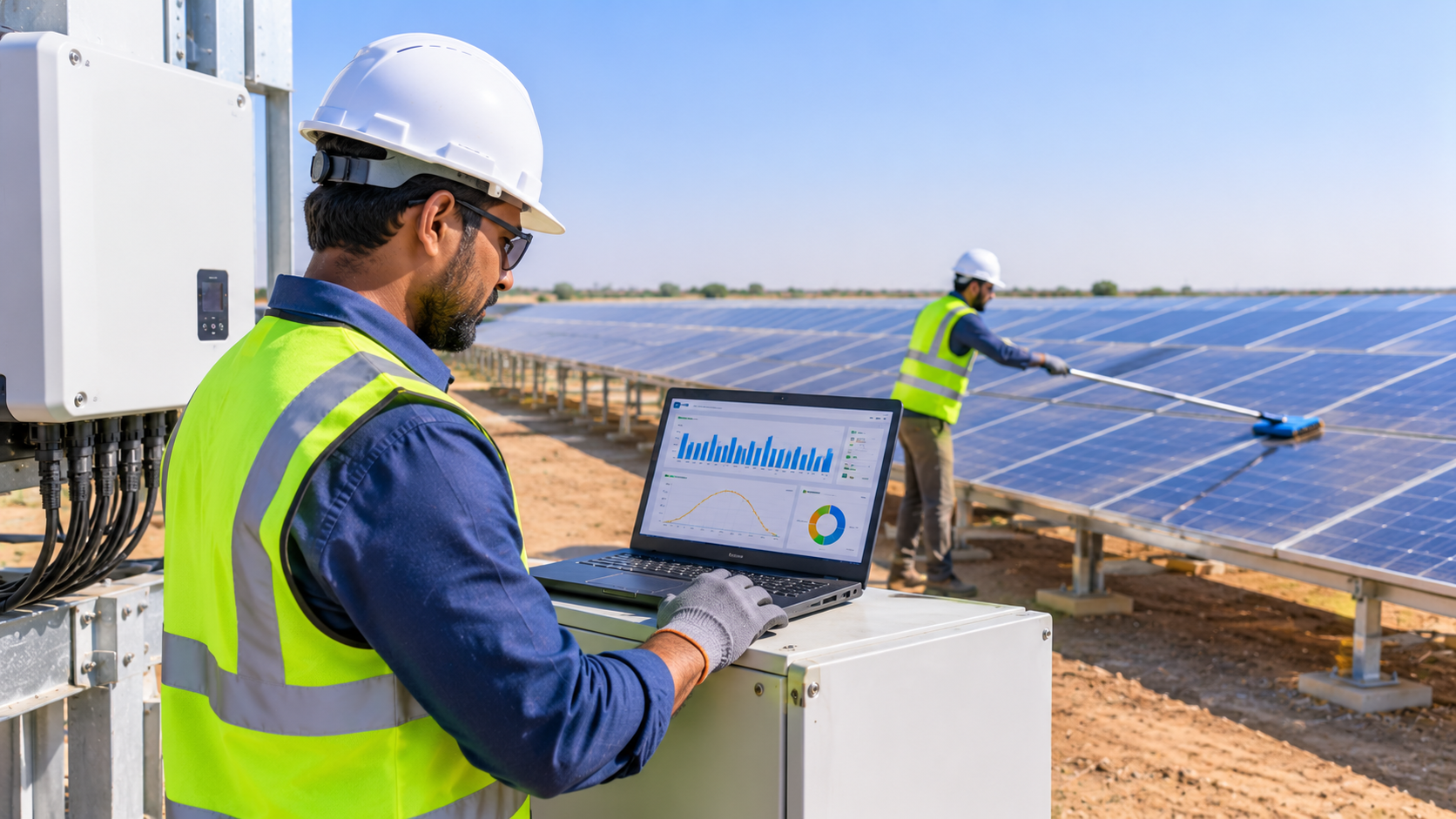
Cleaning. In dry, dusty regions, panels are generally cleaned every 1 to 2 weeks in dry months, and within 24 to 48 hours of a major dust storm. Use soft or deionised water and soft brushes, clean in early morning or evening, and avoid high-pressure jets.
Monitoring. Inverter or SCADA-level tracking and monthly performance ratio reports.
Preventive checks. Earthing resistance tests, thermal imaging for hotspots, and torque checks on structures.
Corrective service. Rapid response to inverter trips and fuse failures, with spares on hand.
For benchmarks, new commercial and industrial rooftop plants typically show a performance ratio of 75% to 80% and availability of about 98% to 99%. Utility-scale plants usually target 99% to 99.5% availability. Whatever number a contractor offers, ask how it is measured and what happens if it is missed.
How Do You Evaluate a Solar EPC Contractor in Kutch?
Marketing language makes every firm sound alike, so judge on documents and evidence.
Searches for the best solar company in Kutch tend to surface rankings and claims that are hard to verify. A more reliable approach is to ask each shortlisted firm for the same set of proof and compare the answers side by side.
A top solar company in Kutch should be able to show a track record of completed projects, give you contact details for clients, and let you visit operating plants of similar size. A firm that cannot do this has not earned a place on your shortlist, whatever its marketing says.
Use this checklist:
Area | What to request |
Legal and credentials | Active GST registration, company incorporation details, state renewable agency empanelment, valid electrical contractor licence |
Track record | Completed plants of similar size, ideally at least 3 years old, with commissioning dates and client references |
Site visits | Access to at least two operating plants |
Engineering | In-house design capability, yield simulation, structural and wind-load assessment |
Equipment | Itemised bill of quantities with make and model; IEC 61215/61730 for modules, IEC 62109 and BIS for inverters, ALMM listing where required |
Management systems | ISO 9001, 14001 and 45001 certificates, where the firm holds them |
Warranties | Written workmanship warranty (at least 5 years is a common ask); pass-through manufacturer warranties, typically 10–12 years product and 25 years linear performance for panels, and 5–10 years for inverters |
Post-commissioning | Draft O&M agreement with cleaning schedule, monitoring access and response-time SLA |
Match the answers to your own needs rather than to a ranking. The best solar EPC company in Kutch for you is the one whose experience fits your project's size and type, whose paperwork holds up, and whose O&M terms you understand before you sign.
Always get at least three itemised quotes. Compare scope line by line before comparing totals.
Where Does White Desert Power Projects Fit?
White Desert Power Projects is based on the Bhuj–Nakhatrana Highway in Nakhatrana, Kutch. It offers EPC services for residential, commercial, industrial and utility-scale solar. Its published service list covers project development, engineering and system design, construction and installation, operations and maintenance, financing and subsidy assistance, procurement of components, and performance monitoring. Its website describes the seven-stage process outlined above and lists project work in Kutch.
As with any contractor, verify rather than assume. Ask White Desert, and every firm on your shortlist, for the documents in the checklist above, including project references, certifications, itemised quotes and draft O&M terms.
Conclusion: What Should You Do Next?
A well-run EPC project is mostly invisible when it works. The design suits the site, the equipment is traceable, approvals move in the right order, and the plant keeps performing because someone is accountable for cleaning and monitoring it. In Kutch, those basics matter even more because heat, dust, salt and wind test every shortcut.
Start with your last 12 months of electricity bills and a clear idea of your daytime load. Then ask three EPC contractors for itemised proposals, site-visit access and draft O&M terms, and compare them on scope and evidence before price.