
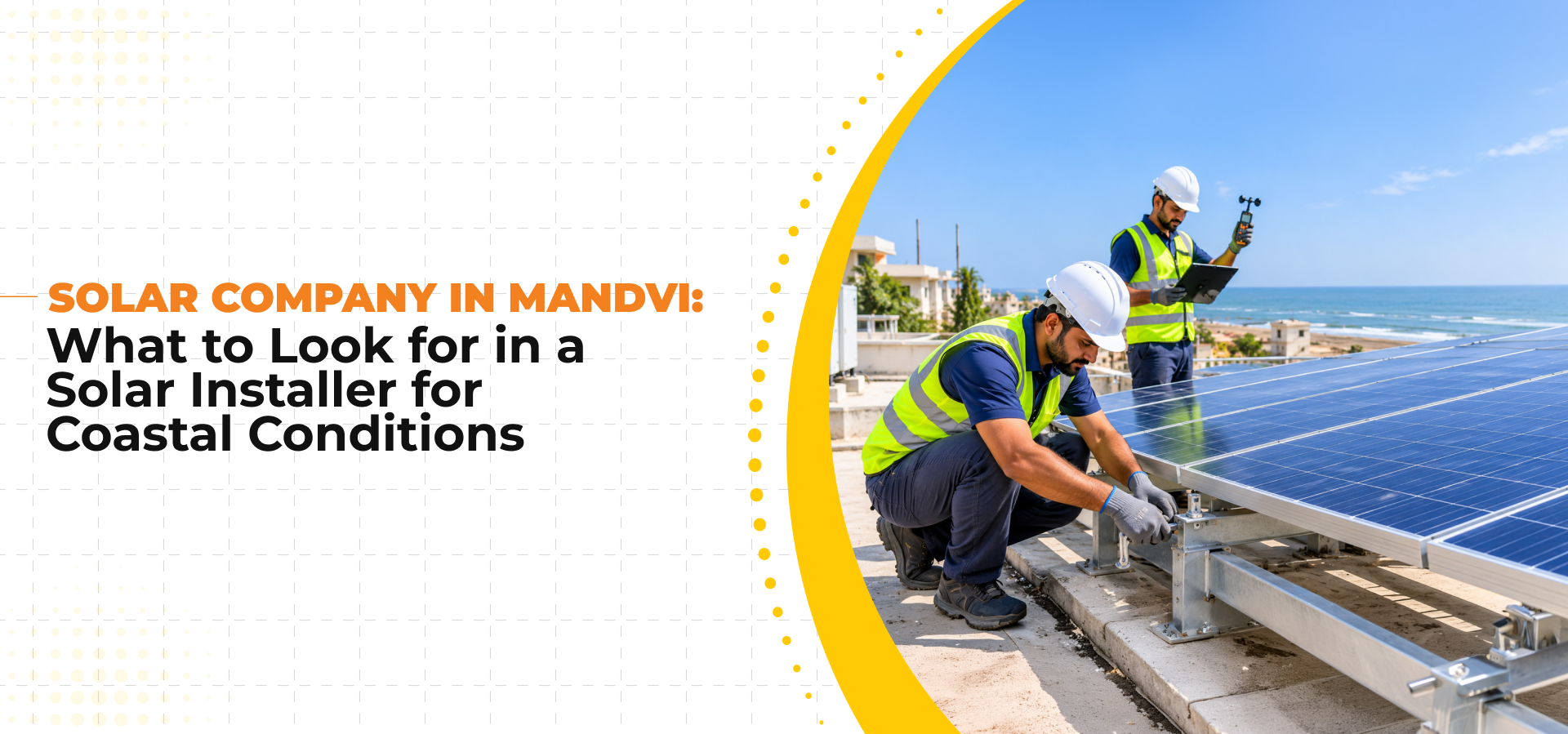
Mandvi sits on the Arabian Sea coast of Kutch, and that changes how a solar plant should be designed, built and maintained. Salt-laden air, humidity and strong winds attack mounting steel, junction boxes and inverters in ways an inland site rarely sees. Choosing a solar company in Mandvi is therefore less about the lowest quote and more about whether the installer understands how the system will look and perform ten and twenty years after commissioning.
Quick answer: what should you look for in a solar installer in Mandvi?
Look for five things:
Valid MNRE and DISCOM empanelment, with subsidy-compliant (DCR/ALMM) panels.
Salt-mist-tested modules (IEC 61701) and inverter enclosures rated IP65 or IP66.
Corrosion-resistant mounting structures designed for Kutch wind loads under IS 875 Part 3.
Written warranties and an O&M plan that includes regular cleaning.
Verifiable past projects and a clear contract scope.
The sections below explain each point, with costs, subsidies and timelines relevant to Mandvi and wider Kutch.
Is Mandvi a good place for solar?
Yes. Kutch has strong sunshine. One regional estimate puts irradiance at about 5.5 kWh/m² per day and annual generation at roughly 1,450 to 1,600 units per kW. For rooftop solar in Mandvi, that implies a well-designed 3 kW home system could produce somewhere around 4,350 to 4,800 units a year. Treat this as indicative, because tilt, shading, cleaning and equipment quality all move the real figure.
Gujarat is also India's rooftop leader. As reported by ANI on 2 November 2026, the state has installed 9.08 lakh residential rooftop systems totalling 3,408 MW. That is about 18.21% of all residential installations in India and 90% of the state's target of 10 lakh homes by March 2027. Demand, vendor competition and DISCOM familiarity are all well established. What differs in Mandvi is the environment.
Why do coastal conditions change what you should ask an installer?
Coastal Gujarat is generally treated as an aggressive corrosion environment (C4 to C5 or higher under ISO 9223). Humidity, airborne chloride and wind combine to age equipment faster. Each component fails differently:
Component | What coastal air does | What to ask the installer |
Panel glass and frame | Salt crust hardens with humidity and scatters sunlight. Moisture can reach panel edges and speed up backsheet delamination. Untreated aluminium frames can corrode. | Which IEC 61701 salt-mist report covers the module? Is it dual-glass? What is the frame coating? |
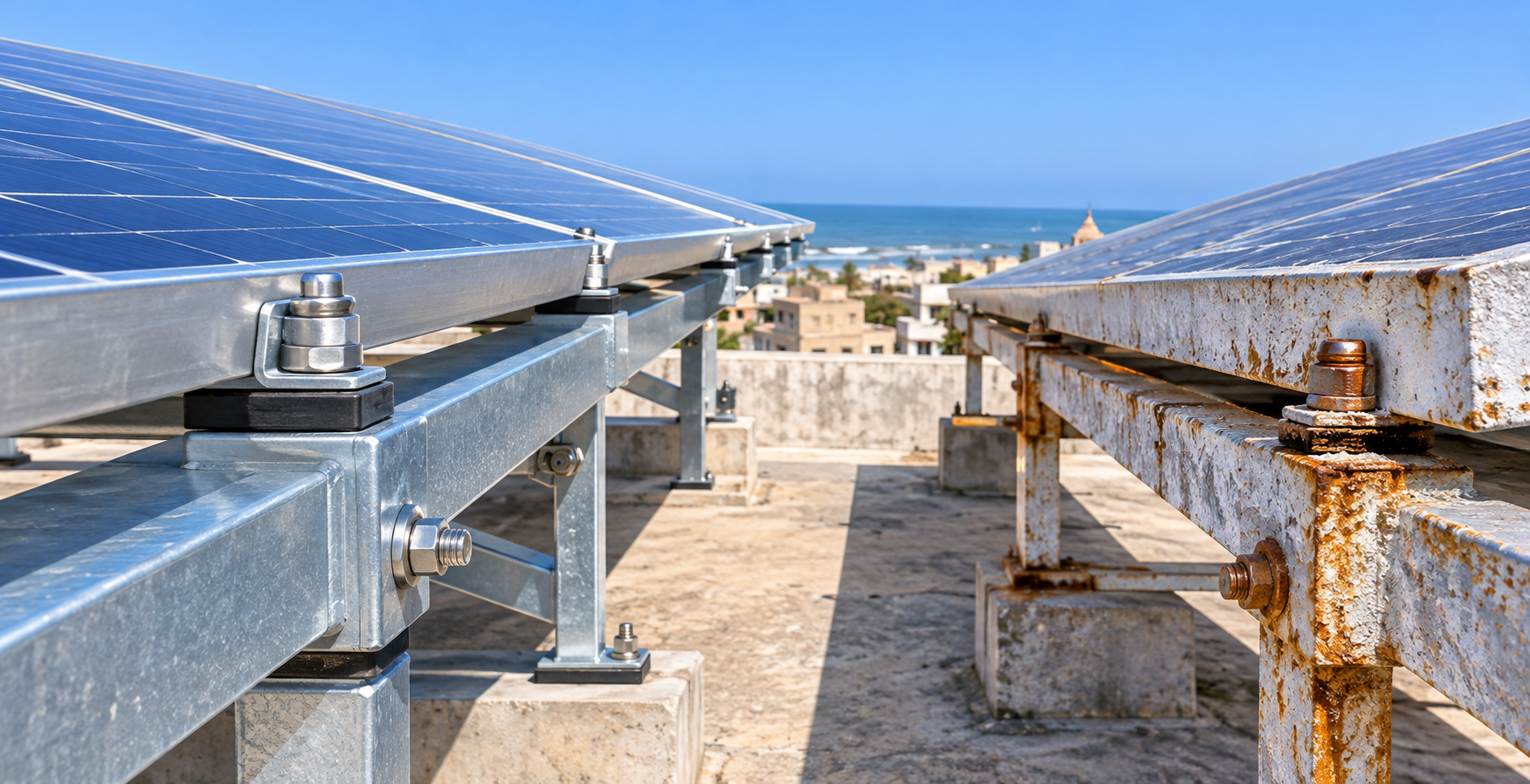
Mounting structure | Zinc coatings erode, and bare mild steel rusts quickly. Aluminium bolted directly to steel causes galvanic corrosion. | What material and coating thickness? Which fasteners? How are dissimilar metals isolated? |
Connectors and junction boxes | Salt on contacts raises resistance, which can cause hot spots. UV and humidity degrade seals. | Is the junction box IP67 rated? Which connector is used? |
DC cables | Marine air accelerates insulation breakdown, risking ground faults. | Which cable make and specification is written into the contract? |
Inverter | Salt clogs ventilation filters, causing overheating and efficiency loss. | Is the enclosure IP65 or IP66? How often are filters cleaned? |
Kutch also faces two structural loads that most of India does not. It falls in a high wind-load category under IS 875 (Part 3), and Bhuj and the wider district sit in Seismic Zone V under IS 1893. A rooftop structure must be engineered for wind uplift and seismic loads, not just for a standard layout.
Which solar panels suit a coastal site?
Buying a solar panel in Mandvi is not the same as buying one for an inland city. Ask for the salt-mist test report, not just a datasheet.
IEC 61701 is the international standard for testing how PV modules withstand salt mist. A certificate alone is not enough. Ask for the actual test report and check which severity level the module passed, because higher severity levels are meant for harsher marine exposure. Cross-check the certificate number with the testing laboratory to avoid expired or grey-market documents.
Dual-glass (glass-glass) modules resist moisture and salt ingress better than standard backsheet modules, which is why they are commonly recommended near the coast. Check the frame finish too, since anodised or powder-coated frames last longer in salt air.
Cell technology matters in heat as well as salt:
Technology | Typical temperature coefficient | Coastal and hot-climate notes |
N-type TOPCon | About -0.30%/°C | Lower annual degradation and near-zero light-induced degradation. Generally the stronger performer in heat. |
Mono PERC | About -0.35%/°C | Budget-friendly and widely available, but loses slightly more output on hot afternoons. |
Bifacial (dual-glass) | Depends on cell type | Resists moisture well, but the rear side adds output only when the panels are raised over reflective surfaces. Flush-mounted flat roofs gain little. |
Panels are rated at 25°C cell temperature, but cell temperatures on a Kutch roof can reach about 65°C. At that level, a TOPCon module loses roughly 12% of rated output to heat and a Mono PERC module roughly 14%.
Inverters deserve equal attention. In coastal air, the enclosure is the first line of defence. Look for IP66, marine-grade corrosion resistance and a PID-resistant design (modules tested to IEC 62804, ideally with night-time PID recovery in the inverter). One practical point: if you want the central subsidy, the module must also be DCR-compliant and ALMM-listed. Ask whether the salt-mist-tested module you want meets that requirement too.
What mounting structure and wind-load design does Kutch need?
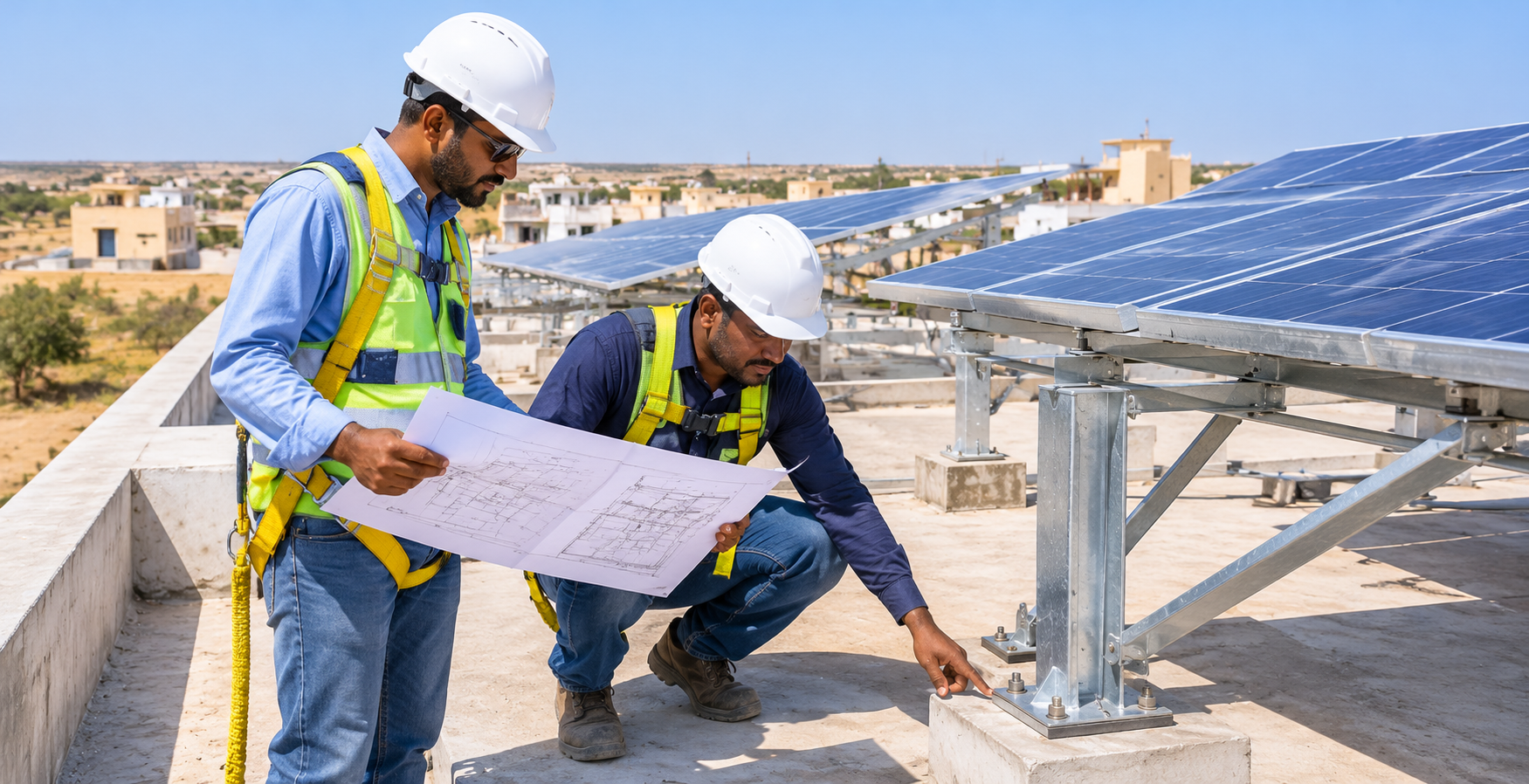
The best solar rooftop company in Mandvi will be able to show you structural calculations, not just a layout drawing. Under IS 875 (Part 3):2015, design wind speed starts from the district's basic wind speed and is then adjusted for risk, terrain, building height, topography and importance. Ask the installer to state in writing which design wind speed was used and who signed off the structure.
Material choice matters just as much:
Material | Strengths | Watch-outs |
Zinc-aluminium-magnesium (ZAM/Magnelis) steel | Self-heals at cut edges and resists chloride attack well. | Confirm the supplier's coating specification and compare price with heavy HDGI. |
Anodised aluminium (6063-T6) | Lightweight and rustproof, with a quoted 30 to 40 year life. | Higher upfront cost. Needs isolation (stainless fasteners, gaskets) where it touches steel. |
Hot-dip galvanised steel (HDGI) | Strong and cost-effective. | Coating thickness is critical. |
Industry sources commonly cite about 85 to 100 microns for inland sites and 120 microns or more for coastal ones. Thin coatings of 40 to 60 microns can show visible rust within three to five years. Because sources vary, ask the installer to specify the coating thickness against IS 4759 or ISO 1461 and your site's distance from the sea. Fasteners should be SS304 or SS316 stainless steel, with EPDM or similar isolation where different metals meet.
Solar EPC company, dealer or installer: who should you hire?
If you are comparing quotes to find the best solar EPC company in Mandvi, check first whether the quote bundles design, procurement, installation, approvals and long-term service under one contract. The three business types differ sharply:
Solar EPC company | Solar dealer | Solar installer | |
Main output | A working, commissioned plant | Hardware and kits | Physical mounting and wiring |
Design and engineering | In-house | Usually not included | Limited, relies on outside design |
Equipment procurement | Handled by the EPC | Sold from stock | Supplied by client or dealer |
Accountability | Single point | Split across vendors | Limited to workmanship |
For homes, a good local installer can be enough. For businesses, a single accountable EPC contract is usually safer, because corrosion, wind and approval problems rarely respect the boundary between vendors.
How do you verify a solar installer before signing?
Anyone searching for the best solar company in Mandvi will quickly meet directories, paid listings and aggregator sites. A better method is to shortlist three installers and put each through the same paperwork test. A top solar company in Mandvi should pass that test as easily as any other, with documents ready on request.
Empanelment: Confirm the installer appears on the PM Surya Ghar portal vendor list and is registered with the local DISCOM. Subsidy claims through unregistered vendors can be rejected.
Licences and tax records: Check for a valid electrical contractor licence and an active GST registration. Names should match across all records.
Equipment in writing: The contract should list the exact make and model of panels, inverters, structures and cables, not "branded" labels. Verify panels against the ALMM list.
Coastal specifications in writing: IEC 61701 report, coating thickness, fastener grade and IP rating.
References: Ask for three to five completed projects with capacity, location and date, plus DISCOM commissioning certificates where possible.
Payment terms: Prefer milestone-based payments over full upfront payment.
Scope: State who handles net-metering paperwork, subsidy tracking and monitoring setup.
Read the warranty exclusions, not just the headline years.
Item | Typical cover | Commonly excluded |
Panel product warranty | 10 to 12+ years | Salt-mist corrosion unless the module is specifically certified; storm, lightning and flood damage |
Panel performance warranty | 25 to 30 years (output typically held at about 80 to 90%) | Damage from neglect or poor maintenance |
Inverter | 5 to 10 years, with paid extensions sometimes available | Unauthorised repairs or modifications |
Workmanship | Varies by installer. One year is a minimum, so ask for more in writing | Labour, freight and reinstallation costs are often not covered by the manufacturer |
The first exclusion matters most near the sea. A standard panel warranty may not cover salt corrosion at all.
What does solar cost in Mandvi, and which subsidies apply?
The figures below are indicative ranges reported by industry sources in 2026. Actual quotes depend on design, brand and site.
Residential solar in Mandvi follows the PM Surya Ghar: Muft Bijli Yojana structure. Gross turnkey cost in Gujarat generally runs from ₹50,000 to ₹75,000 per kW before subsidy.
System size | Indicative gross cost | Central subsidy |
1 kW | ₹55,000 to ₹75,000 | ₹30,000 |
2 kW | ₹1,10,000 to ₹1,50,000 | ₹60,000 |
3 kW | ₹1,65,000 to ₹2,10,000 | ₹78,000 (cap) |
5 kW | ₹2,50,000 to ₹3,30,000 | ₹78,000 (cap) |
A new Gujarat top-up has also been reported. Under a state resolution effective 22 October 2026, new residential systems up to 2.18 kWp are benchmarked at ₹50,000 per kW, with the household paying 10% (5% for SC/ST households) after central and state support. That works out to roughly ₹5,000 for 1 kW and ₹10,000 for 2 kW for general-category households. Systems above 2.18 kWp receive only the central subsidy. Because this is recent, confirm current terms with PGVCL or the official portal before deciding on system size.
Public-sector banks list collateral-free solar loans up to ₹2 lakh under the scheme, with tenures of up to 10 years. Rates and terms change, so confirm them with the bank.
Commercial solar in Mandvi does not receive the residential subsidy. Savings come from lower tariffs and tax treatment instead. Indicative installed costs fall as plants get larger:
Capacity | Indicative cost per kW |
25 to 50 kW | ₹42,000 to ₹55,000 |
100 to 200 kW | ₹38,000 to ₹48,000 |
500 kW to 1 MW+ | ₹35,000 to ₹42,000 |
Payback is commonly quoted at 2.5 to 5 years. White Desert states that industrial clients typically see 3.5 to 5 years. Owners of eligible business systems may also claim accelerated depreciation (a base rate of 40% in the first year has been reported). This depends on ownership, tax regime and commissioning date, so confirm with a chartered accountant. It does not apply to residential PM Surya Ghar systems.
Industrial solar in Mandvi typically means large warehouse or factory roofs, or ground-mounted plants on available land. Net metering in Gujarat has been reported for rooftop systems up to 1 MW AC, subject to distribution transformer capacity and DISCOM approval. Sectors often cited as strong candidates in the Mandvi and Kutch region share one trait, which is heavy daytime electricity use:
Sector | Why it suits solar | Main consideration |
Cold storage | Constant cooling load and large flat roofs | Overnight backup needs batteries |
Hospitality and tourism | Midday air-conditioning peaks | Limited to rooftops and carports |
Salt processing | Abundant non-arable land | Severe corrosion risk |
Ports and logistics | Large warehouse roofs | Dust and salt-mist cleaning burden |
Shipbuilding | Heavy fabrication loads | Intermittent loads and limited roof space |
These are likely candidates, not guarantees. Suitability always depends on the actual load profile and tariff.
How long does solar installation take, and what approvals are needed?
A solar installation in Mandvi is connected through PGVCL (Paschim Gujarat Vij Company Limited), the DISCOM covering Kutch. Residential projects typically take 45 to 60 days from application to commissioning, with the subsidy credited by direct transfer about 30 to 45 days later. The physical work on a home roof is often one to four days.
Step | What happens |
1. Register | Create an account on the PM Surya Ghar portal, select Gujarat and your DISCOM, and enter your consumer number. |
2. Apply | Choose capacity and upload ID, a recent electricity bill and ownership proof. |
3. Feasibility | The DISCOM checks technical feasibility, usually within 7 to 20 days. |
4. Install | An empanelled vendor installs DCR-compliant panels, the inverter and the structure. |
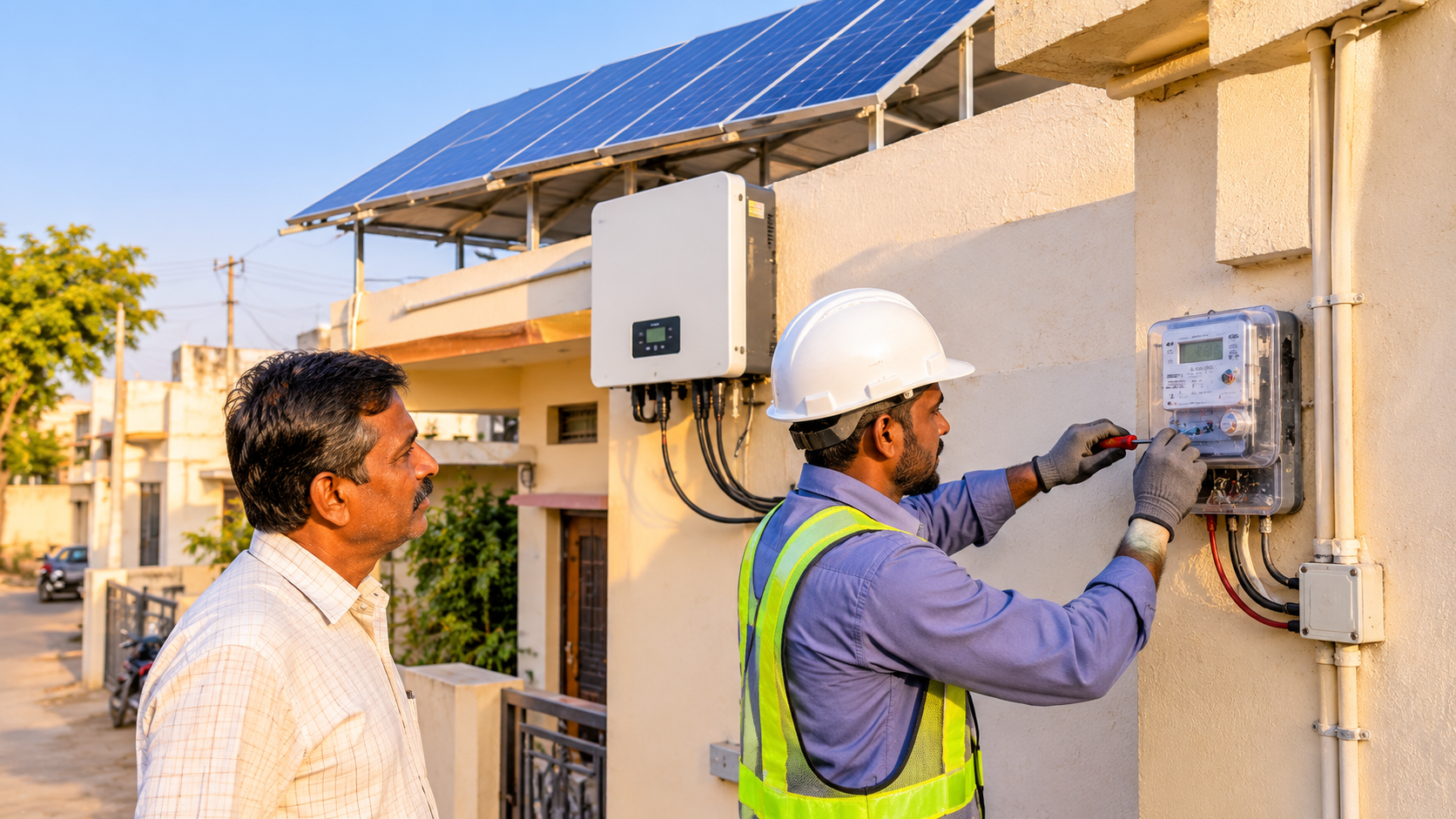
5. Inspect and meter | The DISCOM inspects the plant, installs the net meter and issues a commissioning certificate. |
6. Subsidy | Upload bank details. The subsidy is paid by direct transfer after commissioning. |
Commercial and industrial projects involve more authorities: GEDA for renewable energy registration, the DISCOM for net or gross metering, and the Chief Electrical Inspector (CEIG) for drawing approval and pre-energisation safety inspection. Third-party sources put the total at 8 to 16 weeks including approvals. White Desert's own delivery estimate is typically 30 to 60 days for commercial rooftop projects (50 kW to 1 MW) and 90 to 180 days for ground-mounted plants of 1 to 10 MW. Always ask whether a quoted timeline includes approvals. Documentation mismatches, such as a single-line diagram that does not match the equipment datasheets, can also delay sign-off.
What maintenance does a coastal solar system need?
The best solar service in Mandvi is the one that continues well after the commissioning of photographs. Coastal plants lose output quietly, through salt crust, clogged inverter filters and corroding connectors that nobody checks.
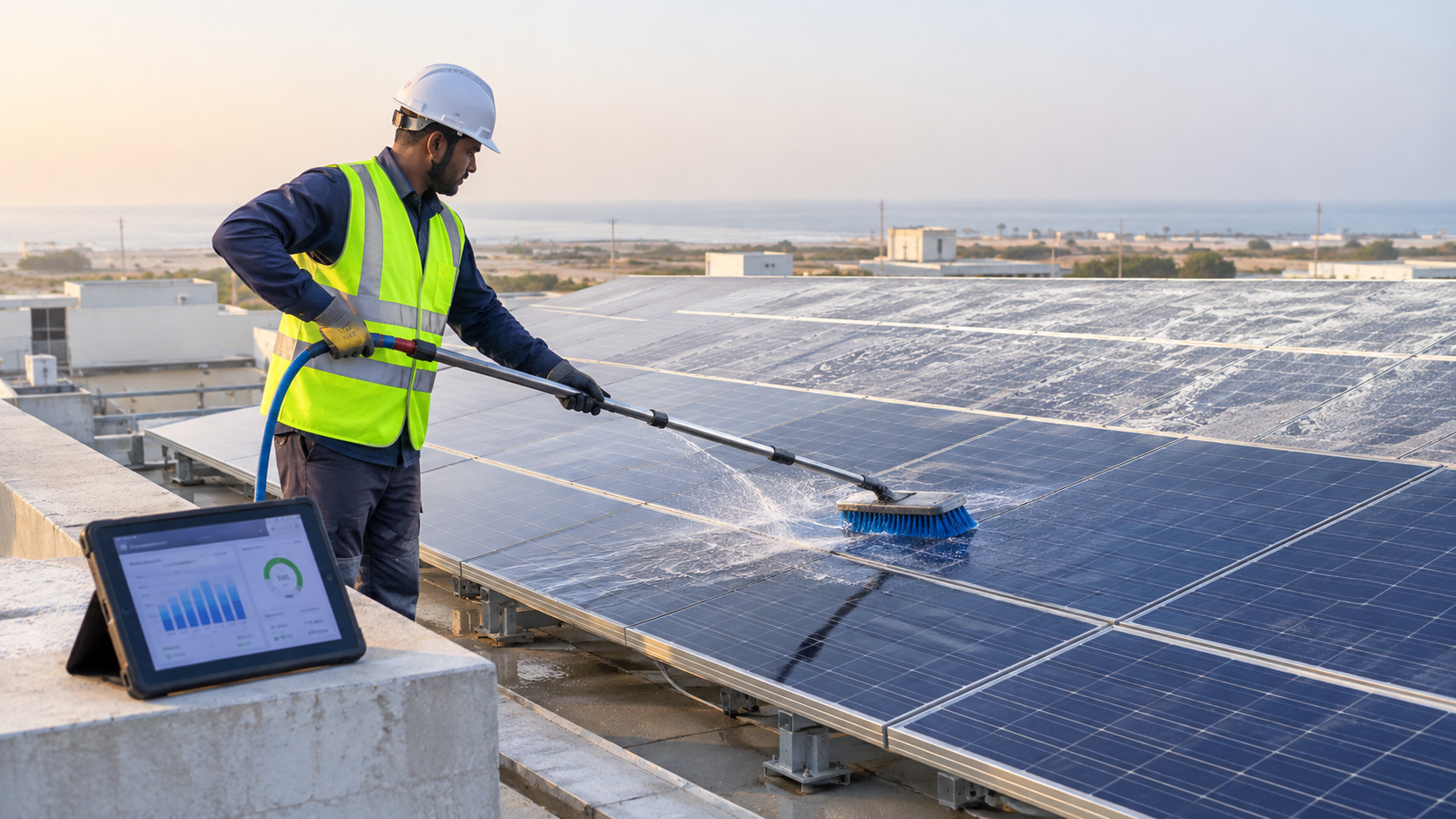
Cleaning: Salt and dust soiling can cut output noticeably. Commonly cited figures are 3 to 10% within a few weeks, and 15 to 25% in dry, dusty belts if neglected. A roughly fortnightly rinse is a sensible starting point near the coast, and more often near the shoreline or after dust storms. Use soft or purified water rather than dry wiping, which can scratch the glass.
Monitoring: Real-time tracking of generation and inverter status, with alerts for underperformance.
Preventive checks: Inspect connectors, earthing, insulation resistance and string currents. Clean inverter filters.
Thermal imaging: An annual infrared scan can reveal hot spots and loose terminations before they cause damage.
Reporting: Monthly actual-versus-expected generation reports and a defined response time for faults.
Budget roughly ₹1,000 to ₹15,000 a year for a small residential system. For commercial rooftops, expect ₹1,000 to ₹2,000 per kW per year, or about 1 to 2% of the original investment. White Desert lists O&M with 24×7 remote monitoring, scheduled cleaning and a 95%+ availability guarantee among its services.
How does White Desert Power Projects work with Mandvi customers?
White Desert Power Projects is a Kutch-based solar EPC company. Its website states that it has operated since 2005, with 20+ years of experience, and that it is MNRE empanelled. It lists in-house crews with no sub-contractors on critical work. Its seven-stage process runs from consultation and site survey (shading analysis, structural review and yield estimate) through engineering design, procurement of MNRE-approved components, installation, commissioning with DISCOM and net-metering coordination, and long-term maintenance. The company also assists with financing and subsidy paperwork under PM Surya Ghar, DREBP and PM-KUSUM.
Its featured projects are elsewhere in Kutch: a 1 MW ground-mounted plant for Shree Ram Kaolin, a 3 MW project for Aditi Packaging, the 300 MW RE Park at Khavda, and a GIPCL solar and battery storage project. White Desert does not currently list a Mandvi installation, so the fair way to evaluate it is the way this guide recommends for anyone. Ask for references, documents and the coastal specifications above in writing, and compare them against other quotes before you decide.
Contact: R.N. Complex, Bhuj–Nakhatrana Highway, Nana Angiya Patiya, Nakhatrana, Gujarat 370675 | +91 78599 82323| Mon to Fri, 9am to 6pm.