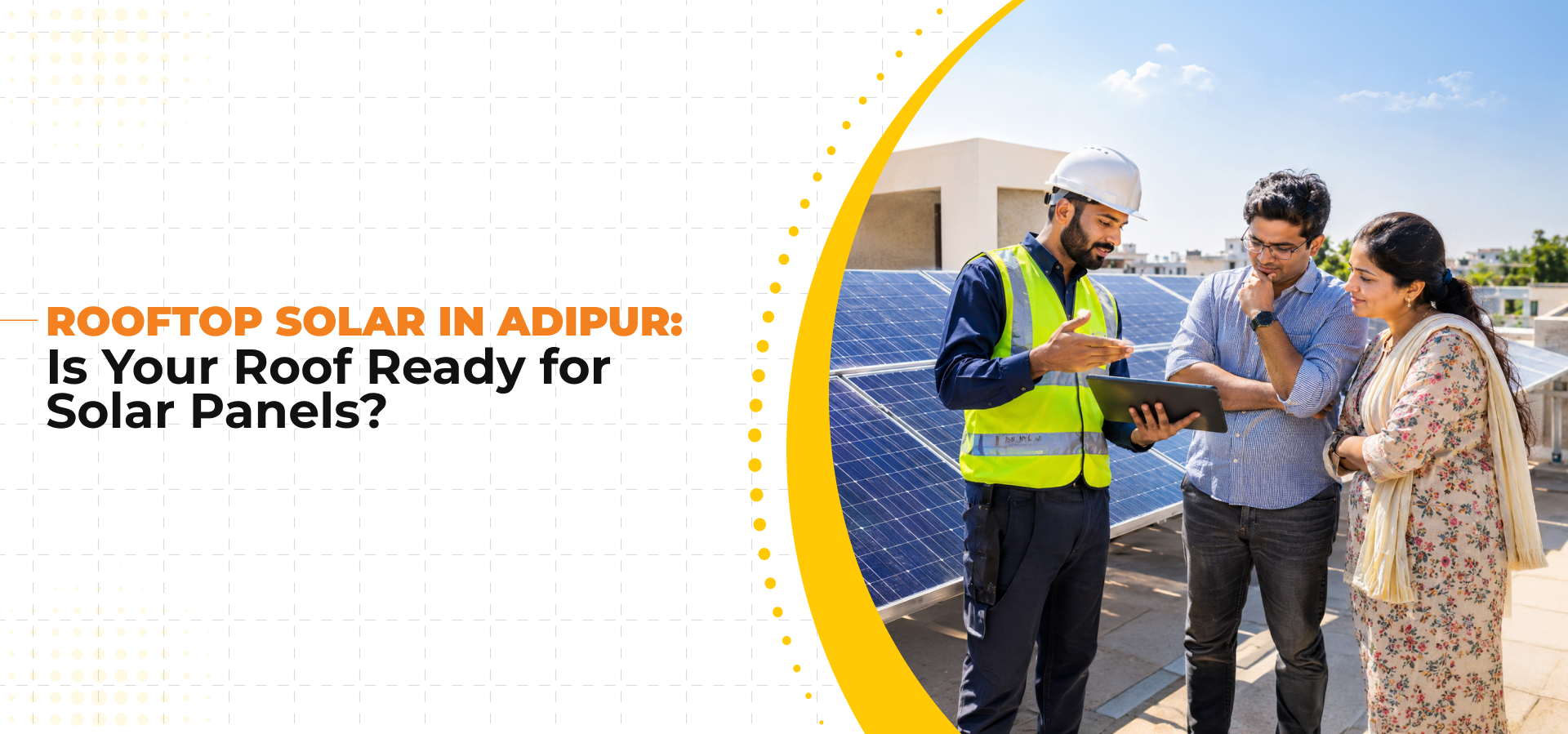
Most people in Adipur start with the wrong question. They ask how many panels they need or what the system will cost. The better question is whether the roof can carry a solar system safely for the next 25 years.
Rooftop solar in Adipur can work very well, but only if the roof, the building and the local conditions are checked before any equipment is ordered. Adipur sits in the Gandhidham–Kandla belt of Kutch. It has strong sunshine, but also salt-laden air, dust, high coastal winds and high seismic risk. A roof that is fine for a water tank may not be ready for panels, rails and a quarter-century of exposure.
This guide covers how to judge your roof, what is specific to Adipur and Gandhidham, what approvals and documents to expect, and what the numbers look like.
Quick answer: is my roof ready for solar?
Your roof is usually ready if it meets most of the following:
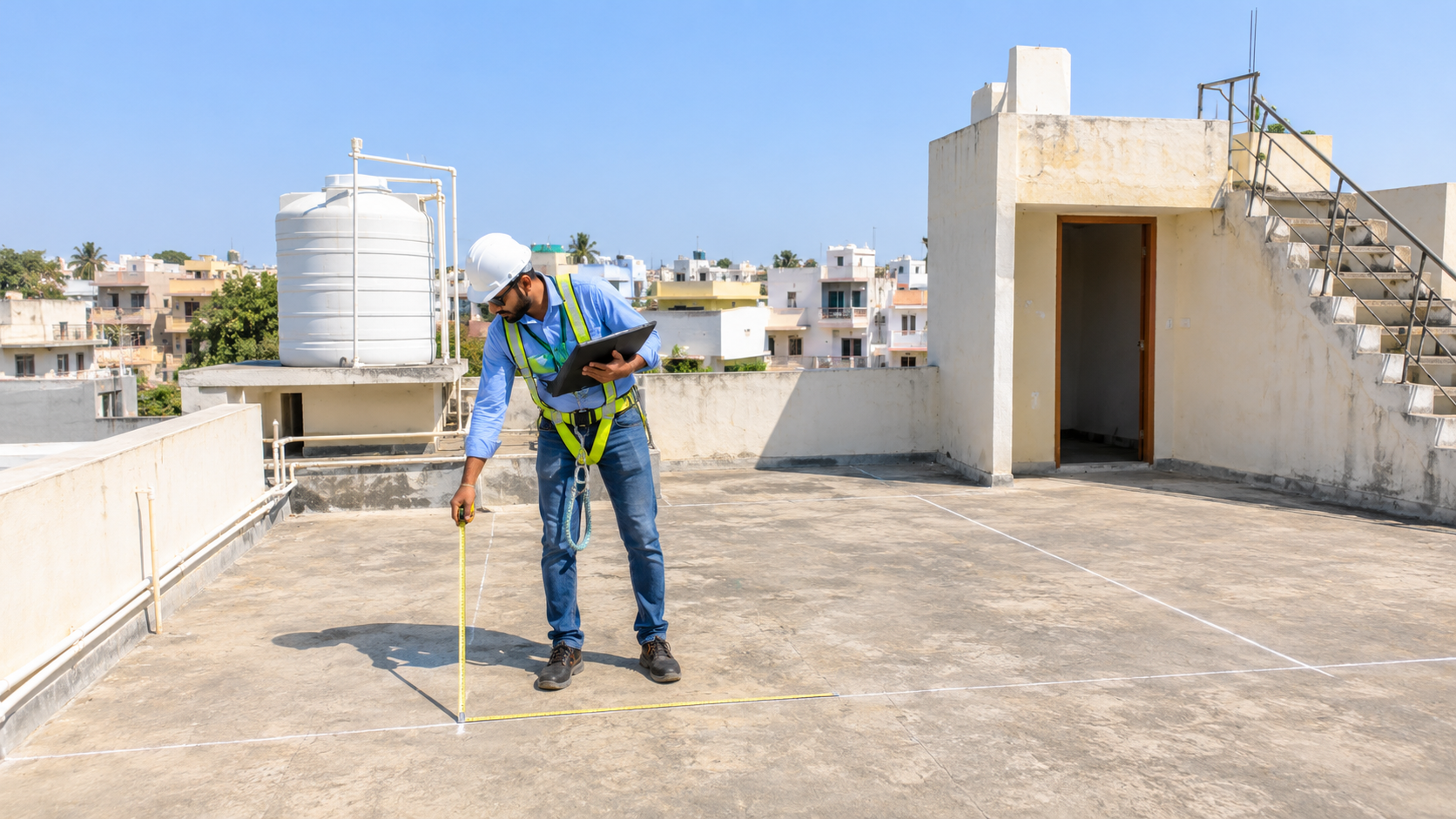
It has roughly 80 to 100 sq. ft. of shadow-free space per kW of solar.
The structure is sound and has 15 to 20 years of useful life left.
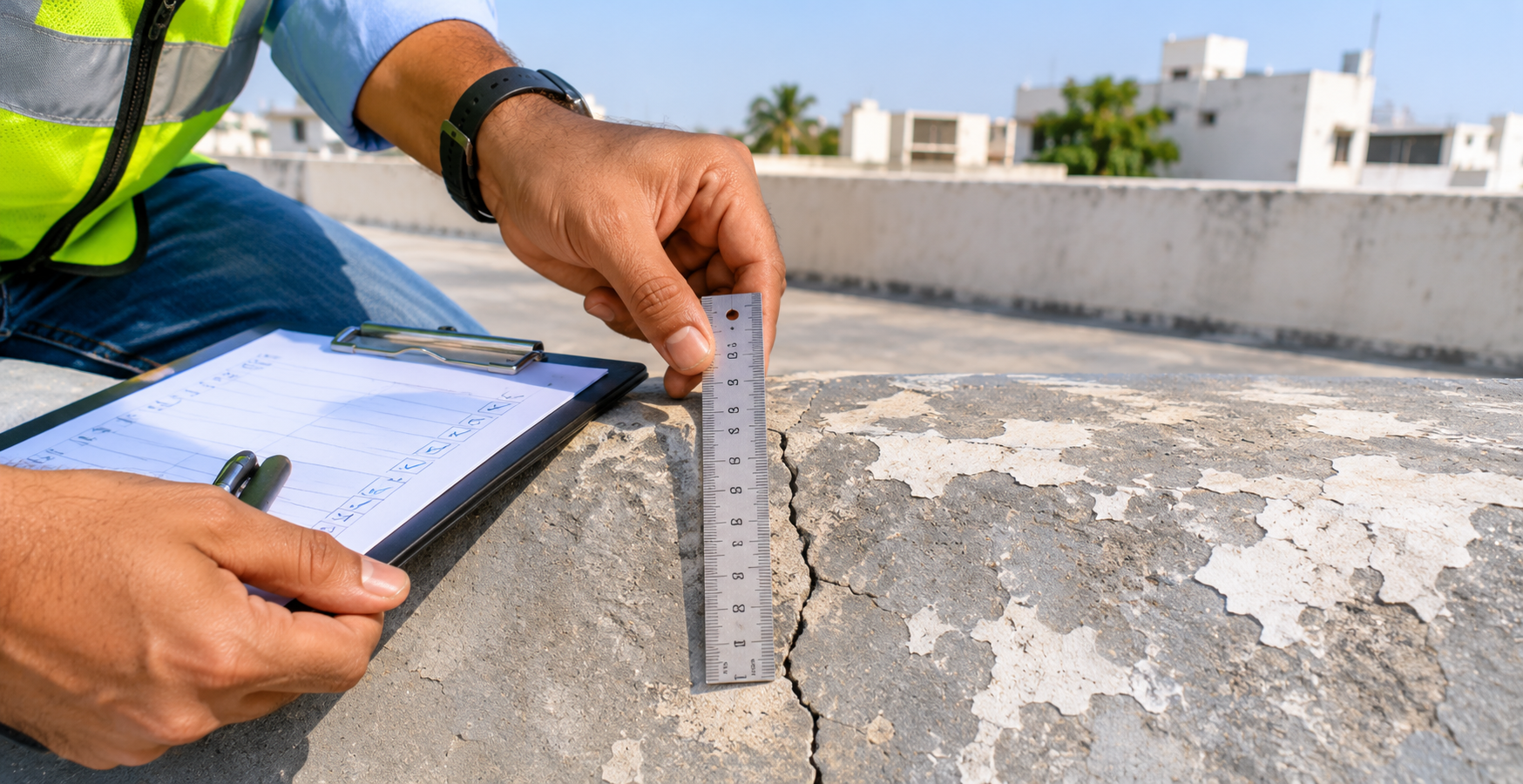
It has no active leaks, major cracks or sagging.
Shade from tanks, staircase rooms, parapets or neighbouring buildings is limited between about 9:00 AM and 4:00 PM.
The mounting design is built for Kutch's wind, salt and dust, not copied from an inland project.
If any of these is uncertain, get a physical roof assessment before you request quotes.
What does "roof-ready" mean for solar panels?
A roof is solar-ready when it can safely support the system's weight, resist wind uplift, stay waterproof, and receive enough unobstructed sunlight. That makes five things worth checking:
Space: enough clear, usable area after allowing for walkways and obstructions
Strength: a structure that can carry the added load, including in wind and earthquakes
Condition: waterproofing, surface cracks and remaining roof life
Sunlight: low shading across the day and across seasons
Environment: materials and coatings that survive salt, dust and heat
Many solar problems come from skipping step 2, 3 or 5 and rushing straight to a quote.
How much roof space does solar need?
A standard system needs about 80 to 100 sq. ft. of shadow-free roof area per kW. The panels themselves take less, around 50 to 60 sq. ft. per kW with modern 540–550 W modules. The rest of the allowance covers:
Row spacing, so panels do not shade each other on winter mornings
Walkways, so panels can be cleaned and serviced
Clearance from parapets, water tanks and staircase structures
System size | Approximate shadow-free area needed |
1 kW | 80–100 sq. ft. |
3 kW | 240–300 sq. ft. |
5 kW | 400–500 sq. ft. |
10 kW | 800–1,000 sq. ft. |
Take a 3 kW home system. In Kutch, a well-maintained system is typically expected to generate about 4 to 4.5 units per kW per day, or roughly 1,450 to 1,650 kWh per kW per year. That works out to about 4,350 to 4,950 units a year for 3 kW. Dust, temperature and shading can move that figure either way.
Commercial and industrial roofs follow a similar rule of thumb. About 10 sq. metres of usable area per kW is a common planning figure, so a 100 kW plant needs roughly 470 sq. metres of roof.
Which roof types work in Adipur?
Roof type | Suitability | What to watch |
Flat RCC slab | Most suitable | Older or degraded slabs need an engineer's sign-off |
GI / colour-coated metal sheet | Good if the structure is sound | Purlins and trusses must carry the added load; clamp-based mounting avoids drilling the sheet |
PEB industrial shed | Good with engineering | Wind uplift often governs the design more than weight |
Tiled roof | Possible but complex | Tiles crack under pressure; fixings must anchor into the rafters |
Asbestos cement sheet | Problematic | Brittle and hazardous to drill; usually needs replacement or an independent frame |
Most homes in Adipur are RCC buildings, so a flat terrace is common. The typical questions are how old the slab is and how much usable space the water tank, staircase room and parapet leave. Industrial and warehouse owners should pay more attention to purlin spacing, sheet condition and wind uplift.
How old can a roof be before it needs repair?
Solar panels are designed to last 25 to 30 years, so the roof underneath should ideally have 15 to 20 years of life remaining. Removing and reinstalling a system to repair the roof is expensive. A roof that is close to the end of its life is better repaired or re-waterproofed first.
Fix these before installation:
Active or past leaks and water stains
Surface cracks wider than 2–3 mm
Concrete spalling or exposed rebar
Bubbling or failing waterproofing
Sagging areas or corroded roof sheets
When do you need a structural check?
Weight itself is rarely the biggest concern. A flush-mounted system on a flat RCC roof adds roughly 15 to 25 kg per sq. metre, including panels and mounting structure. Ballasted or high-wind designs can weigh more.
A formal structural assessment or engineer's sign-off is advisable if:
The building or slab is 20 to 25 years old, or its reinforcement history is unknown
The slab is thinner than a typical 100 mm residential slab
The roof is tiled, asbestos or a non-standard industrial shed
The system is larger than about 10 kW
The array will be ballasted instead of anchored
The terrace shows visible cracks, seepage or exposed steel
The site is exposed to high coastal winds
This matters more in Adipur than in many Indian cities. Kutch is in Seismic Zone V, the highest in India, and its coastal location brings strong winds. Any solar panel in Adipur has to be fixed so that it stays in place in a storm and does not overload the structure in an earthquake.
How do you check for shading?
Shade can cut yield sharply. Unmanaged shading can reduce annual output by 30% to 50%, and any panel that gets less than about five hours of direct sunlight a day contributes little.
A simple home check:
Stand where the panels would go at 9:00 AM, 12:00 PM and 3:00 PM.
Note shadows from neighbouring buildings, trees, water tanks, staircase rooms and parapets.
Take a photo from the same spot at each time.
If you check in summer, mentally lengthen the shadows by 40% to 60% to account for the low winter sun.
Professionals go further with 3D shading models and sun-path tools. A good installer will show you the shading analysis, not just say "no shade."
What is the best tilt and direction in Kutch?
The ideal fixed tilt for Kutch is roughly 22° to 24°, facing true south. East- or west-facing roofs can still work. A deviation of up to about 30° off south costs only around 1% to 3% of annual energy, but north-facing placement should be avoided.
There is a trade-off. Higher tilts shed dust better and generate slightly more energy, but they catch more wind. In high-wind coastal conditions, designers often choose lower tilts of about 10° to 15° on flat concrete roofs to reduce uplift. The right answer depends on the building and the wind-load calculation, not on a single number.
Why does Adipur need a different roof checklist?
Three local factors shape the design: salt, dust and wind. IS 875 (Part 3) is the Indian standard for wind loads, and its map places Kutch in the 44 to 50 m/s basic wind-speed bands depending on how close the site is to the coast. Exact design wind speed depends on location, height and terrain, so it should be calculated for each building.
Local factor | What it does | What good design looks like |
Salt-laden air (near Gandhidham and Kandla) | Speeds up corrosion of frames, brackets and bolts and leaves salt crusts on glass | Hot-dip galvanised or anodised aluminium structures; A4/SS 316 stainless fasteners; salt-mist-tested modules |
Dust | Soils panels and cuts output | Reasonable tilt for runoff, planned cleaning access, water points on the roof |
High winds and cyclone exposure | Creates uplift and edge suction | Wind-load design to IS 875, proper anchoring into purlins or structure, wind deflectors where needed |
Heat | Expands and contracts metal roofs | Fixing methods that allow movement and do not tear sheets |
Seismic Zone V | Stresses structure and connections | Engineer-certified mounting and structural stability |
The hardware choices are where cheap quotes often cut corners. In a coastal environment, the stronger specification typically includes:
Hot-dip galvanised steel to ISO 1461, or marine-grade aluminium for the mounting structure
A4 / SS 316 stainless steel bolts and clamps, with isolating gaskets between dissimilar metals
Modules tested for salt-mist resistance (IEC 61701)
Inverters rated IP66 or higher, kept in sheltered, ventilated spots
Deep earthing, which matters because coastal soil is saline
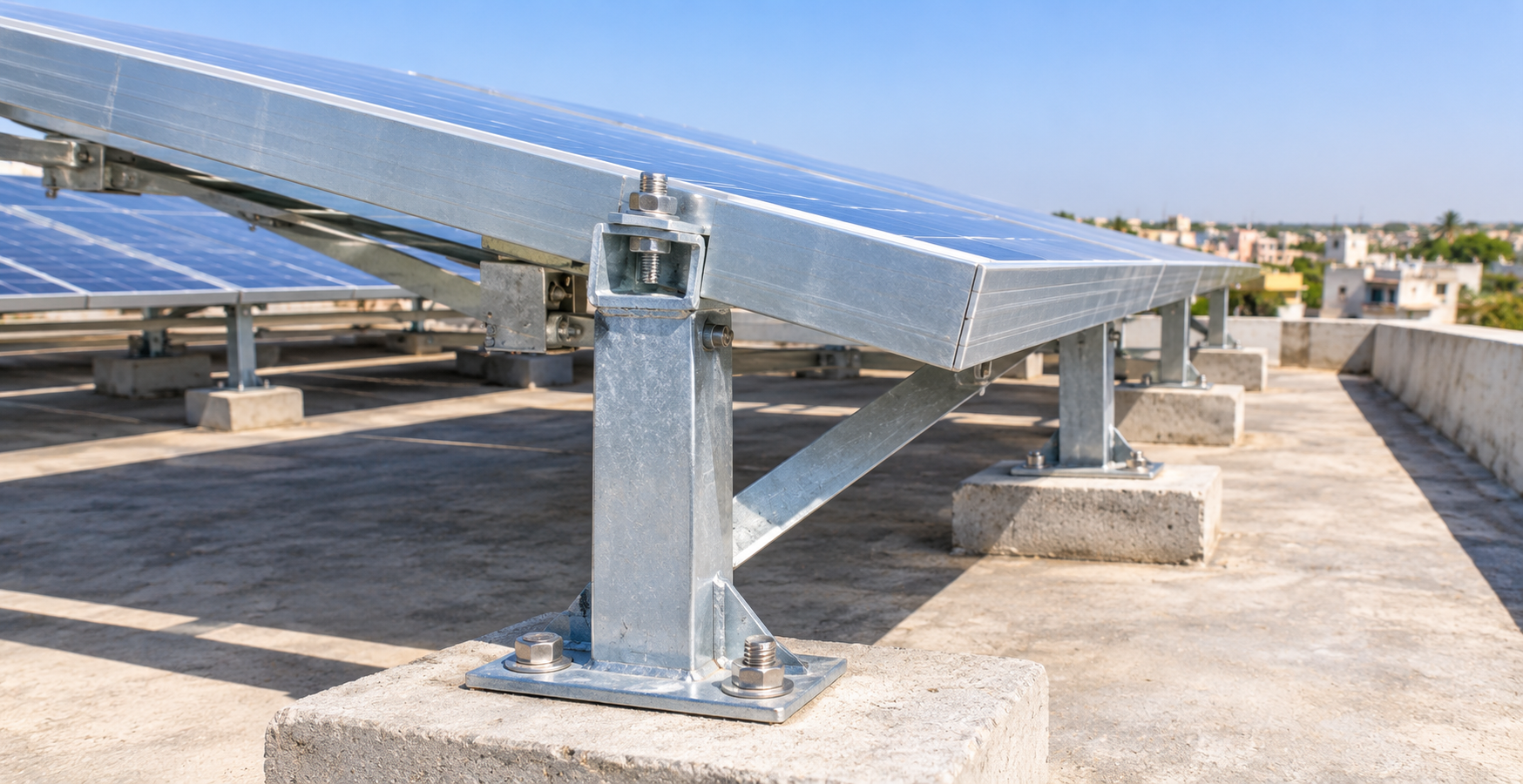
What building types are common in Adipur, and what limits do they have?
Building type | Typical construction | Key roof considerations |
RCC homes and apartments | Cast-in-place RCC frames with block infill | Seismic load limits; salt attack on concrete; slab age and waterproofing |
Industrial sheds | Steel trusses or pre-engineered buildings (PEB) | Wind uplift; sheet and purlin condition; equipment loads |
Warehouses and logistics hubs | Large-span PEB steel structures | Purlin spacing; slope and drainage; capacity for added load |
For metal sheds in particular, plain galvanised sheets rust quickly in coastal conditions. Premium Galvalume or colour-coated sheets last longer and make better solar bases. Standing-seam roofs often work better than exposed-fastener sheets because clamp-based mounting avoids punching new holes.
How do professionals assess a roof before installing solar?
A proper assessment covers space, structure, shading, electrical load and expected yield. White Desert Power Projects, a Kutch-based solar EPC company, describes its process as consultation, site survey with shading analysis and structural review, engineering design, procurement, installation, commissioning with DISCOM coordination, and ongoing maintenance.
A solar company in Adipur should always visit the roof before quoting. A quote based only on a satellite image or a phone call can miss tanks, cracks, shade and structural limits.
At the survey, expect questions or checks on:
Roof type, age and waterproofing condition
Measured usable area and obstructions
Shading at different times of day
Your electricity bill and load profile
Structural condition and, if needed, an engineer's sign-off
Where the inverter, earthing and cable routes will go
How do you choose the right installer in Adipur?
People searching for the best solar company in Adipur are really asking a more practical question: who can I trust with my roof for 25 years? No ranking replaces checking documents, so judge installers on what they show you.
The best solar rooftop company in Adipur for your building will be the one that inspects your roof, explains the structure and wind design in plain language, and gives you a written scope. If a quote does not name the panel, inverter, structure material, fastener grade and warranty terms, ask for them.
If you are comparing the best solar EPC company in Adipur, remember that EPC stands for Engineering, Procurement and Construction. It means one party designs the system, sources the components and builds it. Ask who actually does the critical work on your roof and who handles DISCOM coordination.
A top solar company in Adipur should be able to show:
Equipment datasheets and certificates (panels, inverters)
MNRE empanelment and DISCOM approval status, where applicable
A structural or wind-load basis for the mounting design
The warranty terms for panels, inverter and workmanship
A clear process for net metering and subsidy paperwork
White Desert lists MNRE empanelment, in-house installation crews, subsidy and financing assistance and operations and maintenance among its services. As with any installer, verify the documents relevant to your project before you sign.
What approvals and paperwork should Adipur owners expect?
Adipur and Gandhidham are served by PGVCL (Paschim Gujarat Vij Company Limited). A typical solar installation in Adipur follows the Gujarat DISCOM process below.
Step | What happens | Typical time |
1. Registration | Register on the PM Surya Ghar portal with your DISCOM and consumer number | 1–2 days |
2. Technical feasibility | DISCOM reviews documents; systems up to 10 kW are generally treated as quickly feasible | 7–15 days |
3. Installation | Vendor installs structure, panels, inverter and wiring (residential, up to 10 kW) | 1–3 days |
4. Inspection | Completion documents submitted; DISCOM engineer inspects | 7–15 days |
5. Net meter and commissioning | Bi-directional meter fitted; system energised | About 1–2 weeks (overlaps with step 4) |
6. Subsidy payout | Subsidy credited to your bank account via DBT | About 30 days after commissioning |
End to end, the typical residential journey is about one to two months. White Desert's website indicates 30 to 60 days for commercial rooftop projects between 50 kW and 1 MW, depending on approvals and equipment.
Documents commonly required for a residential application:
Aadhaar card and an Aadhaar-linked mobile number
Latest electricity bill (within the last 90 days)
Property ownership proof, such as a sale deed or house tax receipt
Cancelled cheque or bank proof
PAN card
Passport-size photograph
Local property checks. Much of Adipur's land is leasehold land from the Sindhu Resettlement Corporation (SRC), and building rules fall under the Gandhidham Development Authority and the local civic body. These approvals are mainly required for property transfers and construction changes, not as solar-specific requirements. Still, if you live in a co-operative society, get its NOC before putting equipment on the roof. Ask your installer which ownership documents your DISCOM application needs. Port or SEZ clearances apply only to industrial users located within port-trust land or SEZ boundaries.
What does rooftop solar cost, and what subsidies apply?
These are indicative 2026 market ranges for on-grid residential systems in Gujarat, including panels, inverter, structure and installation. Actual quotes vary by brand, roof type and site.
System size | Typical price before subsidy | Central PM Surya Ghar subsidy | Typical net price |
1 kW | ₹55,000–₹75,000 | ₹30,000 | ₹25,000–₹45,000 |
2 kW | ₹1,10,000–₹1,40,000 | ₹60,000 | ₹50,000–₹80,000 |
3 kW | ₹1,65,000–₹2,10,000 | ₹78,000 | ₹87,000–₹1,32,000 |
5 kW | ₹2,50,000–₹3,30,000 | ₹78,000 (cap) | ₹1,70,000–₹2,52,000 |
Gujarat's new state top-up. In October 2026, Gujarat announced an additional state subsidy for residential systems up to 2.18 kWp. Reported conditions:
It applies to systems commissioned on or after 22 October 2026.
General-category households pay about 10% of the benchmark cost, and SC/ST households about 5%.
The system must be grid-connected with net metering, funded by the consumer (capex mode), and use domestically manufactured modules as per DCR rules.
Households taking this benefit are reported to be barred from adding more rooftop capacity for three years.
Because the top-up applies only up to 2.18 kWp, it can change the best system size. A household with limited space may find the small subsidised system attractive. A larger home with high bills may still prefer 3 kW or more under the central subsidy. Confirm the exact amounts on the official portal or with your DISCOM before you decide.
Payback. Estimates vary by tariff, system size and tax treatment. Subsidised residential systems are commonly estimated at roughly 2 to 5 years. Commercial and industrial systems are commonly quoted at roughly 3 to 5 years, helped by higher tariffs and tax benefits such as accelerated depreciation. Treat these as ranges, not promises.
Residential, commercial and industrial: how do roof needs differ?
Residential solar in Adipur is usually a question of terrace space, slab condition and shade from tanks and staircase rooms. Homes mostly choose systems of 1 to 5 kW, and the main decisions are system size, subsidy route and roof preparation. Small systems up to 2.18 kWp may qualify for the state top-up, while 3 kW and above receive the central cap of ₹78,000.
Commercial solar in Adipur, for shops, offices, schools, hospitals and similar buildings, depends more on daytime load. Businesses with high weekday consumption can offset a large share of their bill. Commercial roofs often have more equipment, such as air-conditioning units and tanks, so layout planning matters. Commercial users also benefit from GST input credit and accelerated depreciation on solar equipment. A tax adviser should confirm what applies to your entity.
Industrial solar in Adipur is shaped by shed construction, wind uplift and the load profile of the plant. Metal-shed roofs depend on the age and gauge of sheets, purlin spacing and corrosion condition. Gujarat's policy permits rooftop net metering from 1 kW up to 1 MW, and cross-subsidy and additional surcharges do not apply to captive self-consumption. Industrial and commercial users face different settlement and banking terms from residential ones, so ask your installer to explain them in writing.
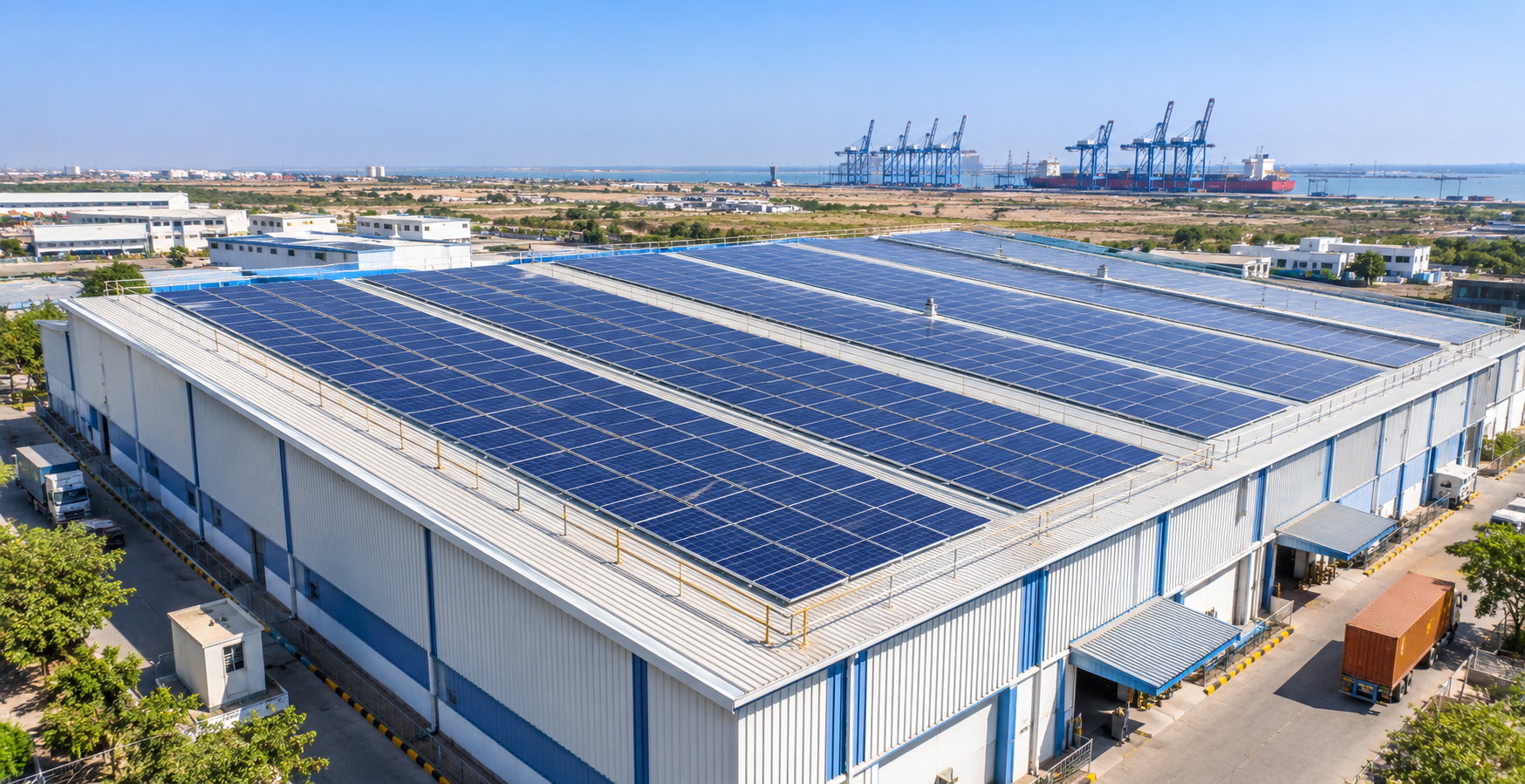
Rooftop or ground-mounted: which suits an industrial site?
Factor | Rooftop on metal shed | Ground-mounted |
Land need | None | Needs spare land |
Upfront cost | Usually lower | Roughly 20–25% higher by one estimate |
Energy yield | Limited by roof slope and orientation | Free to use optimal tilt; often 8–12% more |
Maintenance | Work at height | Easier ground-level access |
Main risk | Roof condition, wind uplift | Land use and civil approvals |
Best when | Shed passes a structural and wind check | Roof is old, weak or shaded, or more capacity is needed |
If the structural audit fails, ground-mounted or a mix of both can be the safer choice.
How do you maintain panels in Adipur's dust and salt?
Maintenance protects the output you paid for. The best solar service in Adipur is not the one that installs fastest. It is the one that also supports the system through years of dust and salt. Ask what the service includes: cleaning schedule, monitoring, inspections and response time when output drops.
Cleaning guidance for dusty and coastal areas of Gujarat:
Clean roughly every 2 to 6 weeks, depending on dust, salt buildup and season.
Clean early in the morning or after sunset. Cold water on hot glass can crack modules.
Use soft brushes or microfibre cloths with clean water. Avoid high-pressure washers and harsh chemicals.
Heavy rain helps in the monsoon, but a post-monsoon wash removes mud streaks.
Watch your inverter or app. A sudden 8% to 10% drop is a good signal to clean.
Have connectors, earthing and bolt torque inspected periodically, as salt air attacks these first.
Your pre-installation roof readiness checklist
Measure shadow-free area: about 80–100 sq. ft. per kW
Check roof age and waterproofing; fix leaks and cracks first
Get a structural opinion for old, thin or non-standard roofs
Photograph shade at 9 AM, 12 PM and 3 PM
Ask for coastal-grade materials: HDG or aluminium structure, A4/SS 316 fasteners
Confirm wind-load basis and anchoring method
Check society NOC and ownership papers
Understand the subsidy route for your system size
Ask for a written scope with warranty and maintenance terms
Final word
A roof is ready for solar when it has space, strength, condition and sunlight, and when the design respects Adipur's wind, salt and seismic conditions. A short physical assessment costs little compared with the cost of a system installed on the wrong roof. If you want a roof reviewed, you can request a site survey from White Desert Power Projects through the contact details on its website.