

Gandhidham's warehouses, godowns and factories sit under large, mostly unshaded roofs, which makes them good candidates for solar. But a big roof is not the same as a solar-ready roof. A sheet-metal shed that is ten years old and already leaking, a purlin layout that was never designed for extra load, or a factory that runs only one shift can each change the answer.
Industrial solar in Gandhidham works best when four things line up: a roof that can carry the system for 25 years, a design that survives salt air and cyclone-grade wind, a daytime load that uses the power, and a clean grid approval through PGVCL. This guide takes you through each, with indicative costs, timelines and the regulatory position as it stands in October 2026, so you can judge your own roof before you ask anyone for a quote.
Is my warehouse or factory roof ready for solar? (Quick answer)
A roof is generally ready for solar when it meets five conditions:
Structure: a structural engineer confirms the purlins, trusses or slab can carry roughly 10–25 kg/m² of added dead load, plus wind uplift.
Age and condition: the roof has enough remaining life to match the panels' 25-year performance warranty, or it is repaired and waterproofed first.
Material: it is a roof type with a proven mounting method, such as trapezoidal or standing-seam metal sheet, or RCC.
Shading and space: enough clear area, about 500–700 m² per 100 kW, away from tanks, vents and parapet shadows.
Load profile: the building uses a good share of its power in daylight hours.
If one of these fails, the project is usually fixable with repairs or a different mounting approach. It is still better to find that out before ordering equipment.
What makes Gandhidham different from an inland site?
Gandhidham sits in Kutch, close to the coast, and that shapes both the energy yield and the engineering. Anyone comparing solar panel Gandhidham options should look past module wattage and ask how the whole system handles these local conditions.
Factor | Indicative figure or condition | Why it matters |
Solar irradiation | About 5.5 kWh/m² per day | Strong, consistent yield for most of the year |
Typical generation | About 4.2 kWh per kW per day, roughly 1,500 kWh per kW per year | Used for sizing and savings estimates |
Coastal air | Salt-laden, humid | Faster corrosion of structures, fasteners and connectors |
Wind | Gujarat is a high-wind zone; coastal and cyclone-prone sites need higher design values | Uplift forces on large roofs |
Dust | Dry, dusty conditions through much of the year | Soiling losses if panels are not cleaned |
Generation figures are regional estimates from published solar guides. Your own yield depends on layout, shading and system losses, so ask for a site-specific estimate.
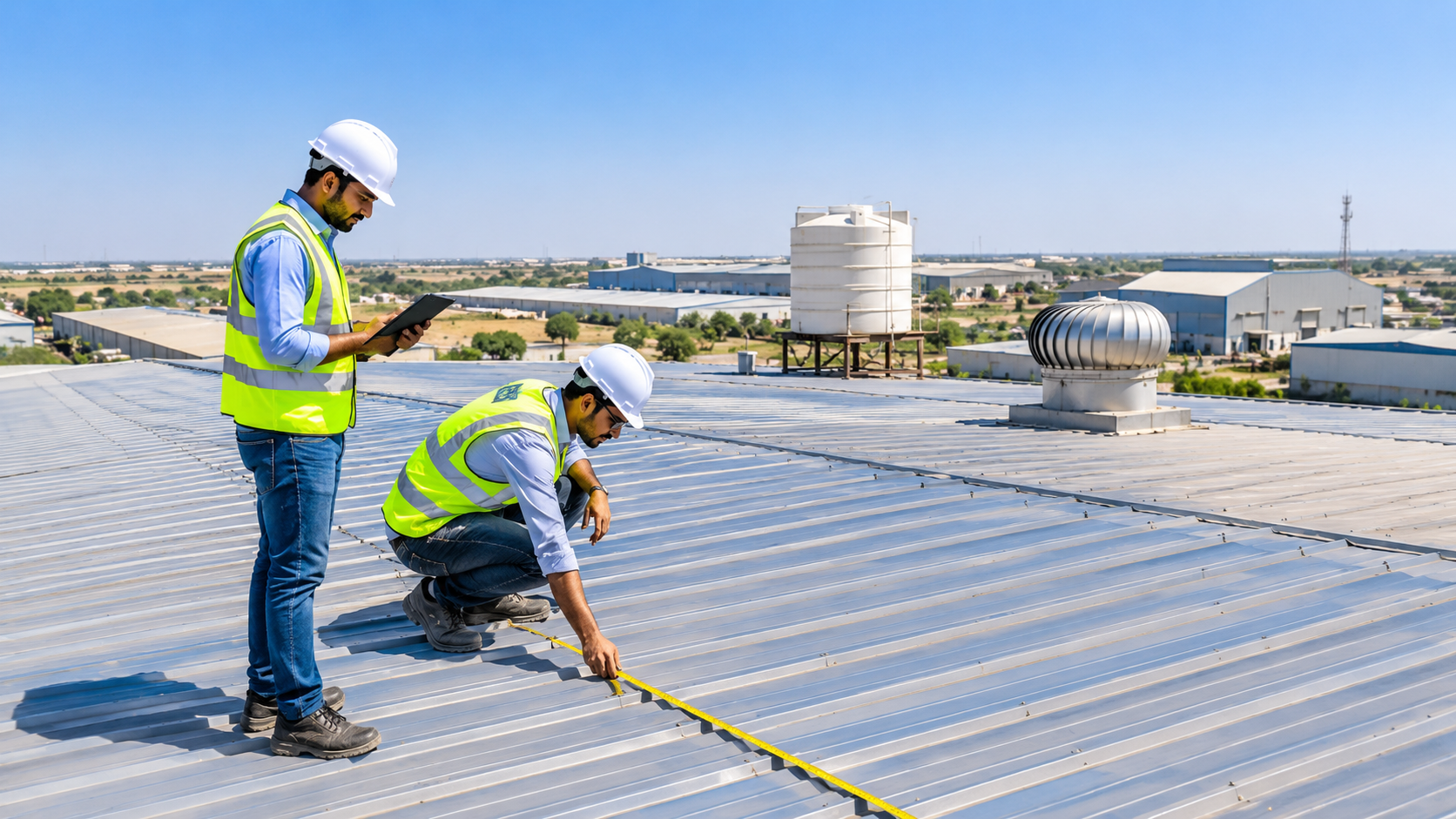
How do you check whether a roof can carry solar?
Treating rooftop solar in Gandhidham as a simple bolt-on job is the most common mistake. The roof is the foundation of the system, and these checks come before any design.
1. Roof load capacity
Panels and mounting structures add permanent weight. Published guidance puts the added dead load at about 10–15 kg/m² for flush-mounted systems on metal roofs and about 18–25 kg/m² or more for ballasted systems on flat concrete roofs. A 100 kW system needs roughly 500–700 m² of roof, depending on whether panels lie flat on the roof or are tilted.
A visual inspection is not enough. A licensed structural engineer should review the original drawings, purlin spacing, truss or slab strength and wind-load calculations. For Indian buildings this normally refers to the IS 875 wind-load standard. Industry guidance puts the cost of an industrial structural assessment at about ₹15,000–₹50,000, depending on building size and complexity. That is small compared with the cost of discovering a problem after installation.
2. Roof age and remaining life
Panels are warranted for 25 years or more. If your roof has only five to ten years left, you will pay to remove and refit the array when the roof is replaced. Either replace or restore the roof first, or choose an elevated structure that keeps the roof accessible. Look at leak history, ponding areas and past repairs, and fix waterproofing, gutters and structural defects before mounting.
3. Roof material and mounting method
Roof type | Common mounting approach | Points to check |
Standing-seam metal | Non-penetrating seam clamps | Lowest leak risk; confirm seam profile compatibility |
Trapezoidal or corrugated metal sheet | Rails fixed with self-drilling screws and EPDM seals, or purlin-tied rails | Workmanship and sealing quality drive long-term water resistance |
Sandwich or insulated panels | Fasteners tied into the steel purlins, not just the outer skin | Do not rely on the thin outer sheet alone |
RCC slab | Low-tilt or elevated frames anchored to the slab, or ballast where permitted | Anchoring and waterproofing around fixings; cyclone zones favour mechanical anchoring over ballast alone |
Asbestos-cement or brittle sheets | Generally unsuitable for direct mounting | Usually needs replacement or a separate elevated structure first |
4. Shading and obstructions
Water tanks, ventilators, parapets, skylights and neighbouring structures all cast shadows. With string inverters, shading on part of a panel can pull down the output of the whole string, so a shadow audit belongs in every site survey. Module-level electronics or split-cell modules can limit the damage where some shading is unavoidable.
How should a system be designed for salt air and cyclone-grade wind?
Salt corrosion and wind uplift are the two local risks that cheap quotes most often ignore. Ask any bidder to state these specifications in writing:
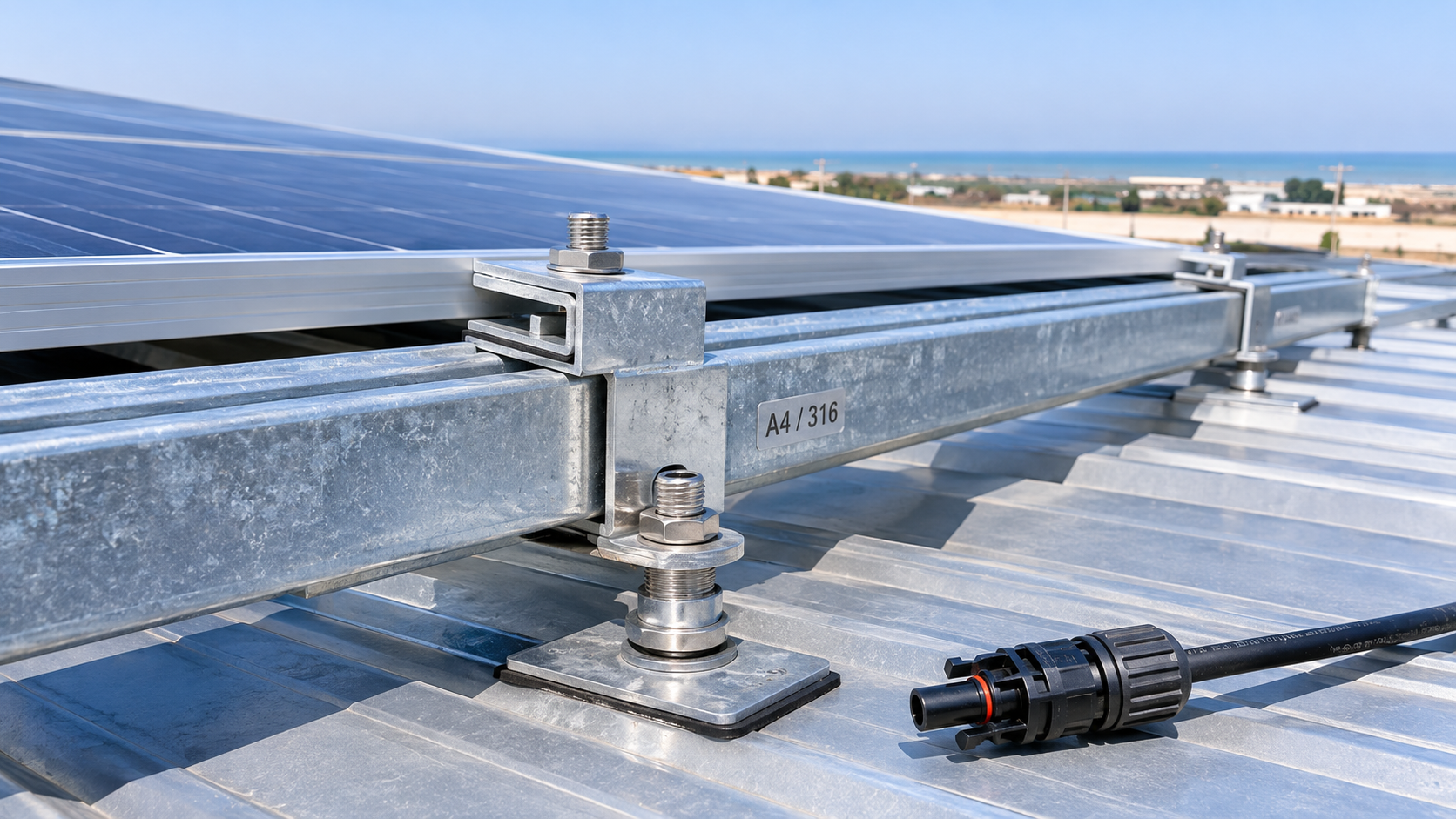
Galvanised steel structures: hot-dip galvanising to Indian or ISO standards (IS 4759 or ISO 1461). Some guidance suggests heavier coatings for coastal Kutch than for inland sites, so ask for the zinc coating thickness to be specified.
Fasteners: stainless steel grade 316 is generally preferred over 304 near the coast because it resists chloride pitting better.
Modules: panels tested for salt-mist resistance (IEC 61701) and sealed junction boxes rated IP65 or higher.
Connectors and cabling: sealed, UV-resistant connectors and cables routed in conduit.
Wind design: structures calculated to IS 875 (Part 3) for your specific site, with direct anchoring to primary structural members rather than relying on friction or ballast alone.
Does your electricity use match solar generation?
Solar generates mostly between about 10 a.m. and 4 p.m. A warehouse or factory that runs through the day uses most of that power on site, and each unit used on site replaces a unit bought from the grid. That is where the savings are largest.
Size the system on your actual hourly or shift-wise consumption, not a monthly average. A single-shift unit may need a smaller array than its monthly bill suggests, or a plan for exporting the surplus through net metering. Warehouses with cold rooms, packaging lines or day-shift processing tend to be strong fits. Units that run mainly at night will see less direct benefit.
Battery storage is a separate question. Published guidance says a battery rarely pays for itself on energy shifting alone. It makes more sense when several drivers overlap: high peak-demand charges, time-of-day tariff differences, expensive diesel generator use, or a regulatory requirement. Check your own tariff structure before adding storage.
What approvals do you need in Gandhidham?
Any solar installation Gandhidham business plan starts with the grid. Gandhidham is served by PGVCL, and approvals generally involve four bodies:
GEDA (Gujarat Energy Development Agency): online project registration and commissioning verification.
PGVCL: technical feasibility check of the transformer and feeder, interconnection consent and the bidirectional meter.
CEIG (Chief Electrical Inspector): drawing approval and a pre-commissioning safety inspection, especially for HT and larger industrial systems.
Local clearances: a structural stability certificate, plus fire or industrial estate permissions where applicable.
What are the net metering limits?
Under the GERC framework, net metering is generally available from 1 kW up to 1 MW. Larger systems typically move to gross metering, open access or captive arrangements. Group net metering and virtual net metering exist as separate options, with virtual net metering reported at up to 4 MW.
On sizing against your sanctioned load, sources differ. Some say the Gujarat Solar Policy removed capacity ceilings tied to contract demand, while others cite a 100% of contract demand limit. Ask PGVCL or your EPC to confirm the position for your connection before you finalise the design.
What is changing under the 2026 draft regulations?
GERC has a draft Grid Interactive Distributed Renewable Energy Sources (DRES) Regulations, 2026, dated May 2026, with a public hearing held in June 2026. As of the latest reports I could find, it had not been formally notified, so the existing framework still applies until notification. If adopted as drafted, reported changes include:
Proposed change | What it would mean |
Group net metering up to 1 MW | One site's surplus can offset multiple connections of the same consumer category |
Virtual net metering up to 4 MW | Larger systems credited across participating accounts, with applicable charges |
Limits on offsetting for non-residential users | Reported cap of about 30% of energy drawn per billing period |
Battery storage requirement | For consumers above 100 kW whose capacity exceeds contract demand, storage sized for part of the excess |
These are draft proposals, not current rules. If you are planning a large system, ask your EPC how it would hold up under both the current and the draft framework.
How long does approval take?
Industry guides put technical feasibility at roughly 10–15 days and the full net-metering process for industrial or HT connections at about 35–60 days or more, depending on CEIG scheduling, feeder checks and documentation quality. Incomplete paperwork is the most common cause of delay.
What does industrial rooftop solar cost, and how fast does it pay back?
Warehouses, cold storage and offices fall under commercial solar in Gandhidham, and the same cost logic applies to them as to factories. Published 2026 indicative figures for Gujarat look like this:
System size | Cost per kW (indicative) | Total project cost (indicative) |
100 kW | ₹40,000–₹48,000 | ₹40–48 lakh |
500 kW | ₹36,000–₹42,000 | ₹1.80–2.10 crore |
1 MW | ₹35,000–₹42,000 | ₹3.5–4.2 crore |
These are market estimates, not quotes. The final price depends on the scope (approvals, structural strengthening, monitoring), module and inverter tier, HT or LT integration, and any transformer work. When comparing quotes, check that each bidder includes the same scope.
A simple worked example
Using the regional estimate of about 1,533 kWh per kW per year, a 100 kW system might generate about 153,000 kWh a year. If all of it is used on site and replaces grid power costing ₹8–₹10 per unit, the yearly saving is roughly ₹12–15 lakh. Against a ₹40–48 lakh cost, that implies a simple payback of about 3 to 4 years before tax benefits, maintenance and panel degradation. This is an illustration, not a forecast. Your tariff, self-consumption share and system quality will move the result.
Published estimates for industrial rooftop solar in Gujarat commonly range from about 3 to 5 years simple payback. Effective industrial tariffs are often quoted at about ₹7.5–₹11 per unit once demand charges and other components are included, so check your own bill.
Tax, GST and incentives
Accelerated depreciation: sources indicate 40% first-year depreciation is available for solar power systems, subject to rules such as the 180-day usage condition. Confirm with your chartered accountant.
GST: solar modules are reported at 5%. Turnkey EPC contracts are commonly treated as a composite supply, with an effective rate reported at around 8.9%. Confirm the treatment for your contract with a tax advisor.
Subsidy: commercial and industrial rooftop systems do not receive the PM Surya Ghar subsidy, which is for homes.
State industrial policy: the Viksit Gujarat Industrial Policy 2026 offers capital and interest support to eligible MSME investment. Whether a solar plant counts as eligible investment, and which taluka category you fall in, should be checked before you plan around it. Its power-tariff support is reported to exclude captive power.
How can you pay for it?
Model | How it works | Trade-off |
CAPEX | You fund and own the plant, with your own money or a bank or MSME loan | Highest lifetime returns and tax benefits, but needs capital |
RESCO or OPEX | A developer installs and owns the plant; you buy power under a long-term agreement | No upfront cost, but lower lifetime savings and a 15–25 year contract |
Loan rates and MSME schemes change, so verify current terms with your bank before relying on published ranges.
What does the installation process look like?
A well-run project follows a clear sequence:
Consultation and load analysis
Site survey with shading analysis, structural review and yield estimate
Engineering design, single-line diagrams and layout drawings
Procurement of panels, inverters and balance of system
Installation of structures, modules and electrical works
Commissioning, DISCOM coordination, CEIG inspection and meter installation
Operations, monitoring and maintenance
White Desert follows a seven-stage process of this kind, and its website states 30–60 days for commercial rooftop projects of 50 kW to 1 MW, with longer schedules for larger ground-mounted plants. Total time in practice depends on approvals and equipment lead times. Industry estimates for 100 kW to 1 MW range from a few weeks to about three months.

What happens after commissioning?
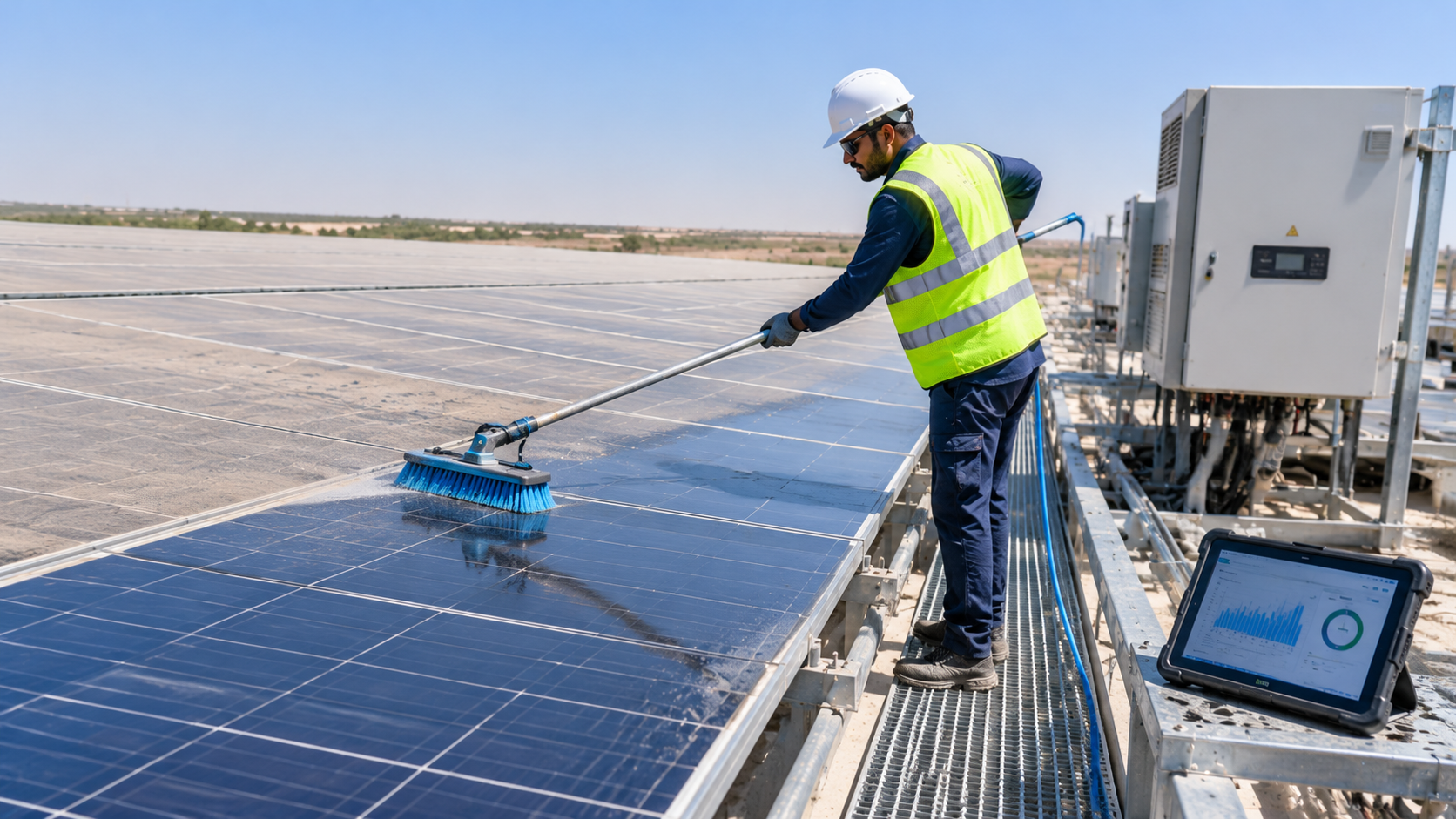
Solar is low maintenance, not no maintenance. In dusty and coastal conditions like Kutch, soiling and salt crust cut output if panels are not cleaned. Published guidance suggests cleaning every two to three weeks in the dry season, with salt-residue rinsing every two to four weeks in coastal-influenced areas. Neglected panels can lose roughly 10–25% of output. Bird droppings are a particular problem because they can cause localised hot spots and etch the glass.
Typical annual O&M is quoted at about ₹200–₹500 per kW. Warranties generally split into a product warranty of 10–15 years and a performance warranty of 25–30 years, while inverters commonly carry 5–10 years.
The best solar service in Gandhidham is one that continues after commissioning, with scheduled cleaning, remote monitoring, thermographic checks and a written response time for faults.
How do you choose the right solar partner in Gandhidham?
There is no official ranking for the best solar company in Gandhidham, so judge by evidence rather than slogans. Ask every bidder for the same documents and compare them side by side.
A solar company in Gandhidham should be able to show experience with industrial roofs, coastal conditions and HT connections, not just home systems. Ask for reference sites you can visit and the contact details of operations managers there.
If you are shortlisting the best solar rooftop company in Gandhidham, ask for a written structural assessment approach, the mounting method proposed for your roof type, and a leak-prevention plan for any roof penetrations.
Calling a firm the best solar EPC company in Gandhidham means little unless it handles engineering, procurement and construction under one accountable contract, with clear responsibility for approvals and commissioning.
Searches for the top solar company in Gandhidham tend to surface rankings and reviews, but the better test is a checklist: scope, specifications, warranties, O&M terms and timelines, all in writing.
Where does White Desert fit?
White Desert Power Projects is a solar EPC company based in Nakhatrana, Kutch. Its website lists services covering project development, engineering and system design, construction, O&M, financing and subsidy assistance, component procurement and performance monitoring. Its portfolio is concentrated in Kutch and includes a rooftop installation, ground-mounted plants for industrial clients, a PV-DG hybrid project and a solar plus battery storage project. White Desert has no project listed in Gandhidham itself, so ask for the nearest relevant Kutch references and judge fit against your own roof.
Which nearby areas does this apply to?
The same roof checks, approvals and design considerations apply across the wider region. Industrial and logistics clusters around Adipur, Kandla and Mundra face similar coastal exposure and port-linked load patterns. Anjar and Bhuj share Kutch's dust and wind conditions, with variations in DISCOM circle and local permits. If your facility is outside Gandhidham, confirm which PGVCL office handles your connection.
What about homes?
Residential solar in Gandhidham is a separate track from industrial projects. Homes can use the PM Surya Ghar scheme, which factories and warehouses cannot, and the paperwork and system sizes differ. White Desert also serves residential customers, so a business owner who wants to power a home or farmhouse can raise it in the same conversation.
What should you do next?
Before asking for quotes, collect four things: your last 12 electricity bills, your sanctioned or contract demand, the building's structural drawings or roof details, and photos of the roof showing obstructions. With those, an EPC can give a far more accurate yield, cost and payback estimate.
To discuss a site survey, use the contact page on the White Desert website, call +91 78599 82323 or message on WhatsApp.