By the White Desert Power Projects Engineering Team | Solar EPC specialists in Kutch, Gujarat Technically reviewed by: White Desert Power Projects Design and Engineering Department Published: October 28, 2026 | Last updated: October 28, 2026 | Scheme rules and figures checked October 2026
Quick answer: PM Surya Ghar Muft Bijli Yojana is a central government scheme that pays residential households a subsidy of up to ₹78,000 for rooftop solar, credited to your bank account after installation, DISCOM inspection and commissioning. You must use a registered vendor and DCR-compliant modules, and in Kutch the full process typically takes about 5 to 12 weeks.
Key takeaways:
The subsidy is reimbursed after commissioning, usually within about 30 days of a complete claim, so you must fund the full system first or use a loan.
Panels must be DCR-compliant and ALMM-listed. Non-compliant panels can make the claim ineligible.
Gujarat announced an additional state subsidy on 21 October 2026 for systems up to about 2 kW, cutting the household contribution to 10% of the benchmark cost (5% for SC/ST households).
Name mismatches between Aadhaar, the electricity bill and the bank account are the most common causes of delay.
Installation quality, equipment choice and financing timing all affect how quickly the subsidy arrives.
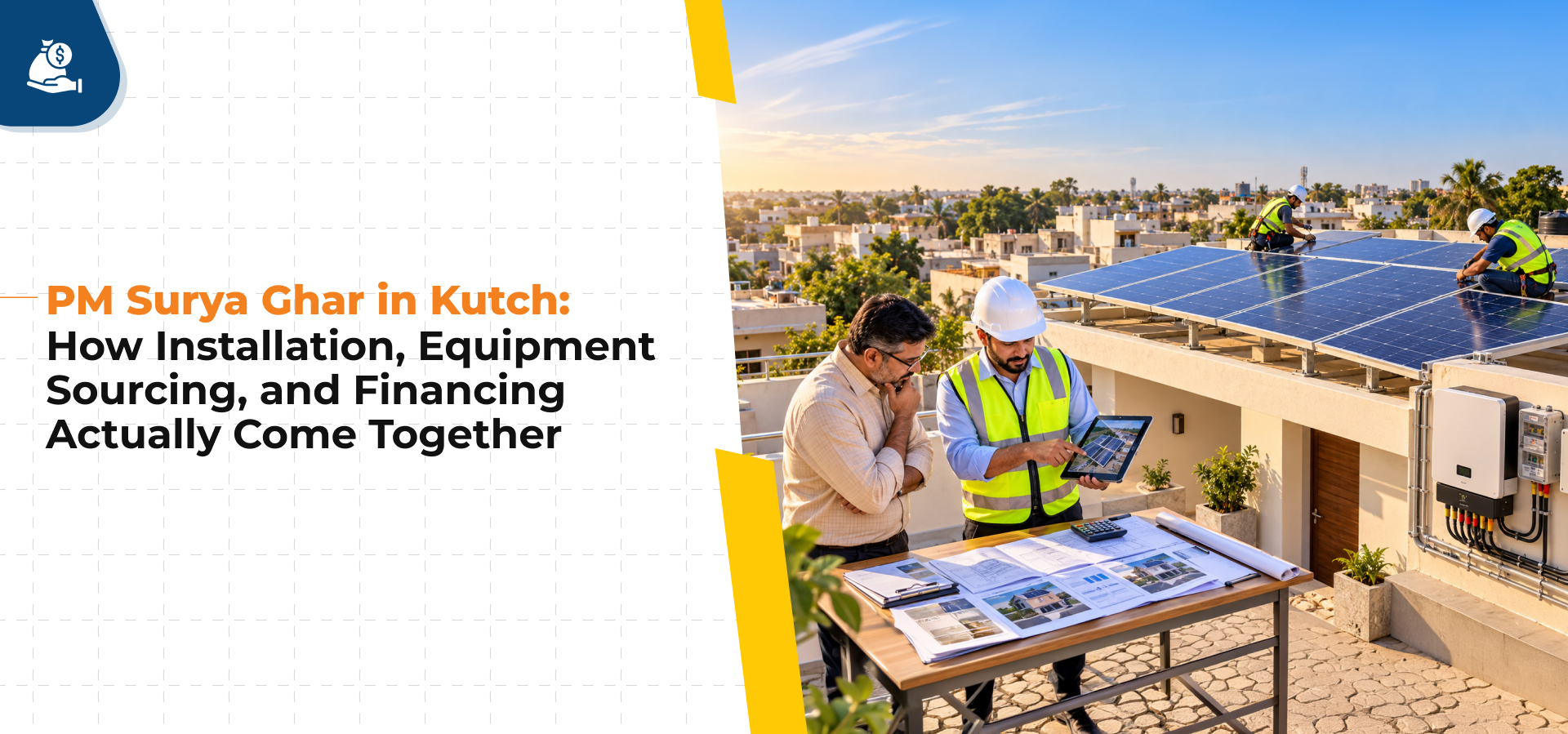
Most people researching PM Surya Ghar in Kutch start with the subsidy number: how much will I get, and how do I apply? That is a reasonable starting point, but it misses something important. The subsidy is only one piece of a process that also depends on proper installation, the right equipment and financing structured around your situation. Get any one of these wrong and the subsidy becomes harder to secure or slower to arrive, however straightforward the scheme looks on paper.
This guide walks through how construction, procurement and financing work together for a PM Surya Ghar application in Kutch, so you understand what the subsidy offers and what must go right around it to receive it on schedule.
What PM Surya Ghar Actually Pays
The central subsidy is calculated per kilowatt of installed capacity:
System size | Central subsidy |
1 kW | ₹30,000 |
2 kW | ₹60,000 |
3 kW and above | ₹78,000 (maximum) |
That is ₹30,000 per kW for the first 2 kW and ₹18,000 for the third kW, with no increase above 3 kW. The subsidy is paid by direct benefit transfer to your Aadhaar-linked bank account after your DISCOM inspects and commissions the system. It is not an upfront discount, which is why financing matters.
New Gujarat state top-up. On 21 October 2026 the Gujarat government announced an additional state subsidy for homes installing systems of up to about 2 kW. The household pays 10% of the benchmark cost, or 5% for SC and ST households, and the state covers the remainder after the central subsidy. Reported examples: a 1 kW system with a benchmark cost of about ₹54,000 would cost a general household about ₹5,400 (SC/ST about ₹2,700), and a 2 kW system with a benchmark of about ₹1,07,200 about ₹10,720 (SC/ST about ₹5,360). The state has estimated around 3 lakh households may benefit. Check the national portal and GEDA for the start date, eligibility and how the benefit is applied before you commit. Systems above 3 kW continue to receive the standard central cap.
What "300 units free" means. The scheme's "free electricity" is the power your own system generates. It is not a voucher. A 3 kW system typically generates roughly 360 to 450 units a month in Gujarat, enough to offset up to about 300 units of household use. You still pay for any consumption beyond what the system covers, and smaller systems offset less.
Who Is Eligible and What You Need
Eligibility, as set out in published guidance:
An Indian citizen household with a residential electricity connection from a participating DISCOM (PGVCL in most of Kutch)
A rooftop you own, with enough shadow-free space (tenants and joint owners generally need an owner's no-objection certificate)
An active connection, ideally in the applicant's name, with a sanctioned load that supports the system size, or a load enhancement first
No previous central or state rooftop solar subsidy on the household
An Aadhaar-linked mobile number and an Aadhaar-seeded savings account in the applicant's name
The documents usually needed:
Document | Notes |
Aadhaar card | Linked to your mobile number and bank account |
Latest electricity bill | Recent (within about 90 days), name matching Aadhaar and bank account |
Roof or property proof | Sale deed, index document or latest property tax receipt; society or co-owner NOC where relevant |
Bank passbook or cancelled cheque | Account number, IFSC and holder name visible |
Passport-size photograph | Digital upload |
PAN card | Commonly requested for verification |
Technical documents | Single-line diagram, datasheets and inverter certificates, uploaded by your installer |
Requirements can change, so confirm the current list on the PM Surya Ghar National Portal.
Why These Three Areas Cannot Be Treated Separately
It is tempting to treat a PM Surya Ghar project as three transactions: pick an installer, choose equipment and sort out the paperwork. In practice they are tightly connected. The equipment you source decides whether your application qualifies. The quality of construction decides whether your system passes DISCOM inspection first time. And your financing structure shapes how you manage cash flow between paying for the system and receiving the subsidy.
Construction: Why Installation Quality Affects Your Subsidy Timeline
Choosing a Registered Vendor
PM Surya Ghar requires installation through a vendor registered on the national portal and empanelled with your DISCOM. This is a requirement, not a formality. Check the vendor on the portal's vendor list for your state and DISCOM, search by the exact company name, and confirm the vendor is active and not deactivated or blacklisted, before you sign or pay an advance.
Registered vendors also carry obligations under the scheme's vendor agreement: complying with equipment requirements, supporting the project completion report and inspection, helping with net metering, educating you on module cleaning, and providing a comprehensive maintenance contract and system warranty of about five years from commissioning, with manufacturer warranties handed over to you. Ask for this in writing.
Why Quality Decides First-Attempt Inspection
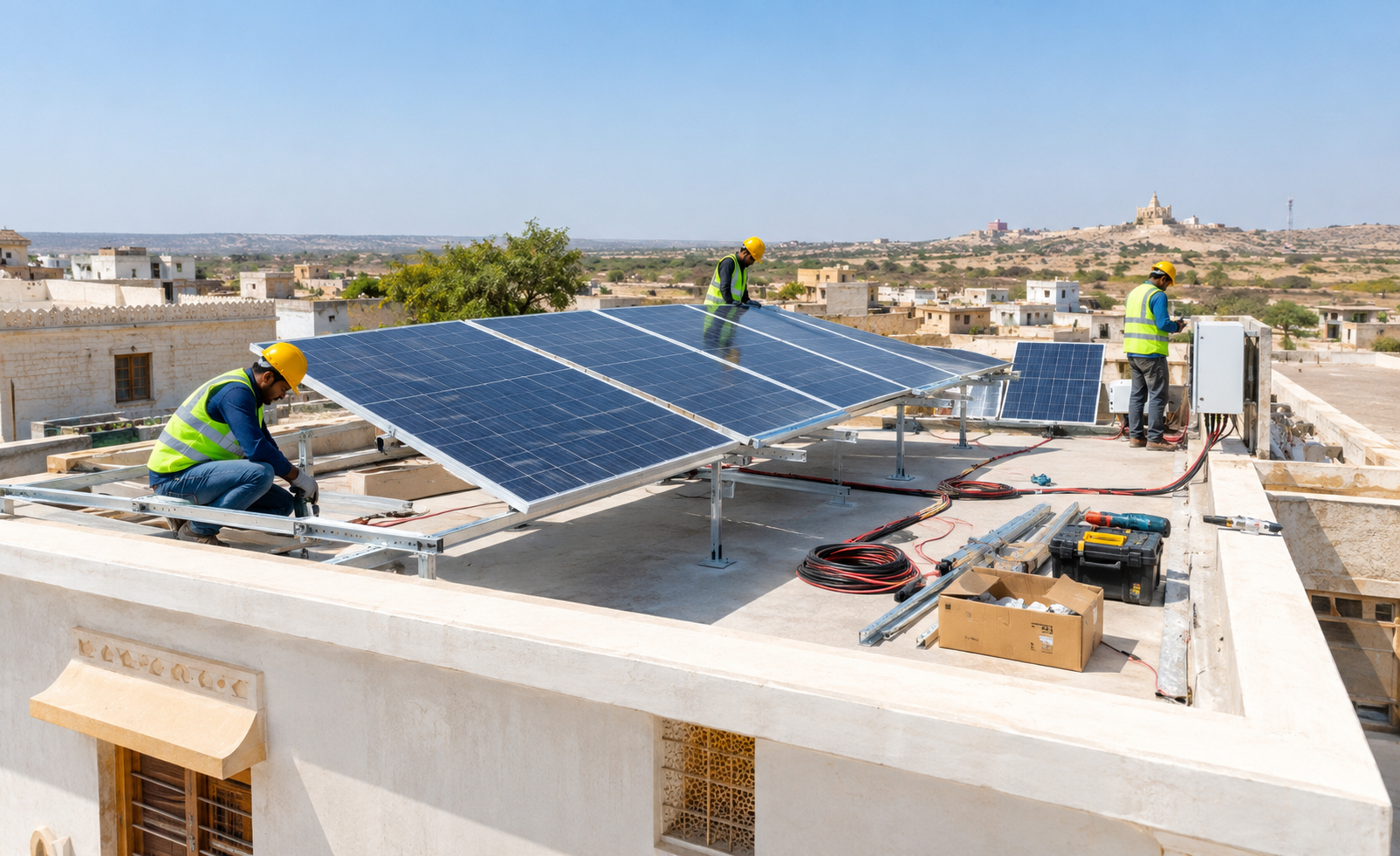
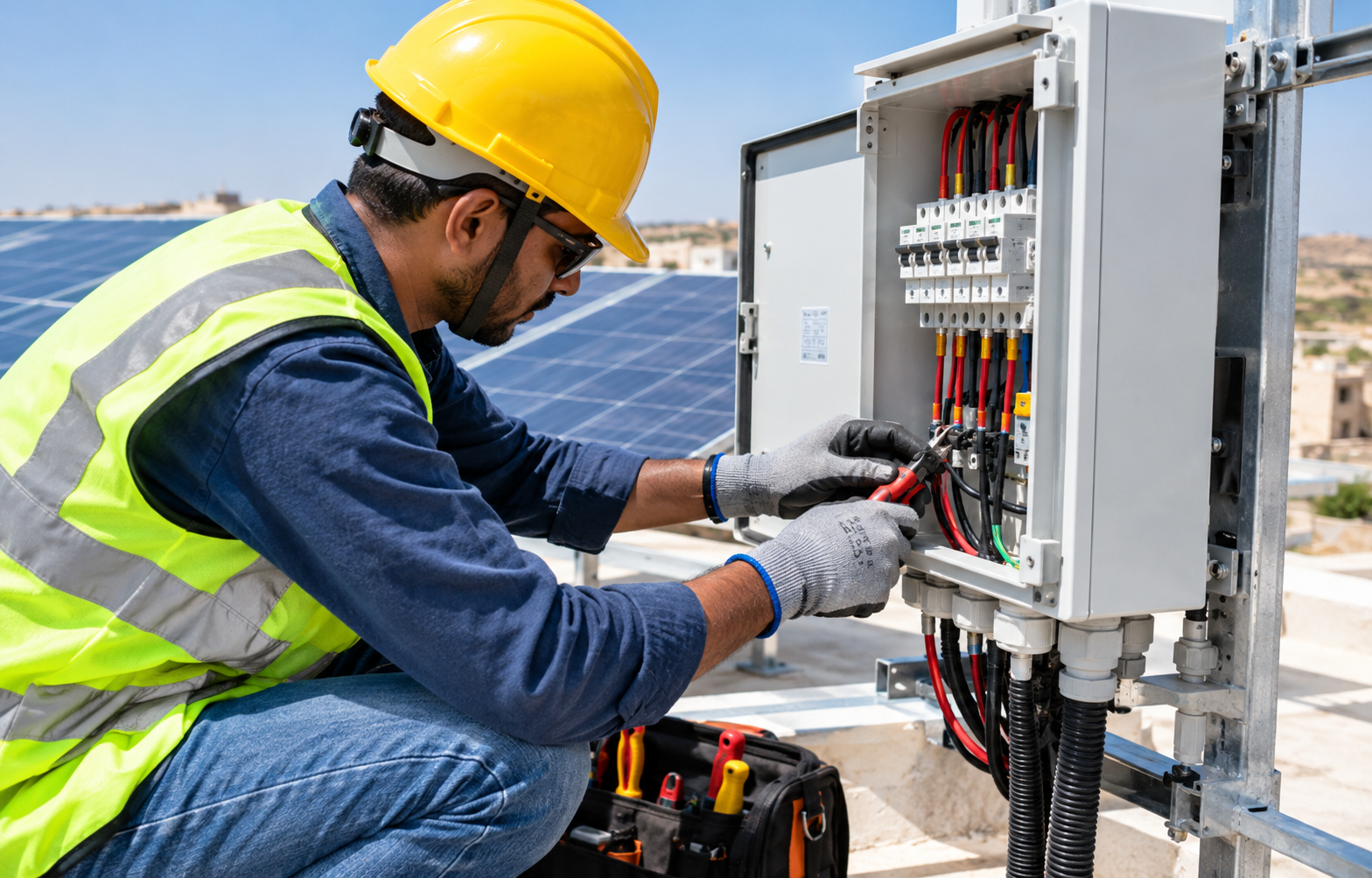
A well-executed installation, with correct alignment, secure mounting, proper earthing and compliant wiring, passes the DISCOM inspection cleanly. A rushed one can fail, requiring corrections and a second visit that pushes your subsidy back by weeks.
Timing and Sequence
Do not start installation before you have registered and received feasibility approval or deemed acceptance. Under central rules, technical feasibility for systems up to 10 kW is generally treated as deemed accepted, but you still need to register and follow the sequence. Installing out of order can lead to rejection of your subsidy claim, technical non-compliance findings and net metering delays.
Procurement: Why Equipment Sourcing Affects Eligibility
DCR and ALMM: What They Mean
Term | What it covers | Why it matters |
ALMM List-I | Approved solar module models and manufacturers | A module must appear here to qualify |
ALMM List-II | Approved solar cell manufacturers | Confirms the cells inside the module are made in India |
DCR | Module and cells both manufactured in India | Required for subsidy-eligible residential systems |
A module can be ALMM-listed yet still non-DCR if its cells are imported, so ask for confirmation of both. DCR modules cost more. Vendor sources put the gap at roughly ₹8 to ₹11 per watt, which is ₹8,000 to ₹11,000 per kW. That is why a suspiciously cheap quote may use non-DCR panels.
How to verify a module before you pay:
Get the exact brand, model number and wattage in the quotation
Check the model on the MNRE ALMM list (List-I for modules, List-II for cells)
Ask for a model-specific DCR certificate from the manufacturer, and check its validity on the DCR verification portal
Ask for BIS and IEC test evidence for the module
Make sure the serial numbers on the delivered panels match the paperwork your installer uploads, since mismatches in the work completion report are a known cause of rejection
Inverters and Other Equipment
Only grid-tied systems qualify. Inverters should be BIS-certified, include anti-islanding protection and carry at least a five-year warranty, and newer efficiency labelling rules have been introduced for inverters, so ask your installer to confirm current requirements. Structures should be galvanized steel designed for local wind loads, and the system needs a net meter approved by your DISCOM. Batteries and off-grid systems do not receive the subsidy.
Why Procurement and Construction Must Match
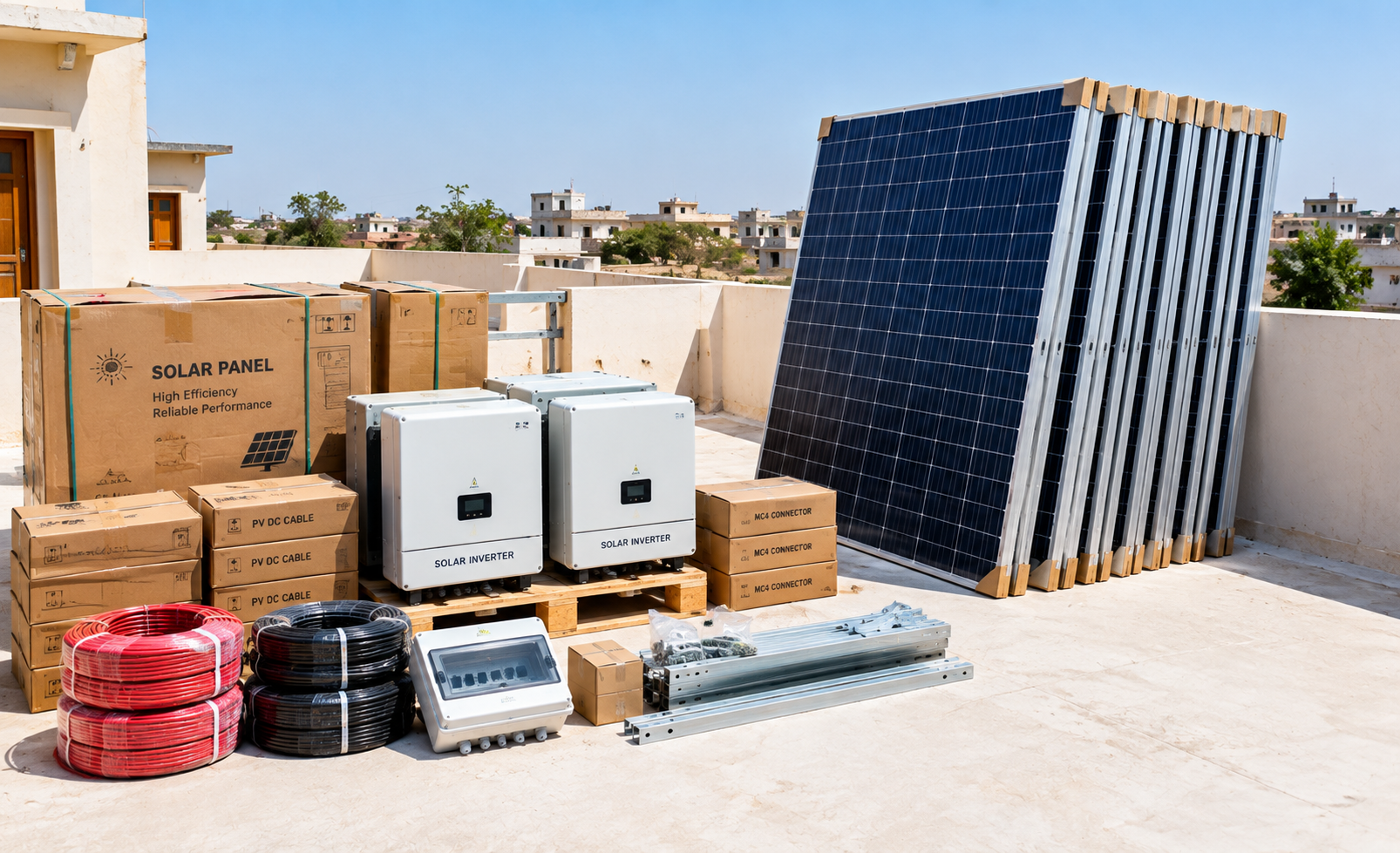
Panel dimensions, inverter specifications and cabling decide what gets built on your roof. When one provider handles both Procurement of Quality Components and construction under one coordinated process, there are fewer mismatches between what was sourced and what is installed.
Financing: Managing the Gap Between Payment and Subsidy
Many first-time applicants assume the subsidy works like an upfront discount. It does not. Disbursement happens after installation, inspection and commissioning, so you need a plan for paying the full cost first.
What a System Costs in Gujarat
Indicative gross costs for 2026, which vary by module type, brand and site:
System | Gross cost | Central subsidy | Net cost before any state support |
1 kW | ₹52,000 to ₹65,000 | ₹30,000 | ₹22,000 to ₹35,000 |
2 kW | ₹1.07 to ₹1.40 lakh | ₹60,000 | ₹47,000 to ₹80,000 |
3 kW | ₹1.57 to ₹1.90 lakh | ₹78,000 | ₹79,000 to ₹1.12 lakh |
Some installers quote higher, so compare several itemized quotes. For 1 kW and 2 kW systems, the new Gujarat state subsidy may lower your contribution further.
What Size Suits Your Bill
Monthly use | Typical system | Roof area needed |
About 150 units | 1.5 to 2 kW | about 150 to 200 sq ft |
About 300 units | 2.5 to 3 kW | about 250 to 350 sq ft |
About 500 units | about 5 kW | about 450 to 500 sq ft |
In Gujarat, 1 kW of rooftop solar typically produces about 120 to 150 units a month. Your system size generally cannot exceed your sanctioned load, so request a load enhancement first if needed.
Loans Under the Scheme
Public sector banks offer collateral-free solar loans under the scheme, secured by hypothecation of the equipment. As published by the lenders, terms are broadly:
Feature | Loans up to ₹2 lakh | Loans above ₹2 lakh up to ₹6 lakh |
Margin money | 10% of project cost | 20% of project cost |
Security | None beyond the equipment | None beyond the equipment |
Tenure | Up to 10 years | Up to 10 years |
Interest | Concessional rate quoted by lenders, around 5.75% for the first tier | Higher, from around 7.90% |
Terms and eligibility differ by bank and change with policy rates, so confirm with SBI, Bank of Baroda, Canara Bank or your own bank before relying on them.
The loan generally covers the gross project cost minus your margin. It does not wait for the subsidy to be deducted. When the subsidy is released, some banks require it to be credited to your loan account to reduce the principal, and you quote your loan account number when claiming on the portal. Disbursement usually goes to the registered vendor in stages.
A Worked Example (Illustrative)
Take a 3 kW system with a gross cost of ₹1.7 lakh:
Paying upfront: you pay ₹1.7 lakh, receive ₹78,000 about a month after commissioning and your net cost is ₹92,000.
Using a loan: you pay a 10% margin of ₹17,000, borrow about ₹1.53 lakh, and when the ₹78,000 subsidy is credited to the loan account the outstanding principal drops to about ₹75,000.
In both cases the timing matters. If installation takes longer than planned, loan disbursement stages and cash flow can come under pressure, which is why financing should be planned together with procurement lead times and construction scheduling.
A Realistic Sequence in Kutch
The stages and typical timings below are indicative for PGVCL circles, and rural parts of Kutch can run longer:
Step | Who acts | Typical time | Where delays happen |
1. Register on the portal | You or your installer | Same day | Name or consumer number mismatches |
2. Apply for rooftop solar and DISCOM feasibility | You, then PGVCL | About 7 to 15 days | Transformer capacity, high application volume |
3. Choose a registered vendor and confirm equipment | You and vendor | Days | DCR and ALMM checks, lead times |
4. Installation | Vendor | About 7 to 10 days | Roof condition, material delays |
5. Inspection | PGVCL | About 12 to 16 days after notification, longer in rural circles | Failed first inspection |
6. Net meter and commissioning certificate | PGVCL | About 5 to 10 days after inspection | Meter availability |
7. Subsidy claim on the portal | You and vendor | Typically around 30 days, sometimes up to 60 | Bank details, Aadhaar linkage, documents |
One regional estimate puts the Kutch application-to-commissioning cycle at roughly 35 to 50 days, with the subsidy credit following. Allow longer if your area has heavy application volume.
Kutch-Specific Factors That Affect Your Application
Solar panel installation in Kutch involves local conditions that generic guides miss:
Grid capacity: where many homes have already gone solar, distribution transformer limits can delay or restrict approvals, and PGVCL applies caps relative to transformer capacity.
Rural feeders: long rural lines and voltage or frequency swings can trip inverters, so ask about the inverter's voltage window and protection settings.
Wind: Kutch falls in a high wind category under IS 875 (Part 3), with 50 m/s commonly applied, so structures and anchoring must resist uplift. See our Mandvi coastal solar guide for wind and corrosion detail.
Roof types: many traditional village homes have clay tile or sheet roofs that cannot carry mounts directly, which may need elevated steel structures anchored to walls or RCC pillars and adds cost.
Heat and dust: summer temperatures above 45°C reduce output, and wide inverter voltage windows and good ventilation under the panels help. Dust from the Rann builds up quickly, and limited water means planning how you will clean.
For the same step-by-step method applied to site checks, see our guide to what a solar site survey reveals in Adipur.
What Goes Wrong When These Areas Are Not Coordinated
The most common causes of rejection, delay or a stuck application are:
Name and bank mismatches: spelling differences between Aadhaar, the electricity bill and the bank account, or a bank account that is not Aadhaar-linked, a current or loan account, or has wrong IFSC details
Ownership gaps: rented or joint-owned homes without a notarised owner NOC
Load and connection issues: a system larger than the sanctioned load, pending electricity dues or a non-domestic connection
Unregistered vendors: installers not registered on the portal or not empanelled with your DISCOM
Non-compliant modules: panels that are not ALMM-listed or DCR-compliant, or serial number mismatches in the completion report
Out-of-sequence installation: work started before registration or feasibility approval
To avoid them, line up your Aadhaar, bill and bank passbook before applying, verify your vendor on the portal, get the exact panel model and DCR certificate written into the quotation, clear dues and apply for load enhancement first if needed, and check your portal dashboard for remarks. If an application stalls, download the remark, fix the flagged issue and re-upload, or file a grievance on the portal.
Scams and Red Flags
The scheme has attracted fraud. Watch for:
Fake apps and links: .apk files shared on WhatsApp or look-alike portals that steal OTPs and bank details
"Free solar" or "zero cost" offers, which are not part of the government framework
Fees to "fast-track" or "guarantee" subsidy approval
Quotes far below market, such as under about ₹35,000 per kW, which often mean non-DCR or unlisted equipment
100% advance payment before delivery or feasibility
Installers who cannot show portal registration, a physical address or GST details
Protect yourself by applying only on the official portal, checking the vendor's GSTIN and company registration, paying in stages against GST invoices (booking, delivery, commissioning), and reporting fraud on 1930 or at the National Cyber Crime Reporting Portal. The National Consumer Helpline is 1915.
Residential, Commercial and Industrial in Context
PM Surya Ghar applies only to residential rooftops. Commercial solar in Kutch and industrial solar in Kutch use different financing, approvals and procurement routes, and they do not receive this subsidy. If you own a business property or a larger system, talk to us about the right route instead.
What to Ask a Provider About All Three Areas
Are you registered on the national portal and empanelled with my DISCOM, and can I see your listing?
Do you handle construction, equipment sourcing and subsidy guidance under one process, or will I manage separate vendors?
How do you confirm DCR and ALMM compliance before finalizing equipment, and will the exact model and certificate be written into the quote?
What is your first-attempt DISCOM inspection record?
Can you give me a realistic timeline from application to subsidy credit for my property?
What maintenance contract and warranties do I receive, and in writing?
The best solar rooftop company in Kutch should answer all six clearly and show evidence.
Conclusion
PM Surya Ghar in Kutch is not simply a subsidy application. Construction quality, equipment compliance and financing structure are deeply connected, and a misstep in any one can delay the outcome you are counting on. Understand how the pieces fit together before you begin, and choose a provider who coordinates all three.
White Desert Power Projects handles construction, procurement and financing guidance together for PM Surya Ghar applicants across Kutch, with equipment sourcing, installation and documentation coordinated as one connected process. Verify any vendor, including us, on the national portal before you sign.
Planning a PM Surya Ghar application in Kutch? Talk to White Desert Power Projects about a coordinated approach to installation, equipment and financing built around your property and timeline.