

By the White Desert Power Projects Engineering Team | Solar EPC specialists in Kutch, Gujarat Technically reviewed by: White Desert Power Projects Design and Engineering Department Published: October 21, 2026 | Last updated: October 21, 2026 | Prices are indicative and checked against market ranges as of October 2026
Quick answer: A solar quote is an itemized estimate of the panels, inverter, mounting structure, wiring, labor and paperwork needed to install a system. In Gujarat, a residential system currently costs roughly ₹50,000 to ₹65,000 per kW before subsidy, so a 3 kW home system is typically about ₹1.5 to ₹1.8 lakh, falling to roughly ₹72,000 to ₹1.02 lakh after the PM Surya Ghar subsidy of up to ₹78,000. Two quotes for the same capacity can differ because they price different modules, structures, protection and support.
Key takeaways:
Compare quotes line by line, not by headline price or kW rating.
Subsidy-eligible systems generally need domestic content (DCR) modules and an empanelled installer, which can explain a big price gap.
Earthing, lightning protection, monitoring and maintenance are the items cheap quotes most often leave out.
Kutch's heat, dust, high wind loads and Seismic Zone V make structure and module choice a real cost factor.
Always confirm whether GST, net metering charges and DISCOM fees are included.
If you have been collecting quotes for solar in Nakhatrana, you have probably noticed something frustrating: the numbers do not line up. One quote comes in far lower than another for what looks like a similar system, and neither explains why. This is one of the most common sources of confusion for first-time buyers, and it usually comes down to one fact: not every quote prices the same thing, even when it appears to.
This guide breaks down what goes into a solar quote, what legitimately drives price differences between providers, and how to read a proposal carefully enough to compare it fairly.
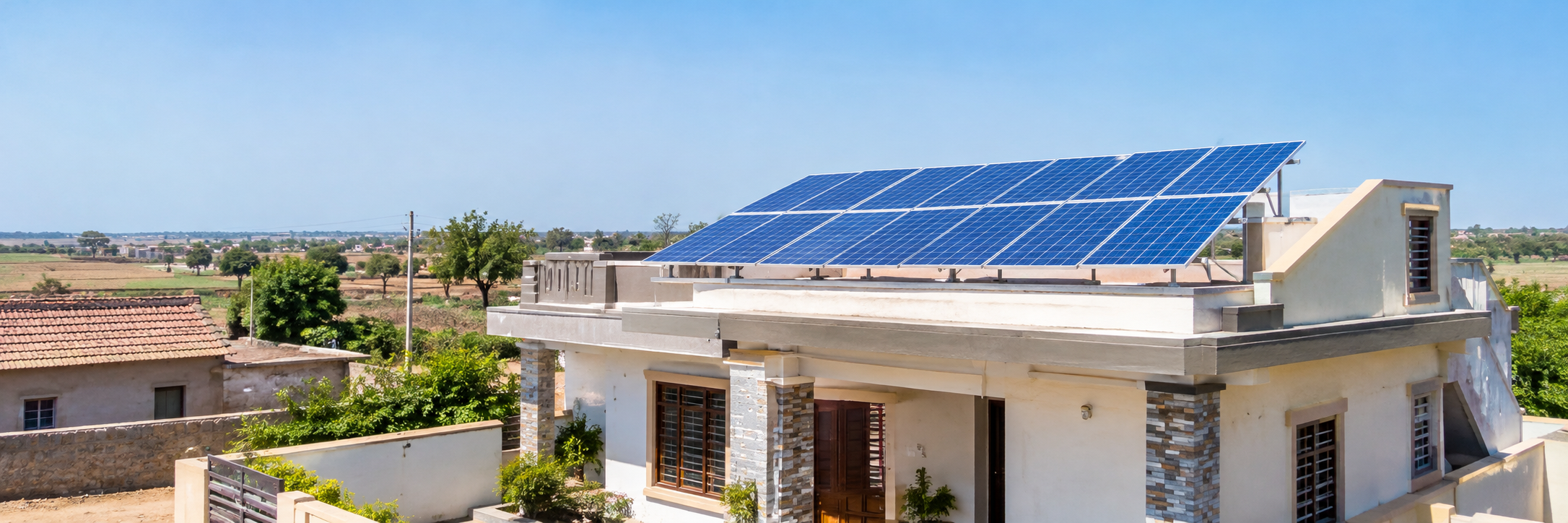
Why Price Transparency Matters in Nakhatrana
In smaller towns like Nakhatrana, buyers are often price-conscious and word of mouth about a bad installation travels fast, so cost transparency matters more than almost anywhere else in the region. A homeowner comparing solar panel pricing in Nakhatrana is not just looking for the lowest number. They want to know whether a quote reflects fair value or hides costs that will surface later as unexpected expenses or disappointing performance.
Understanding what a proper quote includes is the best protection against overpaying and, just as importantly, against underpaying for a system that cuts corners where you will not notice for years.
Indicative Solar Prices in Gujarat in 2026
Vendor price ranges vary by module technology, brand and DISCOM requirements, so treat these as a planning guide and not a quotation.
System size | Typical gross cost (before subsidy) | PM Surya Ghar subsidy | Approximate net cost |
1 kW | ₹45,000 to ₹60,000 | ₹30,000 | ₹15,000 to ₹30,000 |
3 kW | ₹1.5 to ₹1.8 lakh | ₹78,000 | ₹72,000 to ₹1.02 lakh |
5 kW | ₹2.5 to ₹3.3 lakh | ₹78,000 | ₹1.72 to ₹2.52 lakh |
Systems above 3 kW still receive the same ₹78,000 maximum, so subsidy matters most at the smaller end. Larger commercial and industrial rooftop systems are generally cheaper per kW than residential ones, with 100 to 500 kW plants commonly quoted around ₹40,000 to ₹55,000 per kW, and they do not receive the residential cash subsidy. Batteries are an extra cost, can raise hardware spend substantially, and are not covered by the residential subsidy.
Subsidy, DCR Modules and Why They Change the Quote
Under the PM Surya Ghar Muft Bijli Yojana, the central subsidy is ₹30,000 per kW for the first 2 kW and ₹18,000 for the third kW, capped at ₹78,000 for 3 kW and above. Check the official PM Surya Ghar portal for current terms. Three conditions regularly explain differences between quotes:
DCR modules: subsidy-eligible systems generally require modules made with domestic cells and modules, listed under MNRE's ALMM. Domestic content modules cost noticeably more per watt than imported ones, so a quote that quietly uses non-DCR modules can look cheaper while making the subsidy claim ineligible.
Empanelled installer: the subsidy process generally requires an installer registered on the national portal. An unregistered installer may be cheaper and cost you the subsidy.
Timeline: application, DISCOM feasibility, installation, inspection, net metering and subsidy payment typically take roughly 6 to 12 weeks end to end in Gujarat, with the subsidy credited directly to your bank account after commissioning.
Ask every installer in writing whether the quoted modules are DCR and ALMM-listed, and whether the quote assumes you will receive the subsidy. Rules and listing dates change, so confirm current requirements on the portal.
The Core Components Every Quote Should Include
Solar Panels
Panel cost alone rarely explains the full difference between two quotes. What matters is the exact model, technology, efficiency, warranty and manufacturer record, not just panel count and wattage. Two points deserve attention in Kutch:
Technology: TOPCon panels typically cost somewhat more than Mono PERC but offer higher efficiency, lower degradation and a better temperature coefficient.
Heat: panels lose power as cells get hot. As an illustration, if a cell reaches 65°C on a summer afternoon (40°C above the 25°C test condition), a Mono PERC panel at around -0.38% per °C loses roughly 15%, while a TOPCon panel at around -0.28% per °C loses roughly 11%. Ask for the temperature coefficient on the datasheet.
Be cautious with "Tier-1 panels" in a quote. Tier-1 is a financial bankability classification of manufacturers by BloombergNEF, not a technical quality grade and not a certification of a specific module. Ask for the exact brand, model, IEC certificates and warranty terms instead.
Inverter
The inverter converts DC power from your panels into usable AC power, and it is the component most likely to need attention during the system's 25-year life. String inverters commonly last around 10 to 15 years, so one replacement over the system's life is normal. Standard inverter warranties typically run 5 to 10 years, and paid extensions are often available. Ask for the brand, model, warranty length and what a replacement would cost.
Mounting Structure and Racking
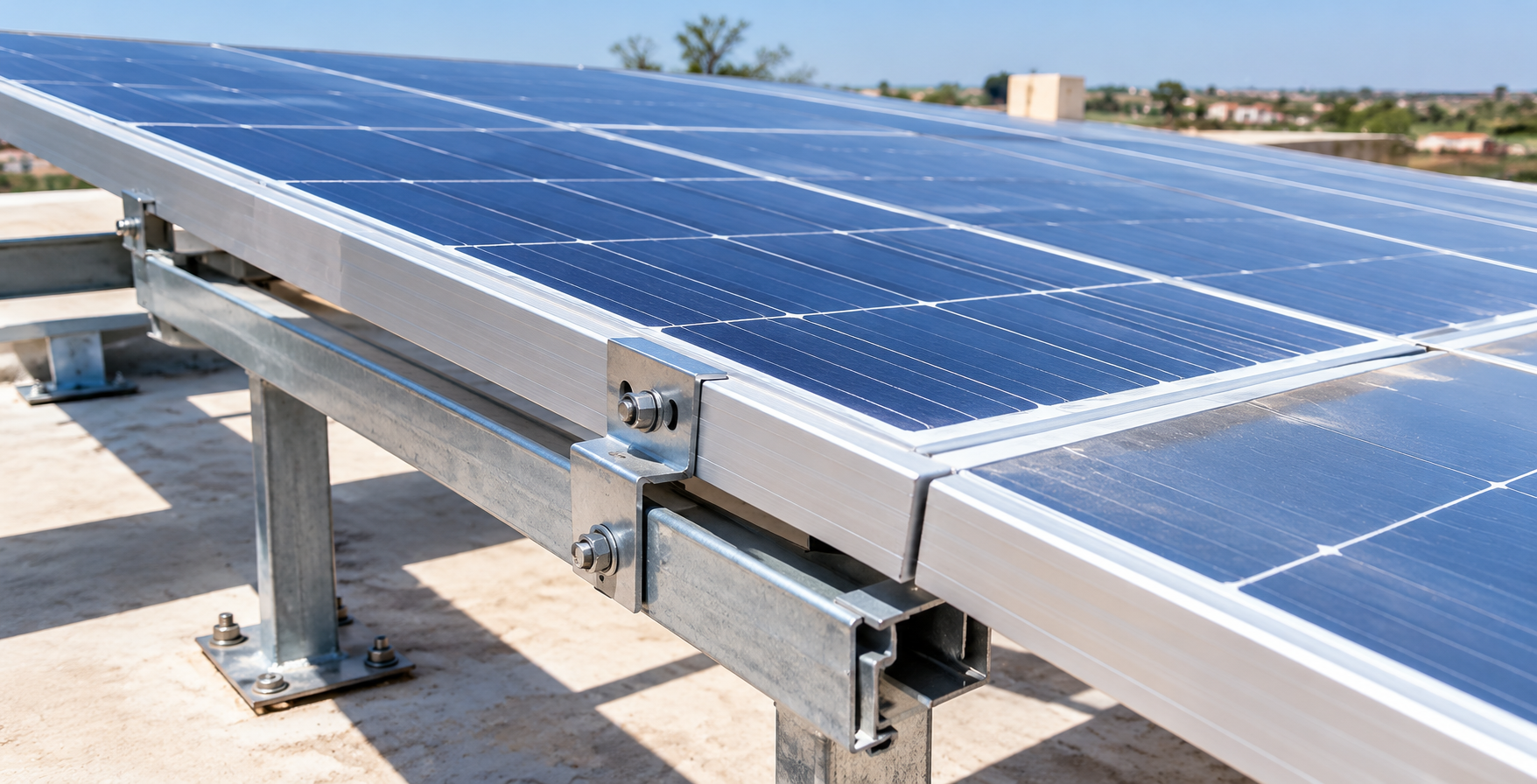
The structure must be rated for local wind loads. Kutch falls in a high wind category under IS 875 (Part 3), with a basic wind speed of 50 m/s commonly applied, and in Seismic Zone V under IS 1893, so uplift and anchoring often govern the design. Hot-dip galvanized steel is the common choice, with 80 to 85 micrometres as the usual minimum under IS 4759 and thicker coatings often preferred for exposed or dusty sites. Thinner members and lighter coatings reduce upfront cost but can shorten the structure's effective life, so ask for the coating thickness, member sizes, structure height and wind rating, and for a structural engineer's drawing on larger systems.
[
Cabling and Electrical Protection
Wiring, connectors, DC and AC distribution boxes, circuit breakers and surge protection all feed into cost. Undersized cable saves money on the invoice and wastes it in resistive losses for years. A common design target is to keep voltage drop around 2% to 3% or lower on the DC side and about 1% to 2% on the AC side. Ask what cable sizes are being used and for UV-resistant conduit where cables are exposed.
Labor and Installation
Installation labor covers structural assessment, mounting, wiring, testing and commissioning, and typically accounts for around a tenth of total cost. This is where experience matters most, because a rushed crew can introduce errors that affect both safety and performance.
Permits, Net Metering and Documentation
Paperwork for net metering, DISCOM interconnection and subsidy applications should appear as a separate line or be clearly included. In Kutch the distribution utility is PGVCL, and its process includes a feasibility check, inspection and installation of a bi-directional meter. Ask what application, meter and liaison charges are included, and who handles the process, so it does not become your responsibility midway.
What a Typical Quote Splits Into
As an illustration, here is how a residential 3 kW quote of about ₹1.6 lakh might break down, based on common market shares. Your quote will differ.
Line item | Typical share | Illustrative amount |
Solar panels | about 43% | about ₹69,000 |
Inverter | about 16% | about ₹26,000 |
Mounting structure | about 12% | about ₹19,000 |
Installation labor and transport | about 11% | about ₹18,000 |
DC and AC cables and connectors | about 6% | about ₹10,000 |
DC and AC distribution boxes, surge protection | about 4% | about ₹6,500 |
Earthing and lightning arrester | about 4% | about ₹6,500 |
Net meter and DISCOM application | about 4% | about ₹6,500 |
Why Two Quotes for the "Same System" Differ So Much
Once you know the components, price variation becomes easier to read. A solar company in Nakhatrana offering a much lower price than its competitors is often cutting costs in one of the items above: module tier, inverter brand, structure gauge, cable size, protection or labor quality.
Here is an illustrative scenario, not a specific customer quote. Two homeowners collect quotes for a 3 kW system. Quote A is ₹1.45 lakh and Quote B is ₹1.75 lakh. On inspection, Quote A uses non-DCR modules, which would make the subsidy claim ineligible, a lighter structure, a single earthing pit and no lightning arrester, and it excludes GST. Quote B uses DCR modules, a thicker galvanized structure, separate earthing for DC, AC and the arrester, and includes GST and net metering support. The ₹30,000 gap is not generosity. It is a different system.
That does not make the lowest quote automatically bad. Some providers do operate more efficiently. It does mean you should ask exactly what is driving the gap.
What Cheap Quotes Often Leave Out
Often missing or understated | What it should include |
Earthing | Separate, compliant earth pits for the DC side, the AC side and the lightning arrester |
Lightning arrester | Proper arrester wired to its own earth pit |
Monitoring | The hardware needed to make the inverter app work, not just "Wi-Fi capable" |
Maintenance (AMC) | Cleaning frequency and technical checks, not just a one-year cleaning promise |
Net metering and liaison | Application, meter testing and DISCOM follow-up |
Structure | Stated height, coating thickness and wind rating |
Cables and conduit | Sufficient length, UV-resistant conduit and correct sizing |
Taxes | Whether GST is included; residential solar contracts are commonly taxed at a blended rate of about 8.9% under the 70:30 composite supply rule, so confirm current treatment |
As a sanity check, a 5 kW home quote far below the indicative range above, around ₹2.5 to ₹3.3 lakh, deserves a line-by-line question list.
What a Fair, Transparent Quote Actually Looks Like
A proper quote from the best solar company in Nakhatrana should itemize each major component rather than present one bundled number. That means the specific module and inverter models by manufacturer, structure specifications, cable and protection details, a labor breakdown and any permit or documentation charges, plus the warranty terms for each.
That level of detail lets you compare like with like. If one quote names a manufacturer with a strong warranty record and another simply says "Tier-1 panels", that gap is worth questioning directly.

Residential Pricing: What Most Nakhatrana Homeowners Are Comparing
For most households, pricing for residential solar in Nakhatrana comes down to balancing upfront cost against long-term reliability. A small household with modest consumption should not pay for an oversized system, while a larger household running more appliances needs a larger one to offset real usage.
The most reliable way to compare is to make sure every quote is for the same system size, calculated from your actual consumption data and not each installer's guess. Without that baseline, you are comparing different systems with similar-sounding specifications.
A typical home system in Gujarat generates roughly 1,500 to 1,700 units per kW per year for a well-oriented system, so a 3 kW system produces on the order of 4,500 to 5,100 units a year. Savings depend on your tariff and how much you consume yourself. Units you use directly save the full tariff, while surplus exported to the grid is credited at a lower rate, so sizing close to your daytime usage matters.
Commercial and Industrial Pricing: A Different Scale
Pricing for commercial and industrial solar in Nakhatrana works on a different scale, where total cost is higher but cost per kW usually falls because fixed expenses such as surveys, engineering and logistics are spread over more capacity. Business buyers should apply the same itemization principle, with extra attention to how sizing was derived from operational consumption data, since an improperly sized commercial system is a much larger miscalculation than a residential one.
Financing also changes the picture. Term loans or capital expenditure financing tied to expected savings affect monthly cash flow differently from a simple residential purchase. Businesses that own the plant have also been able to claim accelerated depreciation on solar equipment, commonly cited at 40% on a written-down value basis. Tax provisions change, so confirm the current rules with your advisor before relying on that figure.
Farms and Rural Properties: PM-KUSUM Is a Separate Track
Nakhatrana's rural economy means many buyers are farmers, and their route differs from rooftop solar. The PM-KUSUM scheme covers agricultural solar pumps and grid-connected pump solarization, with support shared between central and state governments through GEDA and state DISCOMs. Reported structures involve a combined government subsidy of around 60% for pumps, but details change, so check current terms with GEDA. Residential rooftop solar is covered separately by PM Surya Ghar.
Why Choosing Based on Price Alone Is a Mistake
It is tempting to take the lowest quote, particularly in a price-sensitive market. But the cheapest quote is not always the cheapest system over its life. Lower-grade components that fail early, degrade faster than warranted or need more maintenance can cost more across 25 years than a properly specified system that costs somewhat more upfront.
This is where a top solar company in Nakhatrana that explains its pricing openly protects your investment, instead of competing on the smallest headline number. A fair price reflects real component quality and proper installation.

What Drives Legitimate Price Differences
Beyond component quality, a few factors legitimately affect pricing. An established best solar EPC company in Nakhatrana with a long record of installations and reliable support typically prices a little higher than a newer provider, reflecting lower risk and better documented outcomes.
Warranty terms also matter. Typical benchmarks are:
Warranty type | Typical term |
Panel product (manufacturing) warranty | 10 to 15 years, commonly 12 |
Panel performance warranty | 25 to 30 years, often around 80% to 85% output at year 25 |
Inverter warranty | 5 to 10 years, extendable |
Installer workmanship warranty | Commonly 1 to 5 years, not standardized |
A provider offering stronger component and workmanship cover may price higher to reflect the cost of standing behind it. Local service capacity and response time also add value, even when they do not appear as a distinct line.
Maintenance and Operating Costs to Include in Your Comparison
In dry, dusty Kutch, panel cleaning has a real effect on output. Many installers recommend cleaning every one to two weeks in dry summer months and every two to four weeks in winter, with a post-monsoon wash and spot cleaning after dust storms. Clean early morning or evening with soft water to avoid thermal shock, and track daily generation on the inverter app to spot dips. Ask each provider what its maintenance contract covers, how often, and who does the work.
Why Rooftop Pricing Varies by Property Type
Rooftop solar in Nakhatrana also varies with your roof type and condition. A flat RCC roof in good condition is usually simpler to install than a sloped roof needing more complex mounting, or an older structure that needs reinforcement first. These factors should appear in your quote after a proper site assessment, not be assumed away in a generic package. Roof area matters too: as a rough planning figure, a flat RCC roof needs about 95 to 100 sq ft per kW because of row spacing, while a sloped metal roof needs closer to 70 sq ft per kW.
Questions to Ask When Comparing Quotes
Which exact panel and inverter models and manufacturers are quoted, and are the modules DCR and ALMM-listed?
Is the installer empanelled for the PM Surya Ghar subsidy, and does the quote assume I receive it?
How was my system size determined, from my actual bills or a standard package?
What coating thickness, member size, height and wind rating does the structure have?
How many earth pits, and is there a lightning arrester?
What is included in the price, and what is charged extra, including GST, meter and DISCOM charges?
What warranties apply to components and workmanship, and how are claims handled?
What does post-installation support and maintenance include, and is it provided locally?
Conclusion
Understanding what goes into a solar quote is the single most useful thing a Nakhatrana buyer can do before comparing providers. Price differences almost always trace back to component quality, DCR and subsidy eligibility, sizing accuracy, protection and installation quality, or warranty and support, not one company being more generous than another. The most reliable path to a fair price is demanding transparency on exactly what each quote includes, then comparing genuinely equivalent systems.
White Desert Power Projects provides itemized quotes for residential, commercial and industrial solar installations across Nakhatrana and the broader Kutch region, with component specifications and system sizing explained before you commit to anything.
Comparing solar quotes in Nakhatrana? Request an itemized proposal from White Desert Power Projects built around your property's actual needs, not a generic package.