
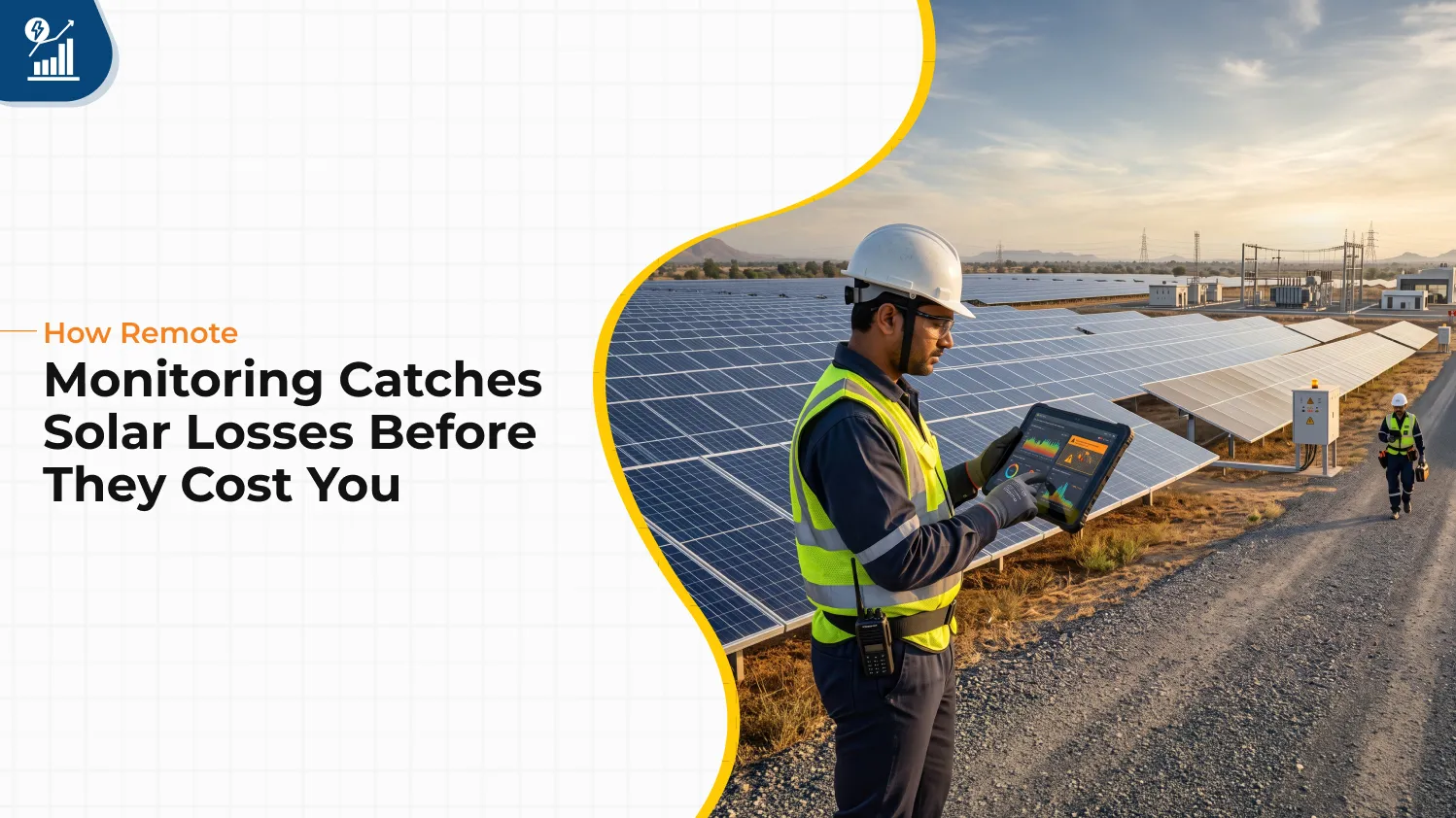
Most solar losses don't announce themselves. A string that's underperforming by fifteen percent doesn't trip an alarm or shut the plant down. It just quietly generates less than it should, month after month, until someone finally compares the numbers against what the system was supposed to produce and asks why the gap is so wide.
By the time that question gets asked, the losses have usually been compounding for weeks or months. That's the real cost of poor visibility, not a single dramatic failure, but a slow bleed that's invisible until someone goes looking for it. Solar project monitoring services in Kutch exist specifically to close that gap, catching the loss the day it starts rather than the quarter someone notices the revenue shortfall.
Why Losses Go Unnoticed for So Long
A solar plant without granular monitoring is essentially being managed by a single number: total output. That number can look reasonable even when something underneath it has gone wrong.
Here's how that happens in practice:
A plant with 20 strings loses 15% output on one string. Total plant output drops by less than 1%, easy to miss against normal daily variation from weather and irradiance.
An inverter operating at 90% efficiency instead of 98% doesn't trigger a fault code. It just produces less, silently, indefinitely.
Gradual soiling reduces output by a fraction of a percent each week. No single week looks alarming, but three months in, the cumulative loss is significant.
None of these show up as an emergency. They show up as underperformance that's easy to attribute to weather, seasonal variation, or simply written off entirely because nobody's tracking output at a fine enough level to notice the pattern.
What Remote Monitoring Actually Catches
The value of proper monitoring isn't that it prevents every fault. Plants develop issues regardless of how well they're monitored. The value is in how fast an issue gets flagged and how precisely it gets located.
String and Component-Level Visibility
Plant-level dashboards tell an owner whether the system is generating power. They don't tell an owner which specific string, inverter, or combiner box is underperforming. Solar operations and maintenance companies in Kutch that monitor at the string level can isolate a fault to a specific section of the plant within hours instead of weeks, which is the difference between a two-day fix and a two-month one.
Performance Ratio Tracking Against Baseline
Every plant has an expected performance ratio based on its design and local irradiance conditions. Monitoring that tracks actual PR against that baseline in real time catches deviation immediately, rather than waiting for someone to notice a shortfall on a monthly generation report.
Early Warning on Inverter Health
Inverters rarely fail without warning signs. Rising internal temperatures, fluctuating efficiency, or irregular shutdown patterns typically show up in the data well before a full failure. Catching these trends is what separates solar panel operation and maintenance in Kutch built around prevention from a reactive model that only responds after something breaks.
Soiling and Environmental Loss Detection
Comparing actual output against a clean-panel model makes it possible to see exactly how much soiling is costing the plant at any given time, which turns cleaning schedules from a fixed calendar into a data-driven decision based on actual accumulated loss.
The Cost of Delayed Detection
The financial impact of a fault isn't just the output lost while the plant is underperforming. It's also the extended timeline before anyone even realizes there's a problem to fix.
Detection Method | Typical Time to Identify Fault | Typical Time to Resolve |
No structured monitoring | Weeks to months (often found during a manual audit) | Additional weeks, since diagnosis has to start from scratch |
Plant-level monitoring only | Days to weeks, once total output drops noticeably | Days to a week for diagnosis, then repair |
String-level remote monitoring | Same day to 24 hours | Hours to days, since the fault location is already known |
The gap between the first row and the third isn't a minor efficiency improvement. Over a year, it's the difference between a plant that loses a few days of output to a handful of faults and one that loses weeks or months to issues that sat undetected for far longer than necessary.
Monitoring as Part of a Broader Maintenance Discipline
Monitoring on its own doesn't fix anything. Its value depends entirely on what happens after an issue is flagged. This is why effective solar operations and maintenance in Kutch treats monitoring as the first stage of a larger response system, not a standalone dashboard.
Fast Fault Response
Once monitoring flags an issue, response time determines how much output is actually lost. A structured maintenance team with a clear protocol for dispatching technicians once a fault is confirmed keeps that window as short as possible.
Scheduled Physical Inspections
Remote data catches most issues, but not all of them. Physical checks for loose connections, corrosion, and structural wear still matter, especially for solar panel maintenance and repair in Kutch where coastal humidity and high dust accelerate wear that data alone won't always reveal early.
Documentation That Supports Warranty Claims
Every flagged fault, response, and repair should be logged. This record becomes essential when filing a warranty claim on a module or inverter years into the plant's operating life, since manufacturers typically require documented proof of proper maintenance.
Commercial and Industrial Plants Have More to Lose
For a residential rooftop system, a missed fault might mean a slightly higher electricity bill for a few weeks. For a commercial or industrial plant, the stakes are considerably higher, and the case for structured monitoring is correspondingly stronger.
Commercial solar panel maintenance in Kutch for larger installations needs to account for factors residential systems don't face:
Multiple inverters and hundreds of strings, where a fault in one section can go unnoticed longer without granular monitoring
Revenue tied directly to a PPA or captive consumption agreement, where underperformance has an immediate, quantifiable financial cost
Higher system value, meaning even a small percentage loss translates to a significant absolute figure
Grid curtailment and compliance requirements that need to be tracked alongside generation data
For solar energy plant maintenance in Kutch operating at commercial or industrial scale, the cost of not having string-level monitoring in place isn't measured in inconvenience. It's measured directly in lost revenue against a financial model the plant was built to meet.
What to Look for in a Monitoring Partner
Not every provider offering monitoring services delivers the same depth of visibility. Before choosing a partner, it's worth asking:
Does monitoring operate at the string or component level, or only at the plant level?
How quickly does a flagged issue reach a technician, and what's the typical response time after that?
Is performance tracked against a baseline model, or only reported as raw generation numbers?
Are faults, repairs, and inspections documented in a way that supports warranty claims?
Can the provider show a track record of catching and resolving issues quickly across other plants they manage?
Vague answers to these questions usually mean monitoring is being offered as a feature rather than a discipline built to actually protect a plant's output.
Conclusion
Solar losses rarely happen all at once. They accumulate quietly through underperforming strings, gradual soiling, and inverter inefficiencies that go unnoticed until someone finally checks the numbers against what the plant should be producing. The plants that avoid this pattern aren't the ones with fewer problems. They're the ones where issues get caught the day they start, not the month someone finally goes looking.
White Desert Power Projects has worked with organizations including Shriram Kaolin, GIPCL, Aditi Packaging, and Monex Solar Power LLP, helping plants catch performance losses early through structured monitoring rather than discovering them after the fact.
If you're not sure whether your plant's actual output is matching what it should be producing, that's worth finding out now. Talk to White Desert Power Projects about setting up structured performance monitoring built to catch losses before they cost you.