Ask most developers how long a MW-scale solar build takes and the answer is usually a single number, a rough estimate handed over during early planning conversations. What that number rarely captures is the actual sequence of work happening on-site, which phases run in parallel, which ones create bottlenecks if delayed, and where the timeline is most likely to slip if something goes wrong. Without that visibility, it's difficult to know whether a contractor's schedule is realistic or optimistic until construction is already underway and behind.
This is what actually happens on-site during a MW-scale build, phase by phase, based on how proper solar plant construction services in Kutch are typically sequenced from mobilization through commissioning.
Why Construction Timelines Are Harder to Predict Than They Look
A MW-scale solar plant involves civil work, structural installation, electrical work, and grid interconnection, each with its own dependencies, and each affected differently by weather, material availability, and site conditions. Unlike a building construction project where phases are relatively linear, solar construction has significant parallel work happening simultaneously across different sections of a large site, which makes coordination, not any single task, the biggest driver of whether a project finishes on schedule.
Kutch adds its own variables. High summer temperatures limit safe working hours for certain outdoor tasks. Monsoon season affects civil work and access to ground-mounted sites. A construction schedule that doesn't account for these seasonal realities from the outset tends to slip regardless of how well the individual tasks are executed.
Phase 1: Site Mobilization and Preparatory Work
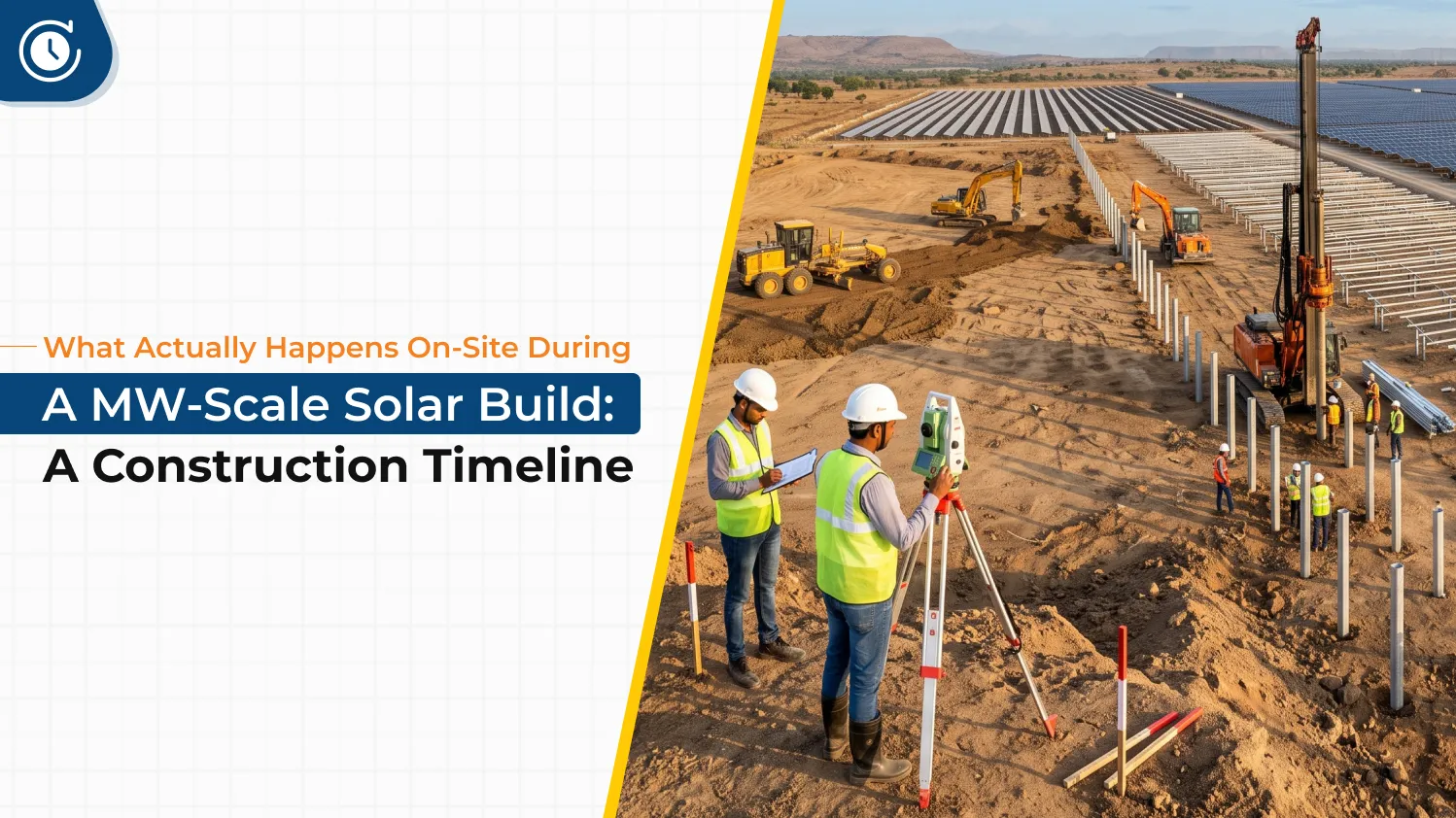
Before any structural work begins, the site needs to be physically ready. This phase typically includes:
Site clearing and grading, particularly for ground-mounted installations on undeveloped land
Access road construction for equipment and material transport
Establishing site infrastructure, including temporary power, water, and secure material storage
Final topographical survey to confirm the layout matches actual site conditions, since design-stage surveys can miss details that only become apparent once equipment is on-site
This phase is often underestimated in early timeline discussions, particularly for larger ground-mount sites where access road construction alone can take longer than expected if the site has limited existing infrastructure. Rushing this phase to get to visible progress faster tends to create problems that surface later, when foundation work reveals soil conditions that weren't accounted for during initial grading.
Phase 2: Foundation and Structural Installation
With the site prepared, foundation work begins for the mounting structures that will hold the panels. This looks different depending on the installation type:
Ground-mounted systems typically use driven piles or concrete foundations, depending on soil conditions identified during the geotechnical survey. Pile driving for a MW-scale ground-mount array involves installing hundreds or thousands of individual foundation points, which is one of the more time-intensive phases of the entire build.
Rooftop and carport systems require structural assessment of the existing roof or structure to confirm load-bearing capacity, followed by mounting rail installation anchored according to that assessment.
Once foundations are set, the mounting structure itself gets assembled, the racking system that will hold panels at the correct tilt and orientation determined during the design phase. This work typically proceeds in sections across the site, allowing panel installation to begin on completed sections while structural work continues elsewhere, which is part of what makes solar construction more parallel than sequential once this phase is underway.
Phase 3: Panel Installation
With mounting structures in place, panel installation follows, typically moving section by section behind the structural crews. This phase is comparatively fast once it starts, since it's largely repetitive work across a standardized racking system, but it depends entirely on structural work staying ahead of it. A delay in foundation or racking work in one section directly delays when panel crews can move into that area.
Quality control during this phase matters more than it might appear. Improper torque on mounting hardware, inconsistent panel alignment, or damage during handling can all introduce issues that are far more expensive to identify and fix once the plant is fully wired and operational than while panels are still being installed.
Phase 4: DC and AC Electrical Installation
This is typically the most technically involved phase of the build, running in parallel with the later stages of panel installation rather than waiting for it to fully complete. Electrical work includes:
String wiring connecting panels within each array section
DC combiner box installation and connection
Inverter installation and commissioning at the section or plant level
AC cabling from inverters to the transformer and switchgear
Grounding and lightning protection system installation
For a solar system installation company in Kutch managing a MW-scale site, electrical work is where careful sequencing matters most, since string and combiner box installation needs to track closely behind panel installation without falling so far behind that completed panel sections sit unconnected and unable to generate for extended periods.
Phase 5: Substation and Grid Interconnection Work
For utility-scale and larger commercial plants exporting power to the grid, substation construction and interconnection work often starts early in the overall timeline, running in parallel with site preparation and structural work, since it typically involves longer lead times for equipment procurement and utility coordination.
This phase includes transformer installation, switchgear setup, protection relay configuration, and the interconnection work required to tie the plant into the grid at the point of connection agreed with the utility. Interconnection timelines are frequently outside the direct control of the construction team, since they depend on utility scheduling and testing windows, which is why this work needs to be initiated well ahead of when the rest of construction is expected to finish.
Phase 6: Testing and Commissioning
Once electrical installation is complete, the plant moves into a structured testing sequence before it's cleared to operate at full capacity:
Continuity and insulation testing on all wiring to confirm no faults exist before energizing any section
String-level testing to verify each string is generating within expected parameters
Inverter commissioning to confirm proper operation and communication with monitoring systems
Protection system testing to verify relays and safety systems respond correctly under simulated fault conditions
Grid synchronization testing to confirm the plant can connect and disconnect from the grid safely under utility protocols
Performance ratio verification comparing initial generation data against design expectations
This phase is where design and construction quality actually get validated against reality. A plant that passes every test cleanly reflects careful execution throughout the earlier phases. A plant with recurring issues during testing usually points back to a shortcut taken somewhere earlier in the build, whether in foundation work, electrical installation, or component quality.
A Realistic Timeline Breakdown
While exact durations vary significantly by plant size, site conditions, and grid interconnection complexity, the relative proportion of time each phase typically consumes looks roughly like this for a MW-scale ground-mount project:
Phase | Typical Share of Total Construction Timeline | Key Dependency |
Site mobilization and preparation | 10-15% | Site access, weather, soil conditions |
Foundation and structural installation | 25-30% | Geotechnical conditions, foundation type |
Panel installation | 15-20% | Pace of structural work completion |
DC and AC electrical installation | 20-25% | Runs parallel to panel installation, needs careful sequencing |
Substation and grid interconnection | Runs parallel from early stages | Utility coordination, equipment lead times |
Testing and commissioning | 5-10% | Completeness and quality of earlier phases |
The overlapping nature of several phases is exactly why a simple linear estimate, adding up individual task durations, tends to overstate total project time in one direction while understating risk in another. Parallel work compresses the overall schedule when it goes well, but a delay in one section can cascade into multiple dependent phases if coordination isn't managed carefully.
Where Timelines Most Commonly Slip
For developers evaluating a solar construction company in Kutch, understanding where delays typically originate is more useful than focusing on the headline timeline number a contractor quotes upfront.
Geotechnical surprises during foundation work, when actual soil conditions differ from what preliminary surveys indicated
Material and equipment lead times, particularly for inverters, transformers, and specialized components sourced internationally
Grid interconnection scheduling, since utility testing windows are often outside the contractor's direct control
Weather-related delays, particularly monsoon impact on civil work and extreme summer heat limiting safe outdoor working hours
Sequencing breakdowns, when electrical work falls too far behind structural and panel installation, creating a backlog that compresses the remaining schedule
A contractor who can speak specifically to how they plan around these risks, rather than offering a single optimistic completion date, is generally a better indicator of realistic project execution than the initial timeline quote alone.
Why Sequencing Discipline Matters More Than Speed
It's tempting to evaluate a solar installation service in a Kutch provider primarily on how fast they claim to complete a project. Speed that comes at the expense of sequencing discipline, rushing panel installation ahead of properly cured foundations, or compressing electrical testing to hit a deadline, tends to show up later as maintenance issues, warranty complications, or underperformance that traces back to shortcuts taken during the rushed final weeks of construction.
A solar plant installation company in Kutch with a disciplined, well-sequenced construction process, even if it doesn't promise the fastest headline timeline, is generally the one whose plants perform reliably against their design specifications for the following 25 years.
Conclusion
A MW-scale solar build isn't a single continuous task, it's a coordinated sequence of civil, structural, electrical, and grid interconnection work, much of it happening in parallel across different sections of the site. Understanding this sequence, and where delays typically originate, gives developers a far more useful basis for evaluating a construction timeline than a single number quoted during early planning conversations.
White Desert Power Projects has delivered construction and installation for organizations including Shriram Kaolin, GIPCL, Aditi Packaging, and Monex Solar Power LLP, with a sequencing approach built around realistic scheduling and long-term plant reliability rather than a rushed timeline that creates problems later.
If you're planning a MW-scale solar project and want a construction timeline built on realistic sequencing rather than an optimistic estimate, talk to White Desert Power Projects about what your specific site and scope would actually require.