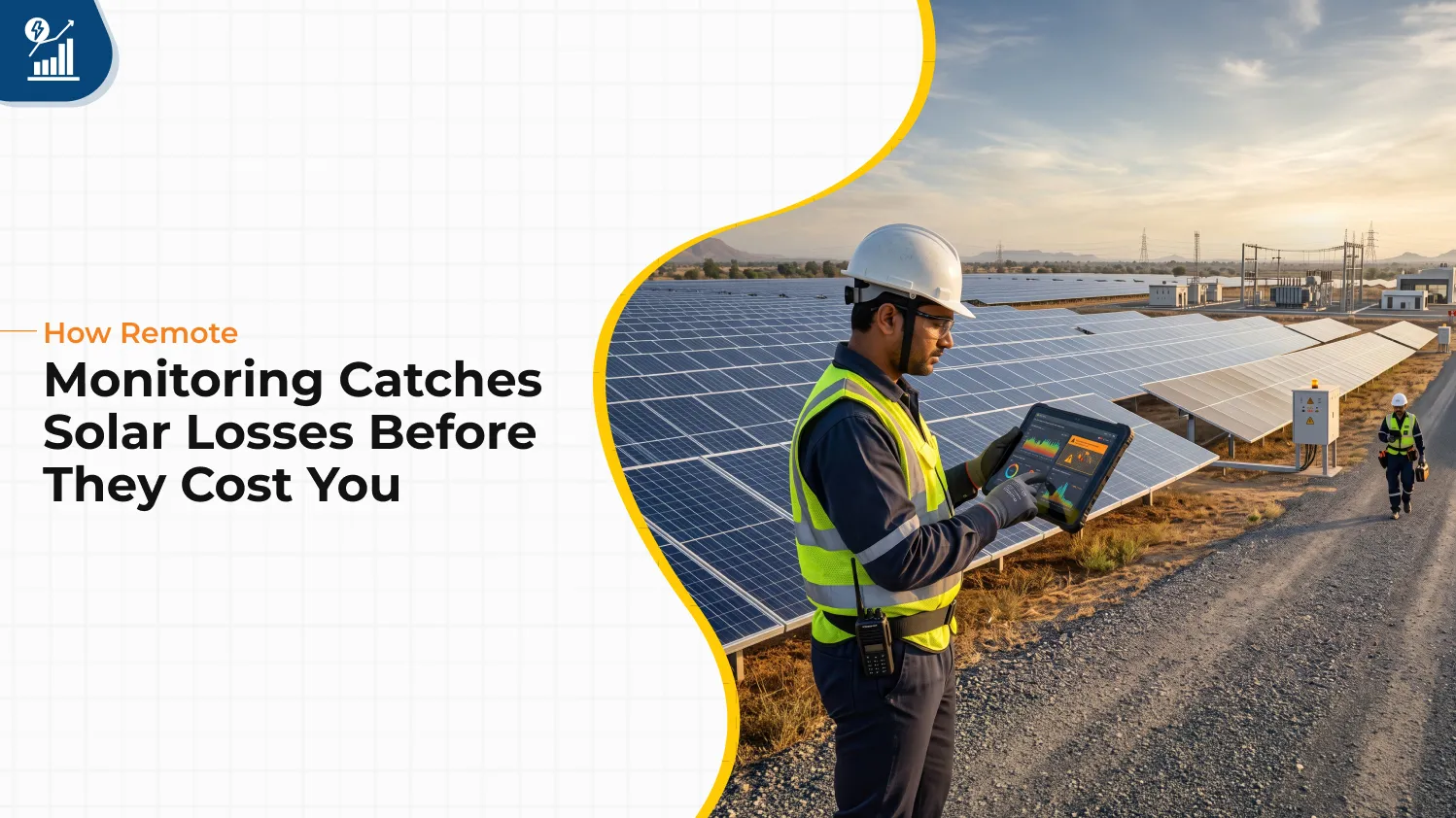

A solar plant's underperformance rarely traces back to a single catastrophic failure. Far more often, it traces back to a design decision made months before construction even started, a decision that looked reasonable on paper but quietly shaved a percentage point or two off the plant's output for the next 25 years. By the time anyone notices the gap between projected and actual generation, the design phase is long finished and the fix, if there is one, is expensive.
This is the case for treating solar engineering services in Kutch as a discipline that determines a plant's lifetime performance, not a formality between site selection and construction. The mistakes below are the ones that show up most consistently, and each one is avoidable with the right approach at the design stage.
Why Design Mistakes Are So Costly to Fix Later
Construction defects and equipment failures get attention because they're visible. A cracked panel or a tripped inverter shows up immediately. Design mistakes are different. A string sized incorrectly for local temperature swings, a layout that creates avoidable shading, or an electrical design that introduces excess resistance over long cable runs doesn't announce itself. It just produces a plant that generates slightly less than it should, indefinitely, for the entire operating life of the system.
The financial impact compounds because these losses aren't one-time events. A 2% generation shortfall from a design flaw isn't a one-year problem, it's a 25-year problem, repeated every single year the plant operates. Retrofitting a design mistake after construction is usually far more expensive than getting it right the first time, and in many cases isn't practically possible at all without significant rework.
Mistake 1: Undersizing or Oversizing the System Against Actual Load
One of the most common errors in commercial and industrial solar design is sizing the system against theoretical or projected load figures rather than actual, measured consumption patterns. An undersized system leaves savings on the table. An oversized system means paying for capacity that either goes unused or gets exported at unfavorable rates depending on the metering arrangement in place.
Proper solar PV system design in Kutch starts with detailed load profiling, not estimates. This means analyzing actual hourly or seasonal consumption data, understanding how load patterns shift across a facility's operating cycles, and sizing the system to match that reality rather than a rough annual average that smooths over the variation that actually matters.
What Good Load Analysis Looks Like
Reviewing at least 12 months of actual consumption data, not a single month extrapolated forward
Accounting for seasonal variation in both load and generation, since the two don't always move together
Factoring in planned changes to facility operations, such as expansion or equipment upgrades, that will shift future load
Distinguishing between daytime consumption that solar can offset directly and off-peak load that may need a different strategy
Mistake 2: Ignoring Site-Specific Shading and Layout Constraints
A design that looks clean on a satellite image can still lose significant generation to shading that only becomes apparent during a proper site survey. Nearby structures, trees, terrain elevation changes, and even the plant's own rows shading each other during low sun angles all reduce output in ways that generic layout software doesn't always catch without careful site-specific input.
This is particularly relevant for solar plant design and engineering in Kutch, where ground-mounted arrays on larger sites need row spacing calculated against actual site latitude and terrain, not a default spacing template. Underestimating row-to-row shading losses during winter months, when the sun angle is lowest, is a common and costly oversight.
Design Oversight | Typical Generation Impact | Why It's Missed |
Inadequate row spacing | 3-8% seasonal shading loss | Layout software defaults not adjusted for site latitude |
Nearby structure or vegetation shading | Variable, often underestimated | Site survey conducted without seasonal sun-path analysis |
Terrain elevation not accounted for | Uneven generation across array sections | Design based on flat-site assumptions |
Roof orientation compromises on commercial rooftops | 5-15% loss versus optimal orientation | Panel count prioritized over orientation efficiency |
Mistake 3: Underestimating Temperature Derating
Solar panels lose efficiency as they heat up, and Kutch's high ambient temperatures make this a bigger factor here than in cooler regions. A design that uses standard test condition ratings without properly accounting for real-world temperature derating will consistently overstate expected generation, setting up a financial model that the plant simply can't meet.
Accurate solar system design services in Kutch apply temperature coefficients specific to the module technology chosen and model expected generation against actual local temperature data, not idealized lab conditions. This affects not just annual output projections but also electrical design decisions like string voltage calculations, which shift based on expected operating temperature ranges.
Mistake 4: Poor Electrical Design Leading to Resistive Losses
Cable sizing, string configuration, and combiner box placement all affect how much generated power actually reaches the grid or the load versus how much is lost as heat along the way. Undersized cables, excessively long DC runs, and poorly planned combiner box locations all introduce resistive losses that are entirely avoidable with proper upfront solar electrical design services in Kutch.
These losses are often small individually, a fraction of a percent here, half a percent there, but they accumulate across a plant's full electrical architecture. A plant with several compounding inefficiencies in its electrical design can lose several percentage points of output compared to a properly engineered system, without a single visible fault anywhere in the plant.
Common Electrical Design Gaps
Cable sizing based on minimum code compliance rather than optimized for the specific run length and expected current
String voltage configurations that don't account for real-world temperature swings, risking either underperformance or inverter input limit violations
Combiner box and inverter placement that adds unnecessary cable length rather than minimizing the distance power has to travel
Inadequate grounding and lightning protection design, which doesn't reduce daily generation but increases long-term failure risk
Mistake 5: Designing Without Maintenance Access in Mind
A plant can be electrically and structurally sound and still be expensive to maintain if the design didn't account for how technicians will actually access components once the system is operational. Tight row spacing that makes cleaning equipment access difficult, inverters placed in locations that are hard to reach for inspection, and combiner boxes buried in inaccessible locations all turn routine maintenance into a slower, more expensive task than it needs to be.
This is where design and long-term operations need to be considered together rather than treated as separate concerns. A design team that has visibility into how the plant will actually be maintained over 25 years tends to make different layout and placement decisions than one focused purely on maximizing panel count within a given footprint.
Mistake 6: Grid Interconnection Design That Invites Curtailment Exposure
For utility-scale and larger commercial projects, the electrical design has to account for grid interconnection realities, not just the plant's internal generation capacity. A design that doesn't properly account for local substation capacity, expected curtailment patterns, or grid compliance requirements can result in a plant that's electrically capable of generating more than it's actually permitted to export under real grid conditions.
Proper engineering at this stage means working through interconnection studies and grid compliance requirements as part of the design process itself, not discovering constraints after construction is already underway.
Comparing a Rigorous Design Process Against a Rushed One
The difference between a design process built to protect long-term generation and one rushed to meet a construction timeline shows up clearly when the two are compared side by side.
Design Element | Rushed Process | Rigorous Process |
Load analysis | Estimated from limited data | Based on 12+ months of actual consumption data |
Shading assessment | Generic layout software defaults | Site-specific seasonal sun-path analysis |
Temperature modeling | Standard test condition assumptions | Local temperature data applied to generation model |
Electrical design | Minimum code compliance | Optimized cable sizing and layout for minimal resistive loss |
Maintenance access | Not considered at design stage | Incorporated into layout and component placement |
Grid interconnection | Addressed after construction begins | Studied and resolved during design phase |
None of the differences in the rigorous column require exotic technology or significantly higher costs. They require a design process that takes the time to work through site-specific realities rather than applying standard assumptions and moving quickly to construction.
How These Mistakes Compound Over 25 Years
Individually, most of these design flaws cost a plant somewhere between half a percent and a few percentage points of annual generation. That doesn't sound dramatic in isolation. But a plant carrying three or four of these compounding issues, undersized load matching, inadequate shading analysis, unaccounted temperature derating, and suboptimal electrical design, can easily be operating five to ten percent below what it should be generating, every single year, for its entire operational life.
Against a 25-year financial model built on projected generation figures, that gap is the difference between a project that meets its return targets and one that consistently falls short of them, without any single dramatic event to point to as the cause.
What to Ask an Engineering Partner Before Committing
For developers evaluating design and engineering partners, a few questions tend to separate rigorous solar engineering services in Kutch from a rushed, template-driven process:
Is system sizing based on actual measured load data or projected estimates?
Does the shading analysis account for site-specific seasonal sun-path variation, or rely on default software assumptions?
Are temperature derating calculations based on local climate data specific to the site?
Is electrical design optimized for minimal resistive loss, or built to minimum code compliance only?
Does the design process incorporate long-term maintenance access as a factor in layout decisions?
Are grid interconnection and curtailment risks studied during design, or addressed only after construction begins?
Vague or generic answers to these questions usually indicate a design process built around speed rather than long-term generation performance.
Conclusion
Most solar plants don't underperform because of a single dramatic failure. They underperform because a handful of design decisions, each individually reasonable-looking, compound into a meaningful generation gap that persists for the plant's entire operating life. Catching these issues requires a design process built around site-specific data and long-term operational thinking, not a template applied quickly to hit a construction deadline.
White Desert Power Projects has delivered engineering and system design for organizations including Shriram Kaolin, GIPCL, Aditi Packaging, and Monex Solar Power LLP, with a design process built around avoiding exactly the generation losses described here.
If you're planning a solar project and want a design that actually protects your projected generation over 25 years, talk to White Desert Power Projects about a rigorous, site-specific engineering approach built for Kutch's conditions.