
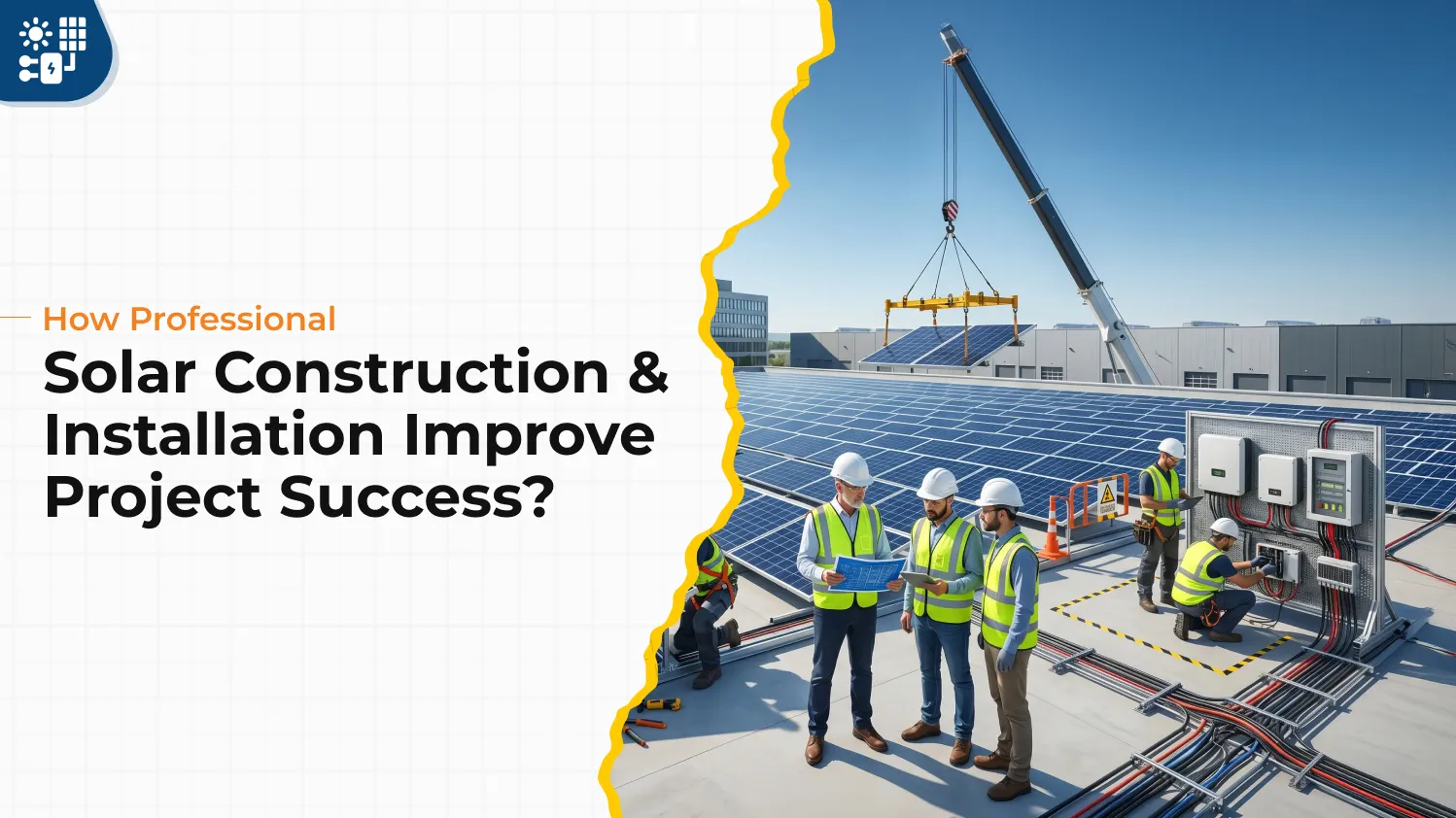
Professional solar installation services are solar photovoltaic (PV) installations carried out by certified installers trained to meet national safety codes, utility interconnection requirements, and manufacturer specifications.
It's not just about panels mounted on a roof. This includes site assessment, load analysis, structural evaluation, cable sizing, earthing design, inverter selection, and grid compliance, all carried out by trained engineers and technicians.
IRENA's Renewable Energy Statistics 2024 found that Certified Professionals achieve up to 22% higher energy production lifetime than non-professionals, which is due to the higher quality of the installed systems.
Solar Industry Statistics: India & Gujarat (2025–2026)
Key Statistics (2024–2026) | Data Point |
The Solar Power Target in India by 2030 | 500 GW (Govt. of India) |
Professionally installed system efficiency | Up to 22% higher output (IRENA, 2024) |
Faulty installation cost overruns | 15 to 30% added repair costs (IEA) |
Gujarat solar installed capacity (2025) | 10,000 MW+ (MNRE) |
Average solar ROI with professional installation | 15 to 20% IRR (Bridge to India, 2025) |
1. Accurate Site Assessment Builds Strong Solar Projects
All successful solar projects start with an accurate site evaluation. Before ordering any modules, a solar construction company will perform a detailed analysis of the solar irradiance, shading analysis, roof or land orientation, load profiles, and the grid connection.
This will help you avoid unexpected expenses. Projects that don't do proper assessments often end up with undersized projects, shading losses, or structural incompatibilities that reduce ROI. Assessments by teams with local knowledge bring huge benefits to businesses and farms in Gujarat, especially those in the Rann of Kutch belt.
Use of drone surveys and satellite irradiance data for shadow mapping
The structural load capacity analysis is performed for rooftop installations
The grid voltage and phase compatibility check is provided
Testing for ground-mounted solar farms
2. Engineering design reduces long-term losses
Design is the most important aspect of a solar system. With professional solar plant construction services, engineering principles, not guesswork, are used to size inverters, configure string layouts, and calculate cable losses to less than 2%.
For example, if a string is incorrectly sized, inverter clipping can occur, which can cause a 5 to 12% loss of annual generation. These parasitic performance-crowders are avoided in a professional design by simulation software like PVsyst or AutoCAD electrical layouts.
Key design parameters handled by professionals:
Optimisation of DC/AC ratio for maximum clipping avoidance
Carefully sizing the cables in such a way that the ohmic losses are kept below 2%
The angle adjustment for the module depends on the latitude where it is installed
Design of protection relay and earthing system according to CEA standards
3. Regulatory Compliance and Subsidy Eligibility
The central government of India, the state DISCOMs, and various net-metering policies regulate the solar sector in India. Failure to comply can cause projects to be delayed, rejected for subsidies, or even disconnected from the grid.
A reliable solar plant installation company has the latest information about MNRE guidelines, state net-metering norms, ALMM (Approved List of Models and Manufacturers) compliance, and DISCOM interconnection requirements. The expertise is particularly valuable for companies that are interested in taking advantage of the PM Surya Ghar or industrial solar incentives provided by the state government in Gujarat.
Applying to state DISCOMs for net metering
Verifying that only MNRE-approved modules are used for subsidy eligibility
Preparing single-line diagrams and load flow reports for utility approval
After commissioning, these electrical inspector certificates must be obtained
4. Construction Quality: Where Projects Win or Lose
Panel mounting is only one way to build solar power plants. This covers civil works (foundation, cable trenching), electrical works (panel mounting, ACDB/DCDB), and mechanical assembly, all to IS/IEC standards.
Businesses looking for solar plant construction in Kutch know that the desert conditions with high wind conditions, blowing sand, and very high temperatures require construction quality far in excess of the national average. Panels to be mounted on hot-dip galvanised or pre-galvanised structures, cables in conduits that are UV rated, junction boxes to be sealed to IP67 or above.
Construction quality markers to verify:
Hot-dip galvanised MS/GI mounting structures (anti-corrosion coating)
IP67-rated junction boxes and weather-proof cable glands
No exposed bare wire joints that are not MC4-compatible crimped connectors
Correct earthing, earth resistance below 1 Ohm
5. Safety Standards That Protect People and Property
The DC voltage levels of solar installations can be quite high, ranging from 600V to 1500V, and the AC is connected to the grid. These systems may present actual fire and electrocution hazards if not installed properly. The Solar Safety Addendum for 2025 by IEA reports that around 18% of residential solar fires occur during installation and are related to incorrect wiring.
A certified solar system installation company abides by NFPA 70 (National Electrical Code), IS 13947 Switchgear Rules, and CEA (Measures Relating to Safety and Electric Supply) Regulations 2010. Safety is integrated into all aspects of the project.
6. Commissioning, Monitoring, and After-Sales Support
A project isn't complete until the day panels are installed. Professional commissioning includes voltage and current testing, insulation resistance measurement, I-V curve tracing, as well as the performance ratio (PR) test before handover.
Post-installation, real-time remote monitoring through SCADA or cloud-based portals enables the system owner or the solar system installation company to monitor generation, identify underperforming strings, and schedule preventive maintenance. This is the monitoring power that makes a long-life asset a depreciating liability.
The string level monitoring with string level alert thresholds
Regular preventative maintenance and cleaning visits
Lowering the risk of failure by using thermal imaging technology to find hot spots
Annual performance reports, including energy yield analysis reports
7. Professional solar installation boosts ROI
Solar investments aren't just about finances; they're about saving the environment. Professionally done projects help to guarantee the project pays back quicker and continues to return over a longer period. Bridge to India's Solar Compass (2025) shows that expert solar installation companies can obtain 15 to 20% IRR, whereas poorly executed systems will only yield 8 to 11% IRR, because of losses and inefficiencies.
How professional execution drives stronger ROI:
Accurately modelling an energy yield avoids over or under-investment in system capacity
The extra annual generation due to optimal panel orientation and tilt angle is in the range of 6 to 10%
Reliable components and workmanship warranties result in reduced downtime of the system
Lower Operations & Maintenance (O&M) costs due to quality civil and electrical work
Early DISCOM approval and commissioning to early energy billing start.
In the case of Gujarat's commercial and industrial real estate, the asset value still further appreciates upon selling or leasing the property when the project is executed well by a qualified solar installation services provider. The costs of professional execution will be multiplied over the 25-year life of the system, and quality will be a multiplier, not a cost.
Professional vs. Non-Professional Solar Installation
Factor | Professional Company | DIY / Unqualified Vendor |
System Lifespan | 25 to 30 years | 8 to 12 years |
Energy Output | Optimal (95 to 100%) | Reduced (60 to 75%) |
Safety Compliance | Full regulatory compliance | Often non-compliant |
Maintenance Cost | Low (planned servicing) | High (frequent breakdowns) |
ROI Timeline | 4 to 6 years | 8 to 12 years |
Warranty Support | Manufacturer + workmanship | Limited or none |
Conclusion
Solar power is an infrastructure investment that takes a long time. The capital investment of a 100 kW rooftop system ranges from ₹40 to 60 lakh. The cost of a 1 MW ground-mounted farm is ₹3 to 4 crore. This has the potential for poor returns, safety concerns, subsidy denials, and rework due to the fact that it is being placed in the hands of unqualified vendors.
Projects that produce 25+ years of reliable returns are distinguished by professional solar plant construction services, accurate engineering, regulatory expertise, and solid after-sales services.
This is the standard of excellence in solar construction and installation in Kutch and Gujarat, which is represented by the name White Desert. Working with a solar project execution company that understands the local market, has qualified engineers, and a proven track record of performance ensures that you're investing in panels, not just another energy project that doesn't deliver.